Event submissions
Published
This submission belongs to the session S3. Coatings and Thin Film Deposition of the event 4th Coatings and Interfaces Online Conference
Published date
16 May, 2025
Academic Editor
'%3e%3cpath%20d='M12.6657%2010.9104C12.4185%2010.325%2012.0599%209.79327%2011.6097%209.34482C11.1609%208.89508%2010.6293%208.5365%2010.0442%208.28888C10.0389%208.28626%2010.0337%208.28495%2010.0285%208.28233C10.8446%207.69279%2011.3752%206.73249%2011.3752%205.64904C11.3752%203.8542%209.92103%202.39999%208.1262%202.39999C6.33136%202.39999%204.87715%203.8542%204.87715%205.64904C4.87715%206.73249%205.40774%207.69279%206.22393%208.28364C6.21869%208.28626%206.21345%208.28757%206.20821%208.29019C5.62129%208.5378%205.09463%208.89284%204.64265%209.34613C4.1929%209.79493%203.83432%2010.3266%203.58671%2010.9117C3.34345%2011.4845%203.21226%2012.0987%203.20023%2012.7209C3.19988%2012.7349%203.20233%2012.7488%203.20744%2012.7619C3.21255%2012.7749%203.22022%2012.7867%203.22998%2012.7968C3.23975%2012.8068%203.25142%2012.8147%203.26431%2012.8202C3.2772%2012.8256%203.29105%2012.8284%203.30504%2012.8284H4.09109C4.14874%2012.8284%204.19459%2012.7825%204.1959%2012.7262C4.2221%2011.7148%204.62823%2010.7676%205.34617%2010.0497C6.08899%209.30683%207.0755%208.89808%208.1262%208.89808C9.17689%208.89808%2010.1634%209.30683%2010.9062%2010.0497C11.6242%2010.7676%2012.0303%2011.7148%2012.0565%2012.7262C12.0578%2012.7838%2012.1037%2012.8284%2012.1613%2012.8284H12.9474C12.9613%2012.8284%2012.9752%2012.8256%2012.9881%2012.8202C13.001%2012.8147%2013.0126%2012.8068%2013.0224%2012.7968C13.0322%2012.7867%2013.0398%2012.7749%2013.0449%2012.7619C13.0501%2012.7488%2013.0525%2012.7349%2013.0522%2012.7209C13.0391%2012.0947%2012.9094%2011.4855%2012.6657%2010.9104ZM8.1262%207.9024C7.52486%207.9024%206.9589%207.6679%206.53312%207.24211C6.10733%206.81633%205.87283%206.25037%205.87283%205.64904C5.87283%205.0477%206.10733%204.48174%206.53312%204.05596C6.9589%203.63018%207.52486%203.39567%208.1262%203.39567C8.72753%203.39567%209.29349%203.63018%209.71927%204.05596C10.1451%204.48174%2010.3796%205.0477%2010.3796%205.64904C10.3796%206.25037%2010.1451%206.81633%209.71927%207.24211C9.29349%207.6679%208.72753%207.9024%208.1262%207.9024Z'%20fill='%235D1EE1'/%3e%3c/g%3e%3c/svg%3e) Adrian David
Adrian DavidCitation
Farid Fadhillah, Fabrication of thin-film composite nanofiltration membrane employing polyelectrolyte and metal–organic framework (MOF) via spin-spray-assisted layer-by-layer assembly, in Proceedings of 4th Coatings and Interfaces Online Conference, 21 May–23 May 2025, MDPI: Basel, Switzerland
Share
Email
Facebook
Twitter
LinkedIn
Fabrication of thin-film composite nanofiltration membrane employing polyelectrolyte and metal–organic framework (MOF) via spin-spray-assisted layer-by-layer assembly

Farid Fadhillah 1
1. Imam Mohammad Ibn Saud Islamic University, Riyadh 11564, Saudi Arabia
Abstract
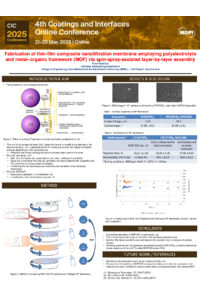
Spin-assisted layer-by-layer (LbL) assembly is an innovative method for producing nanostructured thin films, offering enhanced efficiency and precision over traditional dip-coating techniques. This method enables significantly faster deposition and bilayer cycle times while optimizing material usage. In addition, spray LbL systems present advantages in speed and scalability for large-area substrates. By integrating these approaches, spin-spray-assisted LbL assembly allows for rapid assembly and extensive coverage of substrates. In this study, we demonstrated the efficacy of spin-spray LbL assembly in fabricating a thin-film composite nanofiltration (NF) membrane.
In this work, TFC NF consists of multiple layers of polyelectrolyte, and a metal–organic framework (MOF-303) was fabricated to enhance the membrane's biofouling resistance. Polyethyleneimine (PEI) and poly (sodium-4-styrene sulfonate) (PSS) were sprayed alternately and deposited on the top of a spinning polyethersulfone (PSF) ultrafiltration support to construct thin-film composite NF.
The resulting membrane was examined using standard nanofiltration membrane testing, and its performance is comparable to commercial NF. For instance, five bilayers of PEI/PSS NF membrane, i.e., (PEI/PSS)5, showed a rejection rate of 42.65 ± 0.17 % and a permeability of 9.46 ± 0.14 l/h.bar.m2, while a commercial NFX membrane from Synder Inc. showed a rejection rate of 53.66 ± 3.23 % and a permeability of 3.51 ± 0.42 l/h.bar.m2. We fabricated a PEI/PSS membrane coated with MOF303 as the outermost layer. From our preliminary investigation, (PEI/PSS)5-MOF303 with an MOF concentration of 0.05 wt% exhibited a rejection rate of 18.94 ± 1.58% and a permeability of 0.91 ± 0.13 l/h.bar.m2. Although this is still a preliminary result, this work shows that spin- and/or spin-spray-assisted layer-by-layer assembly is a promising method for fabricating membranes for various applications. Some further details, such as surface characteristics, are also provided in this work.
Keywords
layer-by-layer
nanofiltration
membrane
thin film composite
TFC
reverse osmosis
polyelectrolyte
spin coating
spray coating
MOF303
Poster
sciforum-117401.pdf
Microstructure characterization of titanium oxide coatings with nanoparticles deposited with micro-arc oxidation method on plastically deformed titanium
Oxidation and wear protection of pultruded C/C composites using atmospheric plasma-sprayed environmental barrier coatings