Event submissions
Published
This submission belongs to the session S3. Coatings and Thin Film Deposition of the event 4th Coatings and Interfaces Online Conference
Published date
16 May, 2025
Academic Editor
'%3e%3cpath%20d='M12.6657%2010.9104C12.4185%2010.325%2012.0599%209.79327%2011.6097%209.34482C11.1609%208.89508%2010.6293%208.5365%2010.0442%208.28888C10.0389%208.28626%2010.0337%208.28495%2010.0285%208.28233C10.8446%207.69279%2011.3752%206.73249%2011.3752%205.64904C11.3752%203.8542%209.92103%202.39999%208.1262%202.39999C6.33136%202.39999%204.87715%203.8542%204.87715%205.64904C4.87715%206.73249%205.40774%207.69279%206.22393%208.28364C6.21869%208.28626%206.21345%208.28757%206.20821%208.29019C5.62129%208.5378%205.09463%208.89284%204.64265%209.34613C4.1929%209.79493%203.83432%2010.3266%203.58671%2010.9117C3.34345%2011.4845%203.21226%2012.0987%203.20023%2012.7209C3.19988%2012.7349%203.20233%2012.7488%203.20744%2012.7619C3.21255%2012.7749%203.22022%2012.7867%203.22998%2012.7968C3.23975%2012.8068%203.25142%2012.8147%203.26431%2012.8202C3.2772%2012.8256%203.29105%2012.8284%203.30504%2012.8284H4.09109C4.14874%2012.8284%204.19459%2012.7825%204.1959%2012.7262C4.2221%2011.7148%204.62823%2010.7676%205.34617%2010.0497C6.08899%209.30683%207.0755%208.89808%208.1262%208.89808C9.17689%208.89808%2010.1634%209.30683%2010.9062%2010.0497C11.6242%2010.7676%2012.0303%2011.7148%2012.0565%2012.7262C12.0578%2012.7838%2012.1037%2012.8284%2012.1613%2012.8284H12.9474C12.9613%2012.8284%2012.9752%2012.8256%2012.9881%2012.8202C13.001%2012.8147%2013.0126%2012.8068%2013.0224%2012.7968C13.0322%2012.7867%2013.0398%2012.7749%2013.0449%2012.7619C13.0501%2012.7488%2013.0525%2012.7349%2013.0522%2012.7209C13.0391%2012.0947%2012.9094%2011.4855%2012.6657%2010.9104ZM8.1262%207.9024C7.52486%207.9024%206.9589%207.6679%206.53312%207.24211C6.10733%206.81633%205.87283%206.25037%205.87283%205.64904C5.87283%205.0477%206.10733%204.48174%206.53312%204.05596C6.9589%203.63018%207.52486%203.39567%208.1262%203.39567C8.72753%203.39567%209.29349%203.63018%209.71927%204.05596C10.1451%204.48174%2010.3796%205.0477%2010.3796%205.64904C10.3796%206.25037%2010.1451%206.81633%209.71927%207.24211C9.29349%207.6679%208.72753%207.9024%208.1262%207.9024Z'%20fill='%235D1EE1'/%3e%3c/g%3e%3c/svg%3e) Adrian David
Adrian DavidCitation
Takeo Oku, Iori Ono, Yuto Genko, Riku Okumura, Taiga Nasu, Shinichiro Mizuno, Tomoharu Tachikawa, Sakiko Fukunishi, Fabrication and characterization of DPPS-introduced perovskite solar cells, in Proceedings of 4th Coatings and Interfaces Online Conference, 21 May–23 May 2025, MDPI: Basel, Switzerland
Share
Email
Facebook
Twitter
LinkedIn
Fabrication and characterization of DPPS-introduced perovskite solar cells
'%3e%3cpath%20d='M12.6647%2010.9104C12.4176%2010.325%2012.0589%209.7933%2011.6088%209.34485C11.16%208.89511%2010.6283%208.53653%2010.0432%208.28891C10.038%208.28629%2010.0327%208.28498%2010.0275%208.28236C10.8437%207.69282%2011.3743%206.73252%2011.3743%205.64907C11.3743%203.85423%209.92005%202.40002%208.12522%202.40002C6.33038%202.40002%204.87618%203.85423%204.87618%205.64907C4.87618%206.73252%205.40677%207.69282%206.22296%208.28367C6.21772%208.28629%206.21248%208.2876%206.20724%208.29022C5.62031%208.53783%205.09365%208.89287%204.64167%209.34616C4.19192%209.79496%203.83334%2010.3266%203.58573%2010.9117C3.34247%2011.4846%203.21128%2012.0987%203.19925%2012.721C3.1989%2012.735%203.20135%2012.7489%203.20646%2012.7619C3.21157%2012.7749%203.21924%2012.7868%203.22901%2012.7968C3.23877%2012.8068%203.25045%2012.8148%203.26334%2012.8202C3.27623%2012.8256%203.29007%2012.8284%203.30406%2012.8284H4.09012C4.14776%2012.8284%204.19362%2012.7825%204.19493%2012.7262C4.22113%2011.7148%204.62726%2010.7676%205.34519%2010.0497C6.08802%209.30686%207.07452%208.89811%208.12522%208.89811C9.17592%208.89811%2010.1624%209.30686%2010.9052%2010.0497C11.6232%2010.7676%2012.0293%2011.7148%2012.0555%2012.7262C12.0568%2012.7839%2012.1027%2012.8284%2012.1603%2012.8284H12.9464C12.9604%2012.8284%2012.9742%2012.8256%2012.9871%2012.8202C13%2012.8148%2013.0117%2012.8068%2013.0214%2012.7968C13.0312%2012.7868%2013.0389%2012.7749%2013.044%2012.7619C13.0491%2012.7489%2013.0515%2012.735%2013.0512%2012.721C13.0381%2012.0947%2012.9084%2011.4856%2012.6647%2010.9104ZM8.12522%207.90243C7.52388%207.90243%206.95792%207.66793%206.53214%207.24215C6.10636%206.81636%205.87185%206.2504%205.87185%205.64907C5.87185%205.04773%206.10636%204.48177%206.53214%204.05599C6.95792%203.63021%207.52388%203.3957%208.12522%203.3957C8.72655%203.3957%209.29252%203.63021%209.7183%204.05599C10.1441%204.48177%2010.3786%205.04773%2010.3786%205.64907C10.3786%206.2504%2010.1441%206.81636%209.7183%207.24215C9.29252%207.66793%208.72655%207.90243%208.12522%207.90243Z'%20fill='%235D1EE1'/%3e%3c/g%3e%3c/svg%3e)
Takeo Oku 1
Iori Ono 2
Yuto Genko 2
Riku Okumura 2
Taiga Nasu 2
Shinichiro Mizuno 1
Tomoharu Tachikawa 3
Sakiko Fukunishi 3
1. The University of Shiga Prefecture, Hikone, Shiga, Japan
2. Department of Materials Chemistry, The University of Shiga Prefecture, 2500 Hassaka, Hikone, Shiga 522-8533, Japan
3. Osaka Gas Chemicals Co., Ltd.
Abstract
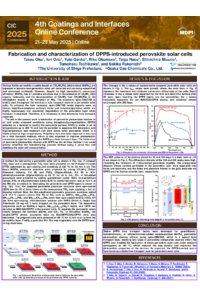
Various halide perovskite crystals based on CH3NH3PbI3 (abbreviated MAPbI3) are expected to become next-generation solar cell materials and are currently undergoing research and development worldwide. However, despite its high photoelectric conversion efficiency, MAPbI3 has an unstable structure due to the presence of CH3NH3 (MA) organic molecules, and the decomposition of CH3NH3 from CH3NH3PbI3 in the atmosphere results in the formation of PbI2. The expensive 2,2',7,7'-tetrakis (N,N-di-p-methoxyphenylamino)-9,9'-spirobifluorene (spiro-OMeTAD) is widely used throughout the world as a hole transport material in perovskite solar cells. To enhance hole transport, spiro-OMeTAD needs dopants such as lithium bis(trifluoromethane sulfonyl) imide and 4-tert-butylpyridine, which are highly hygroscopic and accelerate degradation of the perovskite layer when moisture is absorbed. Therefore, it is necessary to find alternative hole transport materials. In this study, decaphenylcyclopentasilane (DPPS) was selected as a material to modify the perovskite surface, and fabrication of perovskite photovoltaic devices in air and under unsealed conditions was attempted. DPPS is stable in air at temperatures up to 300°C and has the potential to suppress MA desorption; additionally,high-temperature heat treatment can form dense cubic perovskite, which is a stable phase at high temperatures. Polysilane has also been reported to function as a hole transport material, and is also expected to improve photoelectric conversion properties by using the DPPS as a hole transport layer. The fabrication of perovskite photovoltaic devices with DPPS by the air blow method in air could greatly simplify the manufacturing process without using a glove box and stabilize the solar cell characteristics.
Keywords
Perovskite solar cell
Hole transport layer
Decaphenylcyclopentasilane
Poster
sciforum-116959.pdf
Oxidation and wear protection of pultruded C/C composites using atmospheric plasma-sprayed environmental barrier coatings
Fabrication and evaluation of DMA-doped perovskite solar cells