Event submissions
Published
This submission belongs to the session S3. Coatings and Thin Film Deposition of the event 4th Coatings and Interfaces Online Conference
Published date
16 May, 2025
Academic Editor
'%3e%3cpath%20d='M12.6657%2010.9104C12.4185%2010.325%2012.0599%209.79327%2011.6097%209.34482C11.1609%208.89508%2010.6293%208.5365%2010.0442%208.28888C10.0389%208.28626%2010.0337%208.28495%2010.0285%208.28233C10.8446%207.69279%2011.3752%206.73249%2011.3752%205.64904C11.3752%203.8542%209.92103%202.39999%208.1262%202.39999C6.33136%202.39999%204.87715%203.8542%204.87715%205.64904C4.87715%206.73249%205.40774%207.69279%206.22393%208.28364C6.21869%208.28626%206.21345%208.28757%206.20821%208.29019C5.62129%208.5378%205.09463%208.89284%204.64265%209.34613C4.1929%209.79493%203.83432%2010.3266%203.58671%2010.9117C3.34345%2011.4845%203.21226%2012.0987%203.20023%2012.7209C3.19988%2012.7349%203.20233%2012.7488%203.20744%2012.7619C3.21255%2012.7749%203.22022%2012.7867%203.22998%2012.7968C3.23975%2012.8068%203.25142%2012.8147%203.26431%2012.8202C3.2772%2012.8256%203.29105%2012.8284%203.30504%2012.8284H4.09109C4.14874%2012.8284%204.19459%2012.7825%204.1959%2012.7262C4.2221%2011.7148%204.62823%2010.7676%205.34617%2010.0497C6.08899%209.30683%207.0755%208.89808%208.1262%208.89808C9.17689%208.89808%2010.1634%209.30683%2010.9062%2010.0497C11.6242%2010.7676%2012.0303%2011.7148%2012.0565%2012.7262C12.0578%2012.7838%2012.1037%2012.8284%2012.1613%2012.8284H12.9474C12.9613%2012.8284%2012.9752%2012.8256%2012.9881%2012.8202C13.001%2012.8147%2013.0126%2012.8068%2013.0224%2012.7968C13.0322%2012.7867%2013.0398%2012.7749%2013.0449%2012.7619C13.0501%2012.7488%2013.0525%2012.7349%2013.0522%2012.7209C13.0391%2012.0947%2012.9094%2011.4855%2012.6657%2010.9104ZM8.1262%207.9024C7.52486%207.9024%206.9589%207.6679%206.53312%207.24211C6.10733%206.81633%205.87283%206.25037%205.87283%205.64904C5.87283%205.0477%206.10733%204.48174%206.53312%204.05596C6.9589%203.63018%207.52486%203.39567%208.1262%203.39567C8.72753%203.39567%209.29349%203.63018%209.71927%204.05596C10.1451%204.48174%2010.3796%205.0477%2010.3796%205.64904C10.3796%206.25037%2010.1451%206.81633%209.71927%207.24211C9.29349%207.6679%208.72753%207.9024%208.1262%207.9024Z'%20fill='%235D1EE1'/%3e%3c/g%3e%3c/svg%3e) Adrian David
Adrian DavidCitation
Gianfranco Carotenuto, MODULABLE LONGWAVE PASS FILTERS BASED ON KAPTON FILMS, in Proceedings of 4th Coatings and Interfaces Online Conference, 21 May–23 May 2025, MDPI: Basel, Switzerland
Share
Email
Facebook
Twitter
LinkedIn
MODULABLE LONGWAVE PASS FILTERS BASED ON KAPTON FILMS

Gianfranco Carotenuto 1
1. Institute for Polymers, Composites and Biomaterials (IPCB-CNR), Italian National Research Council, 80078 Pozzuoli, Naples, Italy
Abstract
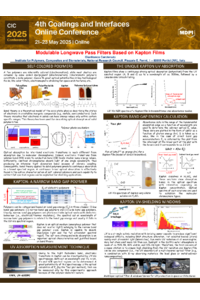
Kapton can be classified as an optical-grade plastic material because its amorphous nature does not allow light-scattering phenomena. Kapton films are amber-colored and have a unique optical absorption spectrum, characterized by a high transmittance value above 500nm (from yellow-red to near-infrared spectral regions) and an extremely high absorbance value below 500nm (from blue-violet to ultra-violet spectral regions). Owing to these special optical characteristics, Kapton films can be used as optical limiters (i.e., absorption-type optical filters), specifically as longwave pass (LWP) filters, and such optical devices can be used as ‘optical windows’ for many technological applications like the protection of sensors, optoelectronic devices (e.g., IR sensors and detectors), etc., from high-energy radiation (e.g., UV light, X-ray, etc.). This thermoplastic polymer has a very high thermal stability; indeed, its maximum service temperature is ca. 400°C. However, Kapton can be carbonized/graphitized by heating at very high temperatures (above 1000°C) to produce well-oriented graphite films. This process can be controlled and used to change Kapton's absorption profile. In particular, it is possible to modulate Kapton's optical absorption behavior by heating the polymer at temperatures slightly above 400°C. In particular, heating Kapton above 400°C leaves the film's optical transparency practically unmodified but causes a red-shift of the cut-on edge wavelength because of the formation of conjugated structures, with delocalized π-bonded electrons, in the Kapton chemical structure (very mild carbonization process). Therefore, it is possible to tune the cut-on edge wavelength of this LWP filter simply by applying a controlled thermal annealing treatment to the pristine film. Here, the optical properties of Kapton films modified by thermal treatment at temperatures higher than 400°C have been investigated by absorption optical spectroscopy (UV-Vis spectroscopy).
Keywords
Kapton
Optical plastics
Longwave pass filters
Cut-on edge wavelength modulation
Instrumental protection
Space
Poster
CIC2025_Poster_Gianfranco Carotenuto.pdf
Experimental Investigation of the Optoelectronic Properties of Carbazole-Based Hole Transport Layers for Photovoltaic Applications
Zinc Oxide Nanoparticles in Cement-Based Antibacterial Coatings: A Pathway to Hygienic and Durable Construction Materials