Event submissions
Published
This submission belongs to the session S4. Corrosion, Erosion and the Tribological and Mechanical Aspects of Coatings of the event 4th Coatings and Interfaces Online Conference
Published date
16 May, 2025
Academic Editor
'%3e%3cpath%20d='M12.6657%2010.9104C12.4185%2010.325%2012.0599%209.79327%2011.6097%209.34482C11.1609%208.89508%2010.6293%208.5365%2010.0442%208.28888C10.0389%208.28626%2010.0337%208.28495%2010.0285%208.28233C10.8446%207.69279%2011.3752%206.73249%2011.3752%205.64904C11.3752%203.8542%209.92103%202.39999%208.1262%202.39999C6.33136%202.39999%204.87715%203.8542%204.87715%205.64904C4.87715%206.73249%205.40774%207.69279%206.22393%208.28364C6.21869%208.28626%206.21345%208.28757%206.20821%208.29019C5.62129%208.5378%205.09463%208.89284%204.64265%209.34613C4.1929%209.79493%203.83432%2010.3266%203.58671%2010.9117C3.34345%2011.4845%203.21226%2012.0987%203.20023%2012.7209C3.19988%2012.7349%203.20233%2012.7488%203.20744%2012.7619C3.21255%2012.7749%203.22022%2012.7867%203.22998%2012.7968C3.23975%2012.8068%203.25142%2012.8147%203.26431%2012.8202C3.2772%2012.8256%203.29105%2012.8284%203.30504%2012.8284H4.09109C4.14874%2012.8284%204.19459%2012.7825%204.1959%2012.7262C4.2221%2011.7148%204.62823%2010.7676%205.34617%2010.0497C6.08899%209.30683%207.0755%208.89808%208.1262%208.89808C9.17689%208.89808%2010.1634%209.30683%2010.9062%2010.0497C11.6242%2010.7676%2012.0303%2011.7148%2012.0565%2012.7262C12.0578%2012.7838%2012.1037%2012.8284%2012.1613%2012.8284H12.9474C12.9613%2012.8284%2012.9752%2012.8256%2012.9881%2012.8202C13.001%2012.8147%2013.0126%2012.8068%2013.0224%2012.7968C13.0322%2012.7867%2013.0398%2012.7749%2013.0449%2012.7619C13.0501%2012.7488%2013.0525%2012.7349%2013.0522%2012.7209C13.0391%2012.0947%2012.9094%2011.4855%2012.6657%2010.9104ZM8.1262%207.9024C7.52486%207.9024%206.9589%207.6679%206.53312%207.24211C6.10733%206.81633%205.87283%206.25037%205.87283%205.64904C5.87283%205.0477%206.10733%204.48174%206.53312%204.05596C6.9589%203.63018%207.52486%203.39567%208.1262%203.39567C8.72753%203.39567%209.29349%203.63018%209.71927%204.05596C10.1451%204.48174%2010.3796%205.0477%2010.3796%205.64904C10.3796%206.25037%2010.1451%206.81633%209.71927%207.24211C9.29349%207.6679%208.72753%207.9024%208.1262%207.9024Z'%20fill='%235D1EE1'/%3e%3c/g%3e%3c/svg%3e) HUIRONG LE
HUIRONG LECitation
Daniel Sandoval-Rivas, Jesús Ramírez, Matías Ignacio Hepp, Manuel Meléndrez, Development of Sustainable Anticorrosive Coatings Based on Pinus Radiata Bark Wax, in Proceedings of 4th Coatings and Interfaces Online Conference, 21 May–23 May 2025, MDPI: Basel, Switzerland
Share
Email
Facebook
Twitter
LinkedIn
Development of Sustainable Anticorrosive Coatings Based on Pinus Radiata Bark Wax
Development of Sustainable Anticorrosive Coatings Based on Pinus Radiata Bark Wax
'%3e%3cpath%20d='M12.6647%2010.9104C12.4176%2010.325%2012.0589%209.7933%2011.6088%209.34485C11.16%208.89511%2010.6283%208.53653%2010.0432%208.28891C10.038%208.28629%2010.0327%208.28498%2010.0275%208.28236C10.8437%207.69282%2011.3743%206.73252%2011.3743%205.64907C11.3743%203.85423%209.92005%202.40002%208.12522%202.40002C6.33038%202.40002%204.87618%203.85423%204.87618%205.64907C4.87618%206.73252%205.40677%207.69282%206.22296%208.28367C6.21772%208.28629%206.21248%208.2876%206.20724%208.29022C5.62031%208.53783%205.09365%208.89287%204.64167%209.34616C4.19192%209.79496%203.83334%2010.3266%203.58573%2010.9117C3.34247%2011.4846%203.21128%2012.0987%203.19925%2012.721C3.1989%2012.735%203.20135%2012.7489%203.20646%2012.7619C3.21157%2012.7749%203.21924%2012.7868%203.22901%2012.7968C3.23877%2012.8068%203.25045%2012.8148%203.26334%2012.8202C3.27623%2012.8256%203.29007%2012.8284%203.30406%2012.8284H4.09012C4.14776%2012.8284%204.19362%2012.7825%204.19493%2012.7262C4.22113%2011.7148%204.62726%2010.7676%205.34519%2010.0497C6.08802%209.30686%207.07452%208.89811%208.12522%208.89811C9.17592%208.89811%2010.1624%209.30686%2010.9052%2010.0497C11.6232%2010.7676%2012.0293%2011.7148%2012.0555%2012.7262C12.0568%2012.7839%2012.1027%2012.8284%2012.1603%2012.8284H12.9464C12.9604%2012.8284%2012.9742%2012.8256%2012.9871%2012.8202C13%2012.8148%2013.0117%2012.8068%2013.0214%2012.7968C13.0312%2012.7868%2013.0389%2012.7749%2013.044%2012.7619C13.0491%2012.7489%2013.0515%2012.735%2013.0512%2012.721C13.0381%2012.0947%2012.9084%2011.4856%2012.6647%2010.9104ZM8.12522%207.90243C7.52388%207.90243%206.95792%207.66793%206.53214%207.24215C6.10636%206.81636%205.87185%206.2504%205.87185%205.64907C5.87185%205.04773%206.10636%204.48177%206.53214%204.05599C6.95792%203.63021%207.52388%203.3957%208.12522%203.3957C8.72655%203.3957%209.29252%203.63021%209.7183%204.05599C10.1441%204.48177%2010.3786%205.04773%2010.3786%205.64907C10.3786%206.2504%2010.1441%206.81636%209.7183%207.24215C9.29252%207.66793%208.72655%207.90243%208.12522%207.90243Z'%20fill='%235D1EE1'/%3e%3c/g%3e%3c/svg%3e)
Daniel Sandoval-Rivas 1
Jesús Ramírez 1
Matías Ignacio Hepp 2

Manuel Meléndrez 3
1. Facultad de Ingeniería, Universidad San Sebastián, Lientur 1457, Concepción, Chile.
2. Laboratorio de Investigación en Ciencias Biomédicas, Departamento de Ciencias Básicas y Morfología, Facultad de Medicina, Universidad Católica de la Santísima Concepción, Concepción, Chile
3. Facultad de Ciencias de la Rehabilitación, Universidad San Sebastián, Lientur 1457, Concepción, Chile
Abstract
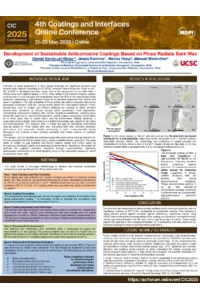
Corrosion is a natural phenomenon that significantly affects metal structures, leading to deterioration, reduced service life, and structural failures, with severe economic and environmental consequences. The Organization for Economic Co-operation and Development (OECD) estimates that corrosion accounts for up to 3% of the GDP in developed countries. In Chile, a country with an extensive coastline and a strong industrial sector, critical infrastructures such as bridges, power plants, and offshore platforms are continuously exposed to corrosive environments. Climate change exacerbates these conditions by increasing coastal salinity and acid rain, accelerating metal degradation, raising maintenance costs, and impacting sustainability.
Traditional anticorrosive coatings contain materials with significant health and environmental risks, including epoxy resins with bisphenol A (BPA), carcinogenic lead chromate pigments, volatile organic compounds (VOCs), and bioaccumulative biocides. Developing safer and sustainable alternatives is crucial to reducing these risks while maintaining corrosion protection effectiveness. This study explores the use of Pinus radiata bark wax extracts as a novel raw material for sustainable anticorrosive coatings. Utilizing this abundant forestry byproduct promotes circular economy principles by repurposing waste while reducing synthetic material dependency and carbon footprint.
Electrochemical impedance spectroscopy (EIS) tests were conducted following ASTM G106 standards to evaluate corrosion resistance. The developed coating exhibited impedance modulus values ranging from 10⁸ to 10¹¹ Ω/cm², demonstrating excellent corrosion protection. To complement the study, mechanical tests were conducted using commercial coatings. Additionally, in vitro cytotoxicity tests using human skin cells (HaCaT) showed cell viability and proliferation comparable to control samples, confirming low toxicity. These results validate the potential of Pinus radiata bark wax-based coatings as a multifunctional, cost-effective, and environmentally friendly alternative to conventional anticorrosive solutions.
Keywords
Sustainable coatings
Corrosion protection
Pinus radiata wax
bark
Poster
sciforum-117439.pdf
Deposition enhanced by coacervation in mixtures of chitosan and a non-ionic sugar-based surfactant
Advanced Protective Epoxy Coatings with Photoactive TiO₂-LDO Nanofillers for Corrosion Protection and Potential NOx mitigation