Event submissions
Published
This submission belongs to the session S4. Corrosion, Erosion and the Tribological and Mechanical Aspects of Coatings of the event 4th Coatings and Interfaces Online Conference
Published date
16 May, 2025
Academic Editor
'%3e%3cpath%20d='M12.6657%2010.9104C12.4185%2010.325%2012.0599%209.79327%2011.6097%209.34482C11.1609%208.89508%2010.6293%208.5365%2010.0442%208.28888C10.0389%208.28626%2010.0337%208.28495%2010.0285%208.28233C10.8446%207.69279%2011.3752%206.73249%2011.3752%205.64904C11.3752%203.8542%209.92103%202.39999%208.1262%202.39999C6.33136%202.39999%204.87715%203.8542%204.87715%205.64904C4.87715%206.73249%205.40774%207.69279%206.22393%208.28364C6.21869%208.28626%206.21345%208.28757%206.20821%208.29019C5.62129%208.5378%205.09463%208.89284%204.64265%209.34613C4.1929%209.79493%203.83432%2010.3266%203.58671%2010.9117C3.34345%2011.4845%203.21226%2012.0987%203.20023%2012.7209C3.19988%2012.7349%203.20233%2012.7488%203.20744%2012.7619C3.21255%2012.7749%203.22022%2012.7867%203.22998%2012.7968C3.23975%2012.8068%203.25142%2012.8147%203.26431%2012.8202C3.2772%2012.8256%203.29105%2012.8284%203.30504%2012.8284H4.09109C4.14874%2012.8284%204.19459%2012.7825%204.1959%2012.7262C4.2221%2011.7148%204.62823%2010.7676%205.34617%2010.0497C6.08899%209.30683%207.0755%208.89808%208.1262%208.89808C9.17689%208.89808%2010.1634%209.30683%2010.9062%2010.0497C11.6242%2010.7676%2012.0303%2011.7148%2012.0565%2012.7262C12.0578%2012.7838%2012.1037%2012.8284%2012.1613%2012.8284H12.9474C12.9613%2012.8284%2012.9752%2012.8256%2012.9881%2012.8202C13.001%2012.8147%2013.0126%2012.8068%2013.0224%2012.7968C13.0322%2012.7867%2013.0398%2012.7749%2013.0449%2012.7619C13.0501%2012.7488%2013.0525%2012.7349%2013.0522%2012.7209C13.0391%2012.0947%2012.9094%2011.4855%2012.6657%2010.9104ZM8.1262%207.9024C7.52486%207.9024%206.9589%207.6679%206.53312%207.24211C6.10733%206.81633%205.87283%206.25037%205.87283%205.64904C5.87283%205.0477%206.10733%204.48174%206.53312%204.05596C6.9589%203.63018%207.52486%203.39567%208.1262%203.39567C8.72753%203.39567%209.29349%203.63018%209.71927%204.05596C10.1451%204.48174%2010.3796%205.0477%2010.3796%205.64904C10.3796%206.25037%2010.1451%206.81633%209.71927%207.24211C9.29349%207.6679%208.72753%207.9024%208.1262%207.9024Z'%20fill='%235D1EE1'/%3e%3c/g%3e%3c/svg%3e) HUIRONG LE
HUIRONG LECitation
Muhammad Ahsan Iqbal, Humaira Asghar, Valter Maurino, Endzhe Matykina, Raúl Arrabal, Marta Mohedano, Advanced Protective Epoxy Coatings with Photoactive TiO₂-LDO Nanofillers for Corrosion Protection and Potential NOx mitigation, in Proceedings of 4th Coatings and Interfaces Online Conference, 21 May–23 May 2025, MDPI: Basel, Switzerland
Share
Email
Facebook
Twitter
LinkedIn
Advanced Protective Epoxy Coatings with Photoactive TiO₂-LDO Nanofillers for Corrosion Protection and Potential NOx mitigation

Muhammad Ahsan Iqbal 1
'%3e%3cpath%20d='M12.6647%2010.9104C12.4176%2010.325%2012.0589%209.7933%2011.6088%209.34485C11.16%208.89511%2010.6283%208.53653%2010.0432%208.28891C10.038%208.28629%2010.0327%208.28498%2010.0275%208.28236C10.8437%207.69282%2011.3743%206.73252%2011.3743%205.64907C11.3743%203.85423%209.92005%202.40002%208.12522%202.40002C6.33038%202.40002%204.87618%203.85423%204.87618%205.64907C4.87618%206.73252%205.40677%207.69282%206.22296%208.28367C6.21772%208.28629%206.21248%208.2876%206.20724%208.29022C5.62031%208.53783%205.09365%208.89287%204.64167%209.34616C4.19192%209.79496%203.83334%2010.3266%203.58573%2010.9117C3.34247%2011.4846%203.21128%2012.0987%203.19925%2012.721C3.1989%2012.735%203.20135%2012.7489%203.20646%2012.7619C3.21157%2012.7749%203.21924%2012.7868%203.22901%2012.7968C3.23877%2012.8068%203.25045%2012.8148%203.26334%2012.8202C3.27623%2012.8256%203.29007%2012.8284%203.30406%2012.8284H4.09012C4.14776%2012.8284%204.19362%2012.7825%204.19493%2012.7262C4.22113%2011.7148%204.62726%2010.7676%205.34519%2010.0497C6.08802%209.30686%207.07452%208.89811%208.12522%208.89811C9.17592%208.89811%2010.1624%209.30686%2010.9052%2010.0497C11.6232%2010.7676%2012.0293%2011.7148%2012.0555%2012.7262C12.0568%2012.7839%2012.1027%2012.8284%2012.1603%2012.8284H12.9464C12.9604%2012.8284%2012.9742%2012.8256%2012.9871%2012.8202C13%2012.8148%2013.0117%2012.8068%2013.0214%2012.7968C13.0312%2012.7868%2013.0389%2012.7749%2013.044%2012.7619C13.0491%2012.7489%2013.0515%2012.735%2013.0512%2012.721C13.0381%2012.0947%2012.9084%2011.4856%2012.6647%2010.9104ZM8.12522%207.90243C7.52388%207.90243%206.95792%207.66793%206.53214%207.24215C6.10636%206.81636%205.87185%206.2504%205.87185%205.64907C5.87185%205.04773%206.10636%204.48177%206.53214%204.05599C6.95792%203.63021%207.52388%203.3957%208.12522%203.3957C8.72655%203.3957%209.29252%203.63021%209.7183%204.05599C10.1441%204.48177%2010.3786%205.04773%2010.3786%205.64907C10.3786%206.2504%2010.1441%206.81636%209.7183%207.24215C9.29252%207.66793%208.72655%207.90243%208.12522%207.90243Z'%20fill='%235D1EE1'/%3e%3c/g%3e%3c/svg%3e)
Humaira Asghar 2

Valter Maurino 2
Endzhe Matykina 1

Raúl Arrabal 1

Marta Mohedano 1
1. Departamento de Ingeniería Química y de Materiales, Facultad de Ciencias Químicas, Universidad Complutense de Madrid, 28040 Madrid, Spain
2. Department of Chemistry, University of Torino, Via Giuria 7, 10125 Torino, Italy
Abstract
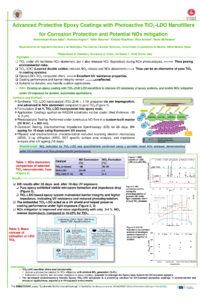
Epoxy resins serve as anticorrosive coatings due to their robust mechanical properties, chemical resistance, and adhesion. Enhancing these coatings with nanoparticles—particularly titanium dioxide (TiO₂)—has proven effective in improving both corrosion resistance and other functional properties. In this work, we synthesized a photoactive TiO₂-based ZnAl-layered double oxide (TiO₂-LDO; 1:10) nanocatalyst via a wet impregnation method and incorporated it into an epoxy matrix. The epoxy resin, formulated with 2 wt.% TiO₂-LDO, was applied to AA2024 substrates using a coating bar coater, yielding a cured film thickness of 20 ± 2 µm. The developed TiO₂-LDO nanocatalyst exhibited high selectivity in the NOx abatement and a minimum NO2 release (3-4%), achieving remarkably up to an 80% NO photoconversion efficiency under 20 W/m² of irradiation in a customized continuous-flow portable photoreactor, designed specifically for NOx studies. In comparison, while TiO₂ (anatase) achieved a similar NO conversion efficiency, it generated 20–25% NO₂ as a byproduct, which is even more toxic than NOx, whereas LDO alone produced minimal NO₂ but achieved a lower NO conversion efficiency of 25–30%.
Electrochemical impedance spectroscopy (EIS) over 28 days revealed that incorporating TiO₂-LDO into the epoxy coating provided a comparable corrosion resistance to the pure resin. However, the improvement was pronounced when the systems were exposed to UV irradiation (10 days of aging with fluorescent source with λmax = 365 nm, 20 W·m−2), which induces micropore formation in the pure epoxy film compared to epoxy with TiO2-LDO, and thus improved corrosion resistance for the epoxy composite on AA2024. The results underscore the dual functionality of TiO₂-LDO as both a photoactive nanocatalyst (air pollution) and an effective anticorrosion additive, offering a promising, environmentally friendly solution for UV-resistant corrosion protection.
Keywords
TiO2-LDO
NOx abatement
Adhesion
UV ageing
EIS.
Poster
sciforum-117415.pdf
Development of Sustainable Anticorrosive Coatings Based on Pinus Radiata Bark Wax
Water vapour transmission properties of waterborne coatings—effect of selected parameters