Event submissions
Published
This submission belongs to the session S4. Corrosion, Erosion and the Tribological and Mechanical Aspects of Coatings of the event 4th Coatings and Interfaces Online Conference
Published date
16 May, 2025
Academic Editor
'%3e%3cpath%20d='M12.6657%2010.9104C12.4185%2010.325%2012.0599%209.79327%2011.6097%209.34482C11.1609%208.89508%2010.6293%208.5365%2010.0442%208.28888C10.0389%208.28626%2010.0337%208.28495%2010.0285%208.28233C10.8446%207.69279%2011.3752%206.73249%2011.3752%205.64904C11.3752%203.8542%209.92103%202.39999%208.1262%202.39999C6.33136%202.39999%204.87715%203.8542%204.87715%205.64904C4.87715%206.73249%205.40774%207.69279%206.22393%208.28364C6.21869%208.28626%206.21345%208.28757%206.20821%208.29019C5.62129%208.5378%205.09463%208.89284%204.64265%209.34613C4.1929%209.79493%203.83432%2010.3266%203.58671%2010.9117C3.34345%2011.4845%203.21226%2012.0987%203.20023%2012.7209C3.19988%2012.7349%203.20233%2012.7488%203.20744%2012.7619C3.21255%2012.7749%203.22022%2012.7867%203.22998%2012.7968C3.23975%2012.8068%203.25142%2012.8147%203.26431%2012.8202C3.2772%2012.8256%203.29105%2012.8284%203.30504%2012.8284H4.09109C4.14874%2012.8284%204.19459%2012.7825%204.1959%2012.7262C4.2221%2011.7148%204.62823%2010.7676%205.34617%2010.0497C6.08899%209.30683%207.0755%208.89808%208.1262%208.89808C9.17689%208.89808%2010.1634%209.30683%2010.9062%2010.0497C11.6242%2010.7676%2012.0303%2011.7148%2012.0565%2012.7262C12.0578%2012.7838%2012.1037%2012.8284%2012.1613%2012.8284H12.9474C12.9613%2012.8284%2012.9752%2012.8256%2012.9881%2012.8202C13.001%2012.8147%2013.0126%2012.8068%2013.0224%2012.7968C13.0322%2012.7867%2013.0398%2012.7749%2013.0449%2012.7619C13.0501%2012.7488%2013.0525%2012.7349%2013.0522%2012.7209C13.0391%2012.0947%2012.9094%2011.4855%2012.6657%2010.9104ZM8.1262%207.9024C7.52486%207.9024%206.9589%207.6679%206.53312%207.24211C6.10733%206.81633%205.87283%206.25037%205.87283%205.64904C5.87283%205.0477%206.10733%204.48174%206.53312%204.05596C6.9589%203.63018%207.52486%203.39567%208.1262%203.39567C8.72753%203.39567%209.29349%203.63018%209.71927%204.05596C10.1451%204.48174%2010.3796%205.0477%2010.3796%205.64904C10.3796%206.25037%2010.1451%206.81633%209.71927%207.24211C9.29349%207.6679%208.72753%207.9024%208.1262%207.9024Z'%20fill='%235D1EE1'/%3e%3c/g%3e%3c/svg%3e) HUIRONG LE
HUIRONG LECitation
Pal Terek, Lazar Kovačević, Vladimir Terek, Zoran Bobić, Branko Škorić, Miha Čekada, Aljaž Drnovšek, The effect of surface roughness on scratch adhesion and tribological behavior of PVD hard coatings with different layer designs, in Proceedings of 4th Coatings and Interfaces Online Conference, 21 May–23 May 2025, MDPI: Basel, Switzerland
Share
Email
Facebook
Twitter
LinkedIn
The effect of surface roughness on scratch adhesion and tribological behavior of PVD hard coatings with different layer designs

Pal Terek 1
'%3e%3cpath%20d='M12.6647%2010.9104C12.4176%2010.325%2012.0589%209.7933%2011.6088%209.34485C11.16%208.89511%2010.6283%208.53653%2010.0432%208.28891C10.038%208.28629%2010.0327%208.28498%2010.0275%208.28236C10.8437%207.69282%2011.3743%206.73252%2011.3743%205.64907C11.3743%203.85423%209.92005%202.40002%208.12522%202.40002C6.33038%202.40002%204.87618%203.85423%204.87618%205.64907C4.87618%206.73252%205.40677%207.69282%206.22296%208.28367C6.21772%208.28629%206.21248%208.2876%206.20724%208.29022C5.62031%208.53783%205.09365%208.89287%204.64167%209.34616C4.19192%209.79496%203.83334%2010.3266%203.58573%2010.9117C3.34247%2011.4846%203.21128%2012.0987%203.19925%2012.721C3.1989%2012.735%203.20135%2012.7489%203.20646%2012.7619C3.21157%2012.7749%203.21924%2012.7868%203.22901%2012.7968C3.23877%2012.8068%203.25045%2012.8148%203.26334%2012.8202C3.27623%2012.8256%203.29007%2012.8284%203.30406%2012.8284H4.09012C4.14776%2012.8284%204.19362%2012.7825%204.19493%2012.7262C4.22113%2011.7148%204.62726%2010.7676%205.34519%2010.0497C6.08802%209.30686%207.07452%208.89811%208.12522%208.89811C9.17592%208.89811%2010.1624%209.30686%2010.9052%2010.0497C11.6232%2010.7676%2012.0293%2011.7148%2012.0555%2012.7262C12.0568%2012.7839%2012.1027%2012.8284%2012.1603%2012.8284H12.9464C12.9604%2012.8284%2012.9742%2012.8256%2012.9871%2012.8202C13%2012.8148%2013.0117%2012.8068%2013.0214%2012.7968C13.0312%2012.7868%2013.0389%2012.7749%2013.044%2012.7619C13.0491%2012.7489%2013.0515%2012.735%2013.0512%2012.721C13.0381%2012.0947%2012.9084%2011.4856%2012.6647%2010.9104ZM8.12522%207.90243C7.52388%207.90243%206.95792%207.66793%206.53214%207.24215C6.10636%206.81636%205.87185%206.2504%205.87185%205.64907C5.87185%205.04773%206.10636%204.48177%206.53214%204.05599C6.95792%203.63021%207.52388%203.3957%208.12522%203.3957C8.72655%203.3957%209.29252%203.63021%209.7183%204.05599C10.1441%204.48177%2010.3786%205.04773%2010.3786%205.64907C10.3786%206.2504%2010.1441%206.81636%209.7183%207.24215C9.29252%207.66793%208.72655%207.90243%208.12522%207.90243Z'%20fill='%235D1EE1'/%3e%3c/g%3e%3c/svg%3e)
Lazar Kovačević 1
Vladimir Terek 1
Zoran Bobić 1
Branko Škorić 1
Miha Čekada 2

Aljaž Drnovšek 2
1. University of Novi Sad, Faculty of Technical Sciences, Trg Dositeja Obradovića 6, 21000 Novi Sad, Serbia
2. Jožef Stefan Institute, Jamova 39, 1000, Ljubljana, Slovenia
Abstract
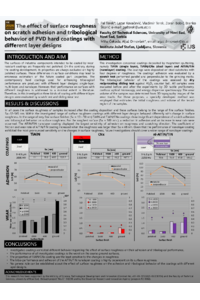
The surfaces of industrial components intended to be coated with wear-resistant coatings are frequently not polished. On the contrary, during the coating development, its properties are always evaluated on highly polished surfaces. These differences in surface conditions may lead to erroneous estimation of the future coated part properties. Contemporary hard coatings that are used for enhancing tribological performance are produced with different layer designs, namely single layers, multi layers, and nanolayers. However, their performance on surfaces with different roughnesses is addressed to a minimal extent in the literature. This investigation examined three kinds of coatings of different layer designs deposited by magnetron sputtering, namely TiAlN (single layer), TiAlN/CNx (dual layer) and AlTiN/TiN (nanolayer) coating. Coatings were deposited on steel substrates with four degrees of roughness. The coatings’ adhesion was evaluated by scratch test performed parallel and perpendicular to the grinding marks. The tribological behavior of the coatings was assessed by dry-reciprocating the sliding test against an Al2O3 counter ball. All samples were evaluated before and after the experiments through 3D tactile profilometry, confocal optical microscopy, and energy dispersive spectroscopy. In all cases, the surface roughness of the samples increased after the coating deposition, and these surfaces belong to the range of fine surface finishes, namely Sa=12–545 nm. Within the investigated range of surface roughness, coatings with different layer designs behaved differently according to changes in surface roughness. TiAlN and TiAlN/CNx coatings showed no dependence on scratch adhesion or tribological behavior on surface roughness. For the roughest surface, a reduction in adhesion and an increase in wear rate were both observed. The AlTiN/TiN nanolayer coating displayed the largest sensitivity of adhesion on roughness and scratching direction. The coefficient of friction and wear rate of AlTiN/TiN coating increased when the roughness was larger than Sa ≈ 100 nm. This indicates that future investigations should cover a wider range of nanolayer coatings.
Keywords
PVD coating
surface roughness
scratch test
adhesion
dry sliding
Al2O3
wear
coefficient of friction
Poster
sciforum-114305.pdf
Sealing PVD coating defects with Ti-O ALD layers
The impact of oxidative amine degradation on the corrosion behavior of 304L and 316L stainless steels in MEA solutions containing SOx and NOx contaminants