Event submissions
Published
This submission belongs to the session S4. Corrosion, Erosion and the Tribological and Mechanical Aspects of Coatings of the event 4th Coatings and Interfaces Online Conference
Published date
16 May, 2025
Academic Editor
'%3e%3cpath%20d='M12.6657%2010.9104C12.4185%2010.325%2012.0599%209.79327%2011.6097%209.34482C11.1609%208.89508%2010.6293%208.5365%2010.0442%208.28888C10.0389%208.28626%2010.0337%208.28495%2010.0285%208.28233C10.8446%207.69279%2011.3752%206.73249%2011.3752%205.64904C11.3752%203.8542%209.92103%202.39999%208.1262%202.39999C6.33136%202.39999%204.87715%203.8542%204.87715%205.64904C4.87715%206.73249%205.40774%207.69279%206.22393%208.28364C6.21869%208.28626%206.21345%208.28757%206.20821%208.29019C5.62129%208.5378%205.09463%208.89284%204.64265%209.34613C4.1929%209.79493%203.83432%2010.3266%203.58671%2010.9117C3.34345%2011.4845%203.21226%2012.0987%203.20023%2012.7209C3.19988%2012.7349%203.20233%2012.7488%203.20744%2012.7619C3.21255%2012.7749%203.22022%2012.7867%203.22998%2012.7968C3.23975%2012.8068%203.25142%2012.8147%203.26431%2012.8202C3.2772%2012.8256%203.29105%2012.8284%203.30504%2012.8284H4.09109C4.14874%2012.8284%204.19459%2012.7825%204.1959%2012.7262C4.2221%2011.7148%204.62823%2010.7676%205.34617%2010.0497C6.08899%209.30683%207.0755%208.89808%208.1262%208.89808C9.17689%208.89808%2010.1634%209.30683%2010.9062%2010.0497C11.6242%2010.7676%2012.0303%2011.7148%2012.0565%2012.7262C12.0578%2012.7838%2012.1037%2012.8284%2012.1613%2012.8284H12.9474C12.9613%2012.8284%2012.9752%2012.8256%2012.9881%2012.8202C13.001%2012.8147%2013.0126%2012.8068%2013.0224%2012.7968C13.0322%2012.7867%2013.0398%2012.7749%2013.0449%2012.7619C13.0501%2012.7488%2013.0525%2012.7349%2013.0522%2012.7209C13.0391%2012.0947%2012.9094%2011.4855%2012.6657%2010.9104ZM8.1262%207.9024C7.52486%207.9024%206.9589%207.6679%206.53312%207.24211C6.10733%206.81633%205.87283%206.25037%205.87283%205.64904C5.87283%205.0477%206.10733%204.48174%206.53312%204.05596C6.9589%203.63018%207.52486%203.39567%208.1262%203.39567C8.72753%203.39567%209.29349%203.63018%209.71927%204.05596C10.1451%204.48174%2010.3796%205.0477%2010.3796%205.64904C10.3796%206.25037%2010.1451%206.81633%209.71927%207.24211C9.29349%207.6679%208.72753%207.9024%208.1262%207.9024Z'%20fill='%235D1EE1'/%3e%3c/g%3e%3c/svg%3e) HUIRONG LE
HUIRONG LECitation
Francesca Borgioli, Evaluation of the corrosion behavior of low-temperature nitrided AISI 316L austenitic stainless steel, in Proceedings of 4th Coatings and Interfaces Online Conference, 21 May–23 May 2025, MDPI: Basel, Switzerland
Share
Email
Facebook
Twitter
LinkedIn
Evaluation of the corrosion behavior of low-temperature nitrided AISI 316L austenitic stainless steel

Francesca Borgioli 1
1. Department of Industrial Engineering (DIEF), University of Florence, via S. Marta 3, 50139 Florence, Italy
Abstract
Introduction
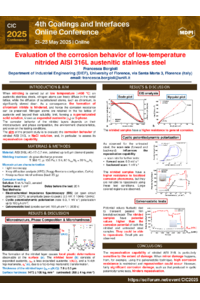
Low-temperature nitriding of austenitic stainless steels allows for the formation of a supersaturated solid solution of nitrogen in the austenite lattice (expanded austenite or S-phase), while inhibiting the precipitation of Cr nitrides. The corrosion behavior of the nitrided layers depends on their microstructure and phase composition, as well as on the environment characteristics. The testing conditions can also play a role, as observed when the repassivation characteristics are assessed. The aim of the present study is to evaluate the corrosion behavior of low-temperature nitrided AISI 316L austenitic stainless steel using different electrochemical techniques and, in particular, to assess the repassivation capability in NaCl solution.
Methods
AISI 316L samples were glow-discharge-nitrided at 380 °C, under 130 Pa, for 5 h. Microstructure, phase composition, and surface microhardness were assessed. Corrosion behavior was evaluated in 5 wt.% NaCl aerated solution using different electrochemical techniques (electrochemical impedance spectroscopy (EIS), cyclic potentodynamic, and galvanostatic techniques).
Results
The hardened nitrided layers mainly consisted of expanded austenite. EIS analysis showed that nitrided samples had higher impedance values than the untreated steel. The cyclic potentiodynamic test results were affected by testing conditions. Corrosion potential and pitting potential values of the nitrided samples were higher than those of the untreated ones, but the nitrided samples were not capable of repassivating. On the contrary, when the galvanostatic technique was employed, the potential value, below which localized corrosion phenomena did not occur, was usually higher than the corrosion potential of the untreated alloy, suggesting that repassivation could occur.
Conclusions
The experimental results suggested that the repassivation capability of nitrided AISI 316L austenitic stainless steel was particularly sensitive to the extent of damage. When minor damage occurred, from, for example, using the galvanostatic technique, high corrosion resistance was maintained. However, fairly significant corrosion damage, such as that occurring in cyclic potentiodynamic tests, hindered repassivation.
Keywords
Austenitic stainless steels
low-temperature nitriding
expanded austenite
S-phase
corrosion behavior
Poster
Borgioli poster.pdf
Corrosion Fatigue Life Analysis of Chip-based Hot-Extruded Aluminum Alloy AA6060
Potassium Permanganate–Fluorozirconate Conversion Coating as a Precursor for Flash-PEO Coatings on AZ31B Magnesium Alloy