Event submissions
Published
This submission belongs to the session S6. Protective Coatings in Cultural Heritage, Conservation and Preservation of the event 4th Coatings and Interfaces Online Conference
Published date
16 May, 2025
Academic Editor
'%3e%3cpath%20d='M12.6657%2010.9104C12.4185%2010.325%2012.0599%209.79327%2011.6097%209.34482C11.1609%208.89508%2010.6293%208.5365%2010.0442%208.28888C10.0389%208.28626%2010.0337%208.28495%2010.0285%208.28233C10.8446%207.69279%2011.3752%206.73249%2011.3752%205.64904C11.3752%203.8542%209.92103%202.39999%208.1262%202.39999C6.33136%202.39999%204.87715%203.8542%204.87715%205.64904C4.87715%206.73249%205.40774%207.69279%206.22393%208.28364C6.21869%208.28626%206.21345%208.28757%206.20821%208.29019C5.62129%208.5378%205.09463%208.89284%204.64265%209.34613C4.1929%209.79493%203.83432%2010.3266%203.58671%2010.9117C3.34345%2011.4845%203.21226%2012.0987%203.20023%2012.7209C3.19988%2012.7349%203.20233%2012.7488%203.20744%2012.7619C3.21255%2012.7749%203.22022%2012.7867%203.22998%2012.7968C3.23975%2012.8068%203.25142%2012.8147%203.26431%2012.8202C3.2772%2012.8256%203.29105%2012.8284%203.30504%2012.8284H4.09109C4.14874%2012.8284%204.19459%2012.7825%204.1959%2012.7262C4.2221%2011.7148%204.62823%2010.7676%205.34617%2010.0497C6.08899%209.30683%207.0755%208.89808%208.1262%208.89808C9.17689%208.89808%2010.1634%209.30683%2010.9062%2010.0497C11.6242%2010.7676%2012.0303%2011.7148%2012.0565%2012.7262C12.0578%2012.7838%2012.1037%2012.8284%2012.1613%2012.8284H12.9474C12.9613%2012.8284%2012.9752%2012.8256%2012.9881%2012.8202C13.001%2012.8147%2013.0126%2012.8068%2013.0224%2012.7968C13.0322%2012.7867%2013.0398%2012.7749%2013.0449%2012.7619C13.0501%2012.7488%2013.0525%2012.7349%2013.0522%2012.7209C13.0391%2012.0947%2012.9094%2011.4855%2012.6657%2010.9104ZM8.1262%207.9024C7.52486%207.9024%206.9589%207.6679%206.53312%207.24211C6.10733%206.81633%205.87283%206.25037%205.87283%205.64904C5.87283%205.0477%206.10733%204.48174%206.53312%204.05596C6.9589%203.63018%207.52486%203.39567%208.1262%203.39567C8.72753%203.39567%209.29349%203.63018%209.71927%204.05596C10.1451%204.48174%2010.3796%205.0477%2010.3796%205.64904C10.3796%206.25037%2010.1451%206.81633%209.71927%207.24211C9.29349%207.6679%208.72753%207.9024%208.1262%207.9024Z'%20fill='%235D1EE1'/%3e%3c/g%3e%3c/svg%3e) PELOSI CLAUDIA
PELOSI CLAUDIACitation
Fabíula Pereira Lessa, Orlando Lima Jr, Élida Margalho, Behzad Zahabizadeh, Vítor Cunha, Eduardo Pereira, Aires Camões, Iran Rocha Segundo, Joaquim Carneiro, Development of Self-Cleaning Cementitious Panels with Nano-TiO₂ and Micro-ZnO: Aesthetic and Photocatalytic Impacts of Epoxy Resin Application, in Proceedings of 4th Coatings and Interfaces Online Conference, 21 May–23 May 2025, MDPI: Basel, Switzerland
Share
Email
Facebook
Twitter
LinkedIn
Development of Self-Cleaning Cementitious Panels with Nano-TiO₂ and Micro-ZnO: Aesthetic and Photocatalytic Impacts of Epoxy Resin Application
'%3e%3cpath%20d='M12.6647%2010.9104C12.4176%2010.325%2012.0589%209.7933%2011.6088%209.34485C11.16%208.89511%2010.6283%208.53653%2010.0432%208.28891C10.038%208.28629%2010.0327%208.28498%2010.0275%208.28236C10.8437%207.69282%2011.3743%206.73252%2011.3743%205.64907C11.3743%203.85423%209.92005%202.40002%208.12522%202.40002C6.33038%202.40002%204.87618%203.85423%204.87618%205.64907C4.87618%206.73252%205.40677%207.69282%206.22296%208.28367C6.21772%208.28629%206.21248%208.2876%206.20724%208.29022C5.62031%208.53783%205.09365%208.89287%204.64167%209.34616C4.19192%209.79496%203.83334%2010.3266%203.58573%2010.9117C3.34247%2011.4846%203.21128%2012.0987%203.19925%2012.721C3.1989%2012.735%203.20135%2012.7489%203.20646%2012.7619C3.21157%2012.7749%203.21924%2012.7868%203.22901%2012.7968C3.23877%2012.8068%203.25045%2012.8148%203.26334%2012.8202C3.27623%2012.8256%203.29007%2012.8284%203.30406%2012.8284H4.09012C4.14776%2012.8284%204.19362%2012.7825%204.19493%2012.7262C4.22113%2011.7148%204.62726%2010.7676%205.34519%2010.0497C6.08802%209.30686%207.07452%208.89811%208.12522%208.89811C9.17592%208.89811%2010.1624%209.30686%2010.9052%2010.0497C11.6232%2010.7676%2012.0293%2011.7148%2012.0555%2012.7262C12.0568%2012.7839%2012.1027%2012.8284%2012.1603%2012.8284H12.9464C12.9604%2012.8284%2012.9742%2012.8256%2012.9871%2012.8202C13%2012.8148%2013.0117%2012.8068%2013.0214%2012.7968C13.0312%2012.7868%2013.0389%2012.7749%2013.044%2012.7619C13.0491%2012.7489%2013.0515%2012.735%2013.0512%2012.721C13.0381%2012.0947%2012.9084%2011.4856%2012.6647%2010.9104ZM8.12522%207.90243C7.52388%207.90243%206.95792%207.66793%206.53214%207.24215C6.10636%206.81636%205.87185%206.2504%205.87185%205.64907C5.87185%205.04773%206.10636%204.48177%206.53214%204.05599C6.95792%203.63021%207.52388%203.3957%208.12522%203.3957C8.72655%203.3957%209.29252%203.63021%209.7183%204.05599C10.1441%204.48177%2010.3786%205.04773%2010.3786%205.64907C10.3786%206.2504%2010.1441%206.81636%209.7183%207.24215C9.29252%207.66793%208.72655%207.90243%208.12522%207.90243Z'%20fill='%235D1EE1'/%3e%3c/g%3e%3c/svg%3e)
Fabíula Pereira Lessa 1

Orlando Lima Jr 2
Élida Margalho 2

Behzad Zahabizadeh 3
Vítor Cunha 3
Eduardo Pereira 3

Aires Camões 4

Iran Rocha Segundo 1

Joaquim Carneiro 1
1. Centre of Physics of Minho and Porto Universities (CF-UM-UP), Azurém Campus, University of Minho, 4800-058 Guimarães, Portugal
2. Advanced Production and Intelligent Systems Associated Laboratory (ARISE), Department of Civil Engineering, Institute for Sustainability and Innovation in Structural Engineering (ISISE), University of Minho, 4800-058 Guimarães, Portugal
3. Institute for Sustainability and Innovation in Structural Engineering (ISISE), Institute of Science and Innovation for Bio-Sustainability (IB-S), Department of Civil Engineering, University of Minho, 4800-058 Guimarães, Portugal
4. Centre for Territory, Environment and Construction (CTAC), Department of Civil Engineering, University of Minho, Azurém, 4800-058 Guimarães, Portugal
Abstract
Self-cleaning materials are highly relevant for exterior surfaces, such as building facades, and for heritage conservation by preserving the original aesthetic appearance of surfaces with minimal effort and cost. The transparency of these coatings is essential to maintain the visual integrity of existing surfaces. In this context, nanotechnology has emerged as a promising alternative, introducing innovations in coatings and treatments that provide water resistance, self-cleaning properties, and protection against biological attack. Despite their potential, implementing these coatings on cementitious surfaces poses challenges related to long-term stability and performance. Unfixed particles are susceptible to displacement by environmental factors such as rain, wind, and wear, compromising durability and reducing their ability to degrade pollutants and maintain clean facades. This study developed self-cleaning cementitious panels by incorporating TiO₂ nanoparticles and ZnO microparticles at varying concentrations, applied using two deposition methods: spray and dip-coating. Rhodamine B (RhB), an organic dye, was used as a model pollutant to assess self-cleaning performance by monitoring dye degradation during irradiation cycles under simulated sunlight. A spectrophotometric analysis was conducted using the CIELAB color coordinate system to measure chromatic variation and evaluate self-cleaning efficiency. The effect of epoxy resin as a particle immobilizer was also examined, focusing on aesthetic preservation and photocatalytic performance. The results showed that neither the photocatalytic coating nor the resin significantly altered substrate aesthetics, confirming their suitability for facades and heritage preservation. Additionally, photocatalytic coatings improved the surfaces' self-cleaning properties; however, a slight reduction in photocatalytic efficiency was observed with resin application, likely due to a decrease in the photocatalyst’s active surface area. This highlights the need for further research into alternative resins or surface treatments that optimize particle fixation while maintaining high photocatalytic activity.
Keywords
smart cementitious materials
building facades
self-cleaning
photocatalysis
resin
titanium dioxide
zinc oxide
cultural heritage
conservation
preservation
Poster
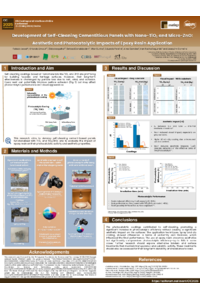
CIC2025_Poster_FV.pdf
Historic Paint Coatings applied to Historic Fibrous Plaster
Beautiful moment, do not pass away!: how to extend the life of decorative exterior coatings