Event submissions
Published
This submission belongs to the session S7. The Biomedical Application of Coatings of the event 4th Coatings and Interfaces Online Conference
Published date
16 May, 2025
Academic Editor
'%3e%3cpath%20d='M12.6657%2010.9104C12.4185%2010.325%2012.0599%209.79327%2011.6097%209.34482C11.1609%208.89508%2010.6293%208.5365%2010.0442%208.28888C10.0389%208.28626%2010.0337%208.28495%2010.0285%208.28233C10.8446%207.69279%2011.3752%206.73249%2011.3752%205.64904C11.3752%203.8542%209.92103%202.39999%208.1262%202.39999C6.33136%202.39999%204.87715%203.8542%204.87715%205.64904C4.87715%206.73249%205.40774%207.69279%206.22393%208.28364C6.21869%208.28626%206.21345%208.28757%206.20821%208.29019C5.62129%208.5378%205.09463%208.89284%204.64265%209.34613C4.1929%209.79493%203.83432%2010.3266%203.58671%2010.9117C3.34345%2011.4845%203.21226%2012.0987%203.20023%2012.7209C3.19988%2012.7349%203.20233%2012.7488%203.20744%2012.7619C3.21255%2012.7749%203.22022%2012.7867%203.22998%2012.7968C3.23975%2012.8068%203.25142%2012.8147%203.26431%2012.8202C3.2772%2012.8256%203.29105%2012.8284%203.30504%2012.8284H4.09109C4.14874%2012.8284%204.19459%2012.7825%204.1959%2012.7262C4.2221%2011.7148%204.62823%2010.7676%205.34617%2010.0497C6.08899%209.30683%207.0755%208.89808%208.1262%208.89808C9.17689%208.89808%2010.1634%209.30683%2010.9062%2010.0497C11.6242%2010.7676%2012.0303%2011.7148%2012.0565%2012.7262C12.0578%2012.7838%2012.1037%2012.8284%2012.1613%2012.8284H12.9474C12.9613%2012.8284%2012.9752%2012.8256%2012.9881%2012.8202C13.001%2012.8147%2013.0126%2012.8068%2013.0224%2012.7968C13.0322%2012.7867%2013.0398%2012.7749%2013.0449%2012.7619C13.0501%2012.7488%2013.0525%2012.7349%2013.0522%2012.7209C13.0391%2012.0947%2012.9094%2011.4855%2012.6657%2010.9104ZM8.1262%207.9024C7.52486%207.9024%206.9589%207.6679%206.53312%207.24211C6.10733%206.81633%205.87283%206.25037%205.87283%205.64904C5.87283%205.0477%206.10733%204.48174%206.53312%204.05596C6.9589%203.63018%207.52486%203.39567%208.1262%203.39567C8.72753%203.39567%209.29349%203.63018%209.71927%204.05596C10.1451%204.48174%2010.3796%205.0477%2010.3796%205.64904C10.3796%206.25037%2010.1451%206.81633%209.71927%207.24211C9.29349%207.6679%208.72753%207.9024%208.1262%207.9024Z'%20fill='%235D1EE1'/%3e%3c/g%3e%3c/svg%3e) MICHELE FERRARI
MICHELE FERRARICitation
Georgiana Cioranu, Elena Ungureanu, Anca Constantina Parau, Alina Vladescu (Dragomir), Diana Maria Vranceanu, Cosmin Mihai Cotrut, Copper-doped hydroxyapatite-based coatings for medical applications, in Proceedings of 4th Coatings and Interfaces Online Conference, 21 May–23 May 2025, MDPI: Basel, Switzerland
Share
Email
Facebook
Twitter
LinkedIn
Copper-doped hydroxyapatite-based coatings for medical applications
'%3e%3cpath%20d='M12.6647%2010.9104C12.4176%2010.325%2012.0589%209.7933%2011.6088%209.34485C11.16%208.89511%2010.6283%208.53653%2010.0432%208.28891C10.038%208.28629%2010.0327%208.28498%2010.0275%208.28236C10.8437%207.69282%2011.3743%206.73252%2011.3743%205.64907C11.3743%203.85423%209.92005%202.40002%208.12522%202.40002C6.33038%202.40002%204.87618%203.85423%204.87618%205.64907C4.87618%206.73252%205.40677%207.69282%206.22296%208.28367C6.21772%208.28629%206.21248%208.2876%206.20724%208.29022C5.62031%208.53783%205.09365%208.89287%204.64167%209.34616C4.19192%209.79496%203.83334%2010.3266%203.58573%2010.9117C3.34247%2011.4846%203.21128%2012.0987%203.19925%2012.721C3.1989%2012.735%203.20135%2012.7489%203.20646%2012.7619C3.21157%2012.7749%203.21924%2012.7868%203.22901%2012.7968C3.23877%2012.8068%203.25045%2012.8148%203.26334%2012.8202C3.27623%2012.8256%203.29007%2012.8284%203.30406%2012.8284H4.09012C4.14776%2012.8284%204.19362%2012.7825%204.19493%2012.7262C4.22113%2011.7148%204.62726%2010.7676%205.34519%2010.0497C6.08802%209.30686%207.07452%208.89811%208.12522%208.89811C9.17592%208.89811%2010.1624%209.30686%2010.9052%2010.0497C11.6232%2010.7676%2012.0293%2011.7148%2012.0555%2012.7262C12.0568%2012.7839%2012.1027%2012.8284%2012.1603%2012.8284H12.9464C12.9604%2012.8284%2012.9742%2012.8256%2012.9871%2012.8202C13%2012.8148%2013.0117%2012.8068%2013.0214%2012.7968C13.0312%2012.7868%2013.0389%2012.7749%2013.044%2012.7619C13.0491%2012.7489%2013.0515%2012.735%2013.0512%2012.721C13.0381%2012.0947%2012.9084%2011.4856%2012.6647%2010.9104ZM8.12522%207.90243C7.52388%207.90243%206.95792%207.66793%206.53214%207.24215C6.10636%206.81636%205.87185%206.2504%205.87185%205.64907C5.87185%205.04773%206.10636%204.48177%206.53214%204.05599C6.95792%203.63021%207.52388%203.3957%208.12522%203.3957C8.72655%203.3957%209.29252%203.63021%209.7183%204.05599C10.1441%204.48177%2010.3786%205.04773%2010.3786%205.64907C10.3786%206.2504%2010.1441%206.81636%209.7183%207.24215C9.29252%207.66793%208.72655%207.90243%208.12522%207.90243Z'%20fill='%235D1EE1'/%3e%3c/g%3e%3c/svg%3e)
Georgiana Cioranu 1
Elena Ungureanu 1
Anca Constantina Parau 2
.jpg)
Alina Vladescu (Dragomir) 2

Diana Maria Vranceanu 3

Cosmin Mihai Cotrut 3
1. National University of Science and Technology Politehnica Bucharest, 313 Splaiul Independentei, 060042 Bucharest, Romania
2. National Institute of Research and Development for Optoelectronics—INOE 2000, 77125 Magurele, Romania
3. National University of Science and Technology POLITEHNICA Bucharest, 313 Independentei Street, 060042, Bucharest, Romania
Abstract
The success of an implant depends on its osseointegration, while its long-term survival is determined by its resistance to bacterial infections. Titanium, commonly used for its mechanical properties and corrosion resistance, has limitations regarding its osteointegration and antibacterial efficiency [1,2]. The present work's aim is to functionalize the Ti surface with hydroxyapatite doped with copper, known for its antibacterial properties and ability to stimulate bone regeneration.
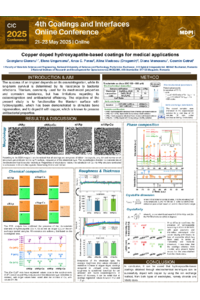
The coatings were obtained by electrochemical deposition of HAp on Ti and subsequent doping by an ion exchange method with a copper solution. The HAp deposition was carried out in pulsed galvanostatic mode at 75°C from two types of electrolytes: Ca nitrate and Ca chlorate salts. The coatings were characterized in terms of morphology, chemical and phase composition, surface roughness, and thickness. SEM images showed that the HAp coating morphology consists of ribbon-like crystals, irrespective of the electrolyte or the presence of Cu. The EDS analysis highlighted the presence of Cu ions and a (Ca+Cu)/P ratio between 1.54 and 1.59. In terms of coating thickness, it was noted that when chloride salts were used, the thickness was smaller than when nitrates were used. Cu addition to HAp resulted in a slight decrease in thickness, regardless of the electrolyte. XRD analysis confirmed the presence of the HAp phase and HAp coatings successfully doped with Cu.
In conclusion, it can be stated that hydroxyapatite-based coatings obtained through electrochemical techniques can be successfully doped with copper by using the ion exchange method.
[1] F. A. Al-Mulhim, M. A. Baragbah, M. Sadat-Ali, A. S. Alomran, M. Q. Azam, Int Surg 2014, 99, 264.
[2] D. M. Vranceanu, E. Ungureanu, I. C. Ionescu, A. C. Parau, V. Pruna, I. Titorencu, M. Badea, C.-Ștefania Gălbău, M. Idomir, M. Dinu, A. V. (Dragomir), C. M. Cotrut, Biomimetics 2024, 9, 244.
Keywords
hydroxyapatite
electrochemical deposition
copper
ion exchange
Poster
Poster CIC Georgiana Cioranu.pdf
A highly hydrophobic siloxane-nanolignin hybrid coating for the protection of heritage wood
Natural coatings as promising green solution for tailoring the degradation of AZ91-magnesium alloy in orthopedic applications