Event submissions
Published
This submission belongs to the session S7. The Biomedical Application of Coatings of the event 4th Coatings and Interfaces Online Conference
Published date
16 May, 2025
Academic Editor
'%3e%3cpath%20d='M12.6657%2010.9104C12.4185%2010.325%2012.0599%209.79327%2011.6097%209.34482C11.1609%208.89508%2010.6293%208.5365%2010.0442%208.28888C10.0389%208.28626%2010.0337%208.28495%2010.0285%208.28233C10.8446%207.69279%2011.3752%206.73249%2011.3752%205.64904C11.3752%203.8542%209.92103%202.39999%208.1262%202.39999C6.33136%202.39999%204.87715%203.8542%204.87715%205.64904C4.87715%206.73249%205.40774%207.69279%206.22393%208.28364C6.21869%208.28626%206.21345%208.28757%206.20821%208.29019C5.62129%208.5378%205.09463%208.89284%204.64265%209.34613C4.1929%209.79493%203.83432%2010.3266%203.58671%2010.9117C3.34345%2011.4845%203.21226%2012.0987%203.20023%2012.7209C3.19988%2012.7349%203.20233%2012.7488%203.20744%2012.7619C3.21255%2012.7749%203.22022%2012.7867%203.22998%2012.7968C3.23975%2012.8068%203.25142%2012.8147%203.26431%2012.8202C3.2772%2012.8256%203.29105%2012.8284%203.30504%2012.8284H4.09109C4.14874%2012.8284%204.19459%2012.7825%204.1959%2012.7262C4.2221%2011.7148%204.62823%2010.7676%205.34617%2010.0497C6.08899%209.30683%207.0755%208.89808%208.1262%208.89808C9.17689%208.89808%2010.1634%209.30683%2010.9062%2010.0497C11.6242%2010.7676%2012.0303%2011.7148%2012.0565%2012.7262C12.0578%2012.7838%2012.1037%2012.8284%2012.1613%2012.8284H12.9474C12.9613%2012.8284%2012.9752%2012.8256%2012.9881%2012.8202C13.001%2012.8147%2013.0126%2012.8068%2013.0224%2012.7968C13.0322%2012.7867%2013.0398%2012.7749%2013.0449%2012.7619C13.0501%2012.7488%2013.0525%2012.7349%2013.0522%2012.7209C13.0391%2012.0947%2012.9094%2011.4855%2012.6657%2010.9104ZM8.1262%207.9024C7.52486%207.9024%206.9589%207.6679%206.53312%207.24211C6.10733%206.81633%205.87283%206.25037%205.87283%205.64904C5.87283%205.0477%206.10733%204.48174%206.53312%204.05596C6.9589%203.63018%207.52486%203.39567%208.1262%203.39567C8.72753%203.39567%209.29349%203.63018%209.71927%204.05596C10.1451%204.48174%2010.3796%205.0477%2010.3796%205.64904C10.3796%206.25037%2010.1451%206.81633%209.71927%207.24211C9.29349%207.6679%208.72753%207.9024%208.1262%207.9024Z'%20fill='%235D1EE1'/%3e%3c/g%3e%3c/svg%3e) MICHELE FERRARI
MICHELE FERRARICitation
Azra Behroozi Farde Mogaddam, Sodeif Azadmard-Damirchi, Soraya Babaie, Azizeh Farshbaf-Khalili, Unlocking the Potential of Flaxseed Oil: Innovative Coating Technologies and Blending Techniques for Enhanced Stability and Health Benefits, in Proceedings of 4th Coatings and Interfaces Online Conference, 21 May–23 May 2025, MDPI: Basel, Switzerland
Share
Email
Facebook
Twitter
LinkedIn
Unlocking the Potential of Flaxseed Oil: Innovative Coating Technologies and Blending Techniques for Enhanced Stability and Health Benefits
'%3e%3cpath%20d='M12.6647%2010.9104C12.4176%2010.325%2012.0589%209.7933%2011.6088%209.34485C11.16%208.89511%2010.6283%208.53653%2010.0432%208.28891C10.038%208.28629%2010.0327%208.28498%2010.0275%208.28236C10.8437%207.69282%2011.3743%206.73252%2011.3743%205.64907C11.3743%203.85423%209.92005%202.40002%208.12522%202.40002C6.33038%202.40002%204.87618%203.85423%204.87618%205.64907C4.87618%206.73252%205.40677%207.69282%206.22296%208.28367C6.21772%208.28629%206.21248%208.2876%206.20724%208.29022C5.62031%208.53783%205.09365%208.89287%204.64167%209.34616C4.19192%209.79496%203.83334%2010.3266%203.58573%2010.9117C3.34247%2011.4846%203.21128%2012.0987%203.19925%2012.721C3.1989%2012.735%203.20135%2012.7489%203.20646%2012.7619C3.21157%2012.7749%203.21924%2012.7868%203.22901%2012.7968C3.23877%2012.8068%203.25045%2012.8148%203.26334%2012.8202C3.27623%2012.8256%203.29007%2012.8284%203.30406%2012.8284H4.09012C4.14776%2012.8284%204.19362%2012.7825%204.19493%2012.7262C4.22113%2011.7148%204.62726%2010.7676%205.34519%2010.0497C6.08802%209.30686%207.07452%208.89811%208.12522%208.89811C9.17592%208.89811%2010.1624%209.30686%2010.9052%2010.0497C11.6232%2010.7676%2012.0293%2011.7148%2012.0555%2012.7262C12.0568%2012.7839%2012.1027%2012.8284%2012.1603%2012.8284H12.9464C12.9604%2012.8284%2012.9742%2012.8256%2012.9871%2012.8202C13%2012.8148%2013.0117%2012.8068%2013.0214%2012.7968C13.0312%2012.7868%2013.0389%2012.7749%2013.044%2012.7619C13.0491%2012.7489%2013.0515%2012.735%2013.0512%2012.721C13.0381%2012.0947%2012.9084%2011.4856%2012.6647%2010.9104ZM8.12522%207.90243C7.52388%207.90243%206.95792%207.66793%206.53214%207.24215C6.10636%206.81636%205.87185%206.2504%205.87185%205.64907C5.87185%205.04773%206.10636%204.48177%206.53214%204.05599C6.95792%203.63021%207.52388%203.3957%208.12522%203.3957C8.72655%203.3957%209.29252%203.63021%209.7183%204.05599C10.1441%204.48177%2010.3786%205.04773%2010.3786%205.64907C10.3786%206.2504%2010.1441%206.81636%209.7183%207.24215C9.29252%207.66793%208.72655%207.90243%208.12522%207.90243Z'%20fill='%235D1EE1'/%3e%3c/g%3e%3c/svg%3e)
Azra Behroozi Farde Mogaddam 1,2
Sodeif Azadmard-Damirchi 1
Soraya Babaie 2
Azizeh Farshbaf-Khalili 2
1. Department of Food Science and Technology, Faculty of Agriculture, University of Tabriz, Tabriz, Iran
2. Physical Medicine and Rehabilitation Research Center, Aging Research Institute, Tabriz University of Medical Science, Tabriz, Iran
Abstract
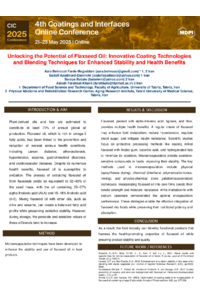
Introduction: Plant-derived oils and fats are estimated to constitute at least 79% of annual global oil production. Flaxseed oil, which is rich in omega-3 fatty acids, has been linked to the prevention and reduction of several serious health conditions, including cancer, diabetes, atherosclerosis, hypertension, eczema, gastrointestinal disorders, and cardiovascular diseases. Despite its numerous health benefits, flaxseed oil is susceptible to oxidation. The process of extracting flaxseed oil from flaxseeds yields an equivalent to 32–45% of the seed mass, with the oil containing 55–57% alpha-linolenic acid (ALA) and 15–18% linolenic acid (n-6). Mixing flaxseed oil with other oils, such as olive and sesame, can create a balanced fatty acid profile while preserving oxidative stability. However, during storage, the peroxide and anisidine values of these oil blends tend to increase.
Methods and Materials: Microencapsulation techniques have been developed to enhance the stability and use of flaxseed oil in food products.
Results: Flaxseed, packed with alpha-linolenic acid, lignans, and fiber, provides multiple health benefits. A regular intake of flaxseed may enhance lipid metabolism, reduce hypertension, regulate blood sugar, and mitigate insulin resistance. Scientific studies focus on protective processing methods like coating milled flaxseed with Arabic gum, ascorbic acid, and hydrogenated fats to minimize its oxidation. Microencapsulation shields oxidation-sensitive compounds in foods, improving their stability. The key methods used in microencapsulation include physical (spray/freeze drying), chemical (interfacial polymerization/cross-linking), and physico-chemical (ionic gelation/coacervation) techniques. Incorporating flaxseed oil into zein films boosts their tensile strength and moisture resistance, while maltodextrin with sodium caseinate demonstrated the optimal encapsulation performance. These strategies enable the effective integration of flaxseed into foods while preserving their nutritional potency and absorption.
Conclusions: As a result, the food industry can develop functional products that harness the health-promoting properties of flaxseed oil while ensuring product stability and quality.
Keywords
coating
flaxseed oil
microencapsulation
food product
Poster
sciforum-118496 .pdf
Natural coatings as promising green solution for tailoring the degradation of AZ91-magnesium alloy in orthopedic applications
Multifunctional Synthesized Flavonoid Complexes for Novel Anticancer Drug Coating Applications