Event submissions
Published
This submission belongs to the session S7. The Biomedical Application of Coatings of the event 4th Coatings and Interfaces Online Conference
Published date
16 May, 2025
Academic Editor
'%3e%3cpath%20d='M12.6657%2010.9104C12.4185%2010.325%2012.0599%209.79327%2011.6097%209.34482C11.1609%208.89508%2010.6293%208.5365%2010.0442%208.28888C10.0389%208.28626%2010.0337%208.28495%2010.0285%208.28233C10.8446%207.69279%2011.3752%206.73249%2011.3752%205.64904C11.3752%203.8542%209.92103%202.39999%208.1262%202.39999C6.33136%202.39999%204.87715%203.8542%204.87715%205.64904C4.87715%206.73249%205.40774%207.69279%206.22393%208.28364C6.21869%208.28626%206.21345%208.28757%206.20821%208.29019C5.62129%208.5378%205.09463%208.89284%204.64265%209.34613C4.1929%209.79493%203.83432%2010.3266%203.58671%2010.9117C3.34345%2011.4845%203.21226%2012.0987%203.20023%2012.7209C3.19988%2012.7349%203.20233%2012.7488%203.20744%2012.7619C3.21255%2012.7749%203.22022%2012.7867%203.22998%2012.7968C3.23975%2012.8068%203.25142%2012.8147%203.26431%2012.8202C3.2772%2012.8256%203.29105%2012.8284%203.30504%2012.8284H4.09109C4.14874%2012.8284%204.19459%2012.7825%204.1959%2012.7262C4.2221%2011.7148%204.62823%2010.7676%205.34617%2010.0497C6.08899%209.30683%207.0755%208.89808%208.1262%208.89808C9.17689%208.89808%2010.1634%209.30683%2010.9062%2010.0497C11.6242%2010.7676%2012.0303%2011.7148%2012.0565%2012.7262C12.0578%2012.7838%2012.1037%2012.8284%2012.1613%2012.8284H12.9474C12.9613%2012.8284%2012.9752%2012.8256%2012.9881%2012.8202C13.001%2012.8147%2013.0126%2012.8068%2013.0224%2012.7968C13.0322%2012.7867%2013.0398%2012.7749%2013.0449%2012.7619C13.0501%2012.7488%2013.0525%2012.7349%2013.0522%2012.7209C13.0391%2012.0947%2012.9094%2011.4855%2012.6657%2010.9104ZM8.1262%207.9024C7.52486%207.9024%206.9589%207.6679%206.53312%207.24211C6.10733%206.81633%205.87283%206.25037%205.87283%205.64904C5.87283%205.0477%206.10733%204.48174%206.53312%204.05596C6.9589%203.63018%207.52486%203.39567%208.1262%203.39567C8.72753%203.39567%209.29349%203.63018%209.71927%204.05596C10.1451%204.48174%2010.3796%205.0477%2010.3796%205.64904C10.3796%206.25037%2010.1451%206.81633%209.71927%207.24211C9.29349%207.6679%208.72753%207.9024%208.1262%207.9024Z'%20fill='%235D1EE1'/%3e%3c/g%3e%3c/svg%3e) MICHELE FERRARI
MICHELE FERRARICitation
Rubén del Olmo, Ana Santos-Coquillat, Reynier Revilla, Anne des Rieux, Iris De Graeve, Surface finishing of as-printed additively manufactured Ti6Al4V meshes for biomedical implants, in Proceedings of 4th Coatings and Interfaces Online Conference, 21 May–23 May 2025, MDPI: Basel, Switzerland
Share
Email
Facebook
Twitter
LinkedIn
Surface finishing of as-printed additively manufactured Ti6Al4V meshes for biomedical implants
'%3e%3cpath%20d='M12.6647%2010.9104C12.4176%2010.325%2012.0589%209.7933%2011.6088%209.34485C11.16%208.89511%2010.6283%208.53653%2010.0432%208.28891C10.038%208.28629%2010.0327%208.28498%2010.0275%208.28236C10.8437%207.69282%2011.3743%206.73252%2011.3743%205.64907C11.3743%203.85423%209.92005%202.40002%208.12522%202.40002C6.33038%202.40002%204.87618%203.85423%204.87618%205.64907C4.87618%206.73252%205.40677%207.69282%206.22296%208.28367C6.21772%208.28629%206.21248%208.2876%206.20724%208.29022C5.62031%208.53783%205.09365%208.89287%204.64167%209.34616C4.19192%209.79496%203.83334%2010.3266%203.58573%2010.9117C3.34247%2011.4846%203.21128%2012.0987%203.19925%2012.721C3.1989%2012.735%203.20135%2012.7489%203.20646%2012.7619C3.21157%2012.7749%203.21924%2012.7868%203.22901%2012.7968C3.23877%2012.8068%203.25045%2012.8148%203.26334%2012.8202C3.27623%2012.8256%203.29007%2012.8284%203.30406%2012.8284H4.09012C4.14776%2012.8284%204.19362%2012.7825%204.19493%2012.7262C4.22113%2011.7148%204.62726%2010.7676%205.34519%2010.0497C6.08802%209.30686%207.07452%208.89811%208.12522%208.89811C9.17592%208.89811%2010.1624%209.30686%2010.9052%2010.0497C11.6232%2010.7676%2012.0293%2011.7148%2012.0555%2012.7262C12.0568%2012.7839%2012.1027%2012.8284%2012.1603%2012.8284H12.9464C12.9604%2012.8284%2012.9742%2012.8256%2012.9871%2012.8202C13%2012.8148%2013.0117%2012.8068%2013.0214%2012.7968C13.0312%2012.7868%2013.0389%2012.7749%2013.044%2012.7619C13.0491%2012.7489%2013.0515%2012.735%2013.0512%2012.721C13.0381%2012.0947%2012.9084%2011.4856%2012.6647%2010.9104ZM8.12522%207.90243C7.52388%207.90243%206.95792%207.66793%206.53214%207.24215C6.10636%206.81636%205.87185%206.2504%205.87185%205.64907C5.87185%205.04773%206.10636%204.48177%206.53214%204.05599C6.95792%203.63021%207.52388%203.3957%208.12522%203.3957C8.72655%203.3957%209.29252%203.63021%209.7183%204.05599C10.1441%204.48177%2010.3786%205.04773%2010.3786%205.64907C10.3786%206.2504%2010.1441%206.81636%209.7183%207.24215C9.29252%207.66793%208.72655%207.90243%208.12522%207.90243Z'%20fill='%235D1EE1'/%3e%3c/g%3e%3c/svg%3e)
Rubén del Olmo 1
Ana Santos-Coquillat 2
Reynier Revilla 1
Anne des Rieux 2

Iris De Graeve 1
1. Department of Materials and Chemistry, Research Group of Sustainable Materials Engineering (SUME), Vrije Universiteit Brussel (VUB), 1050 Brussels, Belgium
2. Université catholique de Louvain (UCLouvain), Louvain Drug Research Institute, Advanced Drug Delivery and Biomaterials, 1200 Brussels, Belgium
Abstract
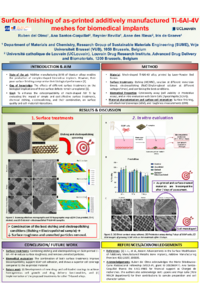
Additive manufacturing (AM), especially titanium (Ti) alloys, enables the production of complex-shaped components with minimal material and energy waste, whose design and surface functionalization are critical for biomedical applications. However, as-printed titanium alloys often exhibit inherent defects, such as cracks and unmelted particles, resulting from the heating regimes during printing. These surface irregularities can significantly influence biocompatibility. Their biological impact remains poorly understood, emphasizing the need to address these defects to enhance cell–material interactions on titanium surfaces. In this study, the cytocompatibility of AM Ti meshes was evaluated after applying three surface treatments: chemical etching, electropolishing, and a combination of both. Surface features were characterized using scanning electron microscopy (SEM) and energy-dispersive X-ray spectroscopy (EDS) to assess the removal of unmelted particles and changes in surface roughness. The results showed that chemical etching effectively removed unmelted particles, while electropolishing significantly reduced surface roughness. The combination of both treatments resulted in clean, uniformly smooth surfaces.
The cytocompatibility of the samples was assessed using the Prestoblue assay with the materials in contact with cells after 24 h, 96 h, and 168 h. After 15 days, cells were fixed and labelled for nuclei and actin staining to evaluate adhesion and spreading on the material surfaces. Cell adhesion to the surfaces was also analyzed by SEM/EDS. The findings revealed that all samples were cytocompatible. Nevertheless, the ones treated with the combined etching and electropolishing approach and electropolishing alone favoured the formation of a monolayer on the surfaces. These results confirm the effectiveness of the studied surface treatments in enhancing cell–surface interactions, underscoring their potential for biomedical applications.
Keywords
additive manufacturing
surface finishing
cytocompatibility
Poster
sciforum-114330.pdf
Application of P4VP polymer brushes with embedded Cu nanoparticles as antibacterial CSE platforms
Eco-Friendly Alginate Films embedding Zinc Oxide Nanostructures: Assessing the Oral Bioaccessibility of Zinc in a Dynamic Mode using a fully automatic flow-through system