Event submissions
Published
This submission belongs to the session S7. The Biomedical Application of Coatings of the event 4th Coatings and Interfaces Online Conference
Published date
16 May, 2025
Academic Editor
'%3e%3cpath%20d='M12.6657%2010.9104C12.4185%2010.325%2012.0599%209.79327%2011.6097%209.34482C11.1609%208.89508%2010.6293%208.5365%2010.0442%208.28888C10.0389%208.28626%2010.0337%208.28495%2010.0285%208.28233C10.8446%207.69279%2011.3752%206.73249%2011.3752%205.64904C11.3752%203.8542%209.92103%202.39999%208.1262%202.39999C6.33136%202.39999%204.87715%203.8542%204.87715%205.64904C4.87715%206.73249%205.40774%207.69279%206.22393%208.28364C6.21869%208.28626%206.21345%208.28757%206.20821%208.29019C5.62129%208.5378%205.09463%208.89284%204.64265%209.34613C4.1929%209.79493%203.83432%2010.3266%203.58671%2010.9117C3.34345%2011.4845%203.21226%2012.0987%203.20023%2012.7209C3.19988%2012.7349%203.20233%2012.7488%203.20744%2012.7619C3.21255%2012.7749%203.22022%2012.7867%203.22998%2012.7968C3.23975%2012.8068%203.25142%2012.8147%203.26431%2012.8202C3.2772%2012.8256%203.29105%2012.8284%203.30504%2012.8284H4.09109C4.14874%2012.8284%204.19459%2012.7825%204.1959%2012.7262C4.2221%2011.7148%204.62823%2010.7676%205.34617%2010.0497C6.08899%209.30683%207.0755%208.89808%208.1262%208.89808C9.17689%208.89808%2010.1634%209.30683%2010.9062%2010.0497C11.6242%2010.7676%2012.0303%2011.7148%2012.0565%2012.7262C12.0578%2012.7838%2012.1037%2012.8284%2012.1613%2012.8284H12.9474C12.9613%2012.8284%2012.9752%2012.8256%2012.9881%2012.8202C13.001%2012.8147%2013.0126%2012.8068%2013.0224%2012.7968C13.0322%2012.7867%2013.0398%2012.7749%2013.0449%2012.7619C13.0501%2012.7488%2013.0525%2012.7349%2013.0522%2012.7209C13.0391%2012.0947%2012.9094%2011.4855%2012.6657%2010.9104ZM8.1262%207.9024C7.52486%207.9024%206.9589%207.6679%206.53312%207.24211C6.10733%206.81633%205.87283%206.25037%205.87283%205.64904C5.87283%205.0477%206.10733%204.48174%206.53312%204.05596C6.9589%203.63018%207.52486%203.39567%208.1262%203.39567C8.72753%203.39567%209.29349%203.63018%209.71927%204.05596C10.1451%204.48174%2010.3796%205.0477%2010.3796%205.64904C10.3796%206.25037%2010.1451%206.81633%209.71927%207.24211C9.29349%207.6679%208.72753%207.9024%208.1262%207.9024Z'%20fill='%235D1EE1'/%3e%3c/g%3e%3c/svg%3e) MICHELE FERRARI
MICHELE FERRARICitation
Elena Ungureanu, Diana Maria Vranceanu, Alina Vladescu (Dragomir), Anca Constantina Parau, Anisoara Cimpean, Cosmin Mihai Cotrut, Assessment of hydroxyapatite coatings doped with silver and strontium through galvanostatic pulse technique, in Proceedings of 4th Coatings and Interfaces Online Conference, 21 May–23 May 2025, MDPI: Basel, Switzerland
Share
Email
Facebook
Twitter
LinkedIn
Assessment of hydroxyapatite coatings doped with silver and strontium through galvanostatic pulse technique
'%3e%3cpath%20d='M12.6647%2010.9104C12.4176%2010.325%2012.0589%209.7933%2011.6088%209.34485C11.16%208.89511%2010.6283%208.53653%2010.0432%208.28891C10.038%208.28629%2010.0327%208.28498%2010.0275%208.28236C10.8437%207.69282%2011.3743%206.73252%2011.3743%205.64907C11.3743%203.85423%209.92005%202.40002%208.12522%202.40002C6.33038%202.40002%204.87618%203.85423%204.87618%205.64907C4.87618%206.73252%205.40677%207.69282%206.22296%208.28367C6.21772%208.28629%206.21248%208.2876%206.20724%208.29022C5.62031%208.53783%205.09365%208.89287%204.64167%209.34616C4.19192%209.79496%203.83334%2010.3266%203.58573%2010.9117C3.34247%2011.4846%203.21128%2012.0987%203.19925%2012.721C3.1989%2012.735%203.20135%2012.7489%203.20646%2012.7619C3.21157%2012.7749%203.21924%2012.7868%203.22901%2012.7968C3.23877%2012.8068%203.25045%2012.8148%203.26334%2012.8202C3.27623%2012.8256%203.29007%2012.8284%203.30406%2012.8284H4.09012C4.14776%2012.8284%204.19362%2012.7825%204.19493%2012.7262C4.22113%2011.7148%204.62726%2010.7676%205.34519%2010.0497C6.08802%209.30686%207.07452%208.89811%208.12522%208.89811C9.17592%208.89811%2010.1624%209.30686%2010.9052%2010.0497C11.6232%2010.7676%2012.0293%2011.7148%2012.0555%2012.7262C12.0568%2012.7839%2012.1027%2012.8284%2012.1603%2012.8284H12.9464C12.9604%2012.8284%2012.9742%2012.8256%2012.9871%2012.8202C13%2012.8148%2013.0117%2012.8068%2013.0214%2012.7968C13.0312%2012.7868%2013.0389%2012.7749%2013.044%2012.7619C13.0491%2012.7489%2013.0515%2012.735%2013.0512%2012.721C13.0381%2012.0947%2012.9084%2011.4856%2012.6647%2010.9104ZM8.12522%207.90243C7.52388%207.90243%206.95792%207.66793%206.53214%207.24215C6.10636%206.81636%205.87185%206.2504%205.87185%205.64907C5.87185%205.04773%206.10636%204.48177%206.53214%204.05599C6.95792%203.63021%207.52388%203.3957%208.12522%203.3957C8.72655%203.3957%209.29252%203.63021%209.7183%204.05599C10.1441%204.48177%2010.3786%205.04773%2010.3786%205.64907C10.3786%206.2504%2010.1441%206.81636%209.7183%207.24215C9.29252%207.66793%208.72655%207.90243%208.12522%207.90243Z'%20fill='%235D1EE1'/%3e%3c/g%3e%3c/svg%3e)
Elena Ungureanu 1

Diana Maria Vranceanu 1
.jpg)
Alina Vladescu (Dragomir) 2
Anca Constantina Parau 2

Anisoara Cimpean 3

Cosmin Mihai Cotrut 1
1. National University of Science and Technology POLITEHNICA of Bucharest, 313 Independeței Street, 060042, Bucharest, Romania
2. National Institute of Research and Development for Optoelectronics INOE 2000, 409 Atomistilor St., 077125, Magurele, Romania
3. Department of Biochemistry and Molecular Biology, University of Bucharest, 91-95 Independentei Street, 050095 Bucharest, Romania
Abstract
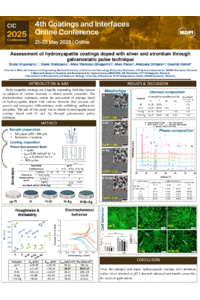
Introduction. Hydroxyapatite coatings are a rapidly expanding field that focuses on the addition of various elements to obtain tunable properties. The electrochemical techniques enable the assessment of coatings based on hydroxyapatite doped with various elements that promote cell growth and osteogenic differentiation while exhibiting antibacterial properties.
Methods. The aim of this study was to obtain hydroxyapatite-based coatings doped with Sr and Ag through the galvanostatic pulse technique. The electrolytes were obtained by subsequently dissolving in ultra-pure water of the following chemical reagents, Ca(NO3)2·4H2O, NH4H2PO4, Sr(NO3)2, and AgNO3 in different concentration with respect to a Ca/P ratio of 1.67. The electrolyte’s pH was adjusted to 5. The coatings were characterized in terms of morphology, elemental and phasic composition, wettability, and roughness. Subsequently, the hydroxyapatite-based coatings were tested in vitro by evaluating their electrochemical behavior and their cellular response to preosteoblast cell cultures.
Results and Discussion. The galvanostatic pulse technique has allowed the development of uniform and compact hydroxyapatite-based coatings, undoped and doped with Sr and/or Ag, that registered a Ca/P ratio closer to 1.67. The XRD analysis highlighted hydroxyapatite as the main phase in all coatings. The contact angle analysis with simulated body fluid (SBF) showed that all coatings have a strong hydrophilic character, registering contact angles within 8° - 10°. The average roughness (Ra) registered values between 300 and 700 nm and a tendency toward a symmetrical topography. The best electrochemical behavior was registered by undoped HAp-based coatings. The studies regarding the response of the preosteoblasts indicated that these surfaces favor the adhesion and proliferation capacity of preosteoblasts, while the addition of Sr exerted beneficial effects on preosteoblast response, irrespective of the presence or absence of Ag.
Conclusions. Thus, the undoped and doped hydroxyapatite coatings with strontium and/or silver obtained at pH 5 denoted enhanced and tunable properties for medical applications.
Keywords
hydroxyapatite
silver
strontium
electrochemical deposition
Poster
sciforum-114237.pdf
Eco-Friendly Alginate Films embedding Zinc Oxide Nanostructures: Assessing the Oral Bioaccessibility of Zinc in a Dynamic Mode using a fully automatic flow-through system
Experimental design-based optimization of bioactive coatings for sustainable antimicrobial applications