Event submissions
Published
This submission belongs to the session S7. The Biomedical Application of Coatings of the event 4th Coatings and Interfaces Online Conference
Published date
16 May, 2025
Academic Editor
'%3e%3cpath%20d='M12.6657%2010.9104C12.4185%2010.325%2012.0599%209.79327%2011.6097%209.34482C11.1609%208.89508%2010.6293%208.5365%2010.0442%208.28888C10.0389%208.28626%2010.0337%208.28495%2010.0285%208.28233C10.8446%207.69279%2011.3752%206.73249%2011.3752%205.64904C11.3752%203.8542%209.92103%202.39999%208.1262%202.39999C6.33136%202.39999%204.87715%203.8542%204.87715%205.64904C4.87715%206.73249%205.40774%207.69279%206.22393%208.28364C6.21869%208.28626%206.21345%208.28757%206.20821%208.29019C5.62129%208.5378%205.09463%208.89284%204.64265%209.34613C4.1929%209.79493%203.83432%2010.3266%203.58671%2010.9117C3.34345%2011.4845%203.21226%2012.0987%203.20023%2012.7209C3.19988%2012.7349%203.20233%2012.7488%203.20744%2012.7619C3.21255%2012.7749%203.22022%2012.7867%203.22998%2012.7968C3.23975%2012.8068%203.25142%2012.8147%203.26431%2012.8202C3.2772%2012.8256%203.29105%2012.8284%203.30504%2012.8284H4.09109C4.14874%2012.8284%204.19459%2012.7825%204.1959%2012.7262C4.2221%2011.7148%204.62823%2010.7676%205.34617%2010.0497C6.08899%209.30683%207.0755%208.89808%208.1262%208.89808C9.17689%208.89808%2010.1634%209.30683%2010.9062%2010.0497C11.6242%2010.7676%2012.0303%2011.7148%2012.0565%2012.7262C12.0578%2012.7838%2012.1037%2012.8284%2012.1613%2012.8284H12.9474C12.9613%2012.8284%2012.9752%2012.8256%2012.9881%2012.8202C13.001%2012.8147%2013.0126%2012.8068%2013.0224%2012.7968C13.0322%2012.7867%2013.0398%2012.7749%2013.0449%2012.7619C13.0501%2012.7488%2013.0525%2012.7349%2013.0522%2012.7209C13.0391%2012.0947%2012.9094%2011.4855%2012.6657%2010.9104ZM8.1262%207.9024C7.52486%207.9024%206.9589%207.6679%206.53312%207.24211C6.10733%206.81633%205.87283%206.25037%205.87283%205.64904C5.87283%205.0477%206.10733%204.48174%206.53312%204.05596C6.9589%203.63018%207.52486%203.39567%208.1262%203.39567C8.72753%203.39567%209.29349%203.63018%209.71927%204.05596C10.1451%204.48174%2010.3796%205.0477%2010.3796%205.64904C10.3796%206.25037%2010.1451%206.81633%209.71927%207.24211C9.29349%207.6679%208.72753%207.9024%208.1262%207.9024Z'%20fill='%235D1EE1'/%3e%3c/g%3e%3c/svg%3e) MICHELE FERRARI
MICHELE FERRARICitation
Mayara Carla Uvida, Silvia Rodriguez Fernandez, Maria Elena Lombardo, Pascale Chevallier, Diego Mantovani, Peter Hammer, Surface engineering of Ti6Al4V alloys by bioactive coatings, in Proceedings of 4th Coatings and Interfaces Online Conference, 21 May–23 May 2025, MDPI: Basel, Switzerland
Share
Email
Facebook
Twitter
LinkedIn
Surface engineering of Ti6Al4V alloys by bioactive coatings
'%3e%3cpath%20d='M12.6647%2010.9104C12.4176%2010.325%2012.0589%209.7933%2011.6088%209.34485C11.16%208.89511%2010.6283%208.53653%2010.0432%208.28891C10.038%208.28629%2010.0327%208.28498%2010.0275%208.28236C10.8437%207.69282%2011.3743%206.73252%2011.3743%205.64907C11.3743%203.85423%209.92005%202.40002%208.12522%202.40002C6.33038%202.40002%204.87618%203.85423%204.87618%205.64907C4.87618%206.73252%205.40677%207.69282%206.22296%208.28367C6.21772%208.28629%206.21248%208.2876%206.20724%208.29022C5.62031%208.53783%205.09365%208.89287%204.64167%209.34616C4.19192%209.79496%203.83334%2010.3266%203.58573%2010.9117C3.34247%2011.4846%203.21128%2012.0987%203.19925%2012.721C3.1989%2012.735%203.20135%2012.7489%203.20646%2012.7619C3.21157%2012.7749%203.21924%2012.7868%203.22901%2012.7968C3.23877%2012.8068%203.25045%2012.8148%203.26334%2012.8202C3.27623%2012.8256%203.29007%2012.8284%203.30406%2012.8284H4.09012C4.14776%2012.8284%204.19362%2012.7825%204.19493%2012.7262C4.22113%2011.7148%204.62726%2010.7676%205.34519%2010.0497C6.08802%209.30686%207.07452%208.89811%208.12522%208.89811C9.17592%208.89811%2010.1624%209.30686%2010.9052%2010.0497C11.6232%2010.7676%2012.0293%2011.7148%2012.0555%2012.7262C12.0568%2012.7839%2012.1027%2012.8284%2012.1603%2012.8284H12.9464C12.9604%2012.8284%2012.9742%2012.8256%2012.9871%2012.8202C13%2012.8148%2013.0117%2012.8068%2013.0214%2012.7968C13.0312%2012.7868%2013.0389%2012.7749%2013.044%2012.7619C13.0491%2012.7489%2013.0515%2012.735%2013.0512%2012.721C13.0381%2012.0947%2012.9084%2011.4856%2012.6647%2010.9104ZM8.12522%207.90243C7.52388%207.90243%206.95792%207.66793%206.53214%207.24215C6.10636%206.81636%205.87185%206.2504%205.87185%205.64907C5.87185%205.04773%206.10636%204.48177%206.53214%204.05599C6.95792%203.63021%207.52388%203.3957%208.12522%203.3957C8.72655%203.3957%209.29252%203.63021%209.7183%204.05599C10.1441%204.48177%2010.3786%205.04773%2010.3786%205.64907C10.3786%206.2504%2010.1441%206.81636%209.7183%207.24215C9.29252%207.66793%208.72655%207.90243%208.12522%207.90243Z'%20fill='%235D1EE1'/%3e%3c/g%3e%3c/svg%3e)
Mayara Carla Uvida 1
Silvia Rodriguez Fernandez 2
Maria Elena Lombardo 2
Pascale Chevallier 2
Diego Mantovani 2

Peter Hammer 1
1. São Paulo State University (UNESP), Institute of Chemistry, Araraquara, SP, Brazil
2. Laboratory for Biomaterials and Bioengineering, CRC-I, Dept of Min_Met-Materials Eng., & University Hospital Centre, Regenerative Medicine, Laval University, Quebec, QC, Canada
Abstract
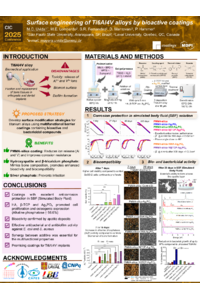
Surface engineering plays a key role in enhancing the performance of next-generation titanium-based implantable medical devices. Incorporating bioactive agents into protective coating offers a promising strategy to tailor surface properties to improve biological responses after implantation. This study aims to develop PMMA–silica coatings containing calcium and silver phosphates in the surface layer, acting simultaneously as an anticorrosion barrier and a bioactive layer. PMMA–silica coatings were synthesized by combining the sol–gel process of tetraethylorthosilicate (TEOS) with the radical polymerization of methyl methacrylate (MMA) and 3-methacryloxypropyl trimethoxysilane (MPTS). Bioactive agents, including hydroxyapatite (HA), β-tricalcium phosphate (β-TCP), and silver phosphate (Ag3PO4), were dispersed in the PMMA–silica solution. The coatings were deposited onto Ti6Al4V substrates by immersion, resulting in uniform layers with thicknesses of up to 17 µm, free of cracks and exhibiting excellent adhesion strength (>14 MPa). The influence of the additives on the structural properties of the nanocomposites was analyzed using infrared spectroscopy, X-ray photoelectron spectroscopy, X-ray diffraction, thermal analysis, and contact angle measurements. Electrochemical impedance spectroscopy conducted in simulated body fluid (SBF, ISO 23317) confirmed the excellent anticorrosion performance of the modified coatings, showing an impedance modulus of up to 70 GΩ cm² after 100 days in SBF, which is four orders of magnitude higher than that of uncoated Ti6Al4V. Additionally, apatite crystal deposits observed after 28 days of immersion in SBF are an indicator of the in vivo bone bioactivity of the coatings. Biological evaluations revealed enhanced proliferation of SaOS-2 osteoblasts after 7 days of culture on coatings containing β-TCP or HA combined with Ag3PO4. These results highlight the potential of modified PMMA–silica coatings as highly promising materials for improving the bioactive and anticorrosive properties of Ti-based implants.
Acknowledgments: This research received financial support from the Brazilian funding agencies CNPq and CAPES.
Keywords
Titanium-based implants
PMMA-silica coatings
bioactive agents
anticorrosion properties
surface engineering
Poster
sciforum 114127.pdf
Novel Composite Films Starting from Black Soldier Fly Protein Extract
Theoretical Assessment of Antimicrobial Properties of Silver Coating for Medical Applications