Event submissions
Published
This submission belongs to the session S1. Morphology and Systematics of the event The 2nd International Electronic Conference on Entomology
Published date
17 May, 2025
Academic Editor
'%3e%3cpath%20d='M12.6657%2010.9104C12.4185%2010.325%2012.0599%209.79327%2011.6097%209.34482C11.1609%208.89508%2010.6293%208.5365%2010.0442%208.28888C10.0389%208.28626%2010.0337%208.28495%2010.0285%208.28233C10.8446%207.69279%2011.3752%206.73249%2011.3752%205.64904C11.3752%203.8542%209.92103%202.39999%208.1262%202.39999C6.33136%202.39999%204.87715%203.8542%204.87715%205.64904C4.87715%206.73249%205.40774%207.69279%206.22393%208.28364C6.21869%208.28626%206.21345%208.28757%206.20821%208.29019C5.62129%208.5378%205.09463%208.89284%204.64265%209.34613C4.1929%209.79493%203.83432%2010.3266%203.58671%2010.9117C3.34345%2011.4845%203.21226%2012.0987%203.20023%2012.7209C3.19988%2012.7349%203.20233%2012.7488%203.20744%2012.7619C3.21255%2012.7749%203.22022%2012.7867%203.22998%2012.7968C3.23975%2012.8068%203.25142%2012.8147%203.26431%2012.8202C3.2772%2012.8256%203.29105%2012.8284%203.30504%2012.8284H4.09109C4.14874%2012.8284%204.19459%2012.7825%204.1959%2012.7262C4.2221%2011.7148%204.62823%2010.7676%205.34617%2010.0497C6.08899%209.30683%207.0755%208.89808%208.1262%208.89808C9.17689%208.89808%2010.1634%209.30683%2010.9062%2010.0497C11.6242%2010.7676%2012.0303%2011.7148%2012.0565%2012.7262C12.0578%2012.7838%2012.1037%2012.8284%2012.1613%2012.8284H12.9474C12.9613%2012.8284%2012.9752%2012.8256%2012.9881%2012.8202C13.001%2012.8147%2013.0126%2012.8068%2013.0224%2012.7968C13.0322%2012.7867%2013.0398%2012.7749%2013.0449%2012.7619C13.0501%2012.7488%2013.0525%2012.7349%2013.0522%2012.7209C13.0391%2012.0947%2012.9094%2011.4855%2012.6657%2010.9104ZM8.1262%207.9024C7.52486%207.9024%206.9589%207.6679%206.53312%207.24211C6.10733%206.81633%205.87283%206.25037%205.87283%205.64904C5.87283%205.0477%206.10733%204.48174%206.53312%204.05596C6.9589%203.63018%207.52486%203.39567%208.1262%203.39567C8.72753%203.39567%209.29349%203.63018%209.71927%204.05596C10.1451%204.48174%2010.3796%205.0477%2010.3796%205.64904C10.3796%206.25037%2010.1451%206.81633%209.71927%207.24211C9.29349%207.6679%208.72753%207.9024%208.1262%207.9024Z'%20fill='%235D1EE1'/%3e%3c/g%3e%3c/svg%3e) Nickolas Kavallieratos
Nickolas KavallieratosCitation
Vukica Dragutin Vujić, Boris Dudić, Luka Lučić, Vladimir Tomić, Sofija Pavković-Lučić, Tatjana Savić, Sexual dimorphism in size and shape of morphological traits in Drosophila simulans (Diptera: Drosophilidae): geometric morphometric approach, in Proceedings of The 2nd International Electronic Conference on Entomology, 19 May–21 May 2025, MDPI: Basel, Switzerland
Share
Email
Facebook
Twitter
LinkedIn
Sexual dimorphism in size and shape of morphological traits in Drosophila simulans (Diptera: Drosophilidae): geometric morphometric approach
'%3e%3cpath%20d='M12.6647%2010.9104C12.4176%2010.325%2012.0589%209.7933%2011.6088%209.34485C11.16%208.89511%2010.6283%208.53653%2010.0432%208.28891C10.038%208.28629%2010.0327%208.28498%2010.0275%208.28236C10.8437%207.69282%2011.3743%206.73252%2011.3743%205.64907C11.3743%203.85423%209.92005%202.40002%208.12522%202.40002C6.33038%202.40002%204.87618%203.85423%204.87618%205.64907C4.87618%206.73252%205.40677%207.69282%206.22296%208.28367C6.21772%208.28629%206.21248%208.2876%206.20724%208.29022C5.62031%208.53783%205.09365%208.89287%204.64167%209.34616C4.19192%209.79496%203.83334%2010.3266%203.58573%2010.9117C3.34247%2011.4846%203.21128%2012.0987%203.19925%2012.721C3.1989%2012.735%203.20135%2012.7489%203.20646%2012.7619C3.21157%2012.7749%203.21924%2012.7868%203.22901%2012.7968C3.23877%2012.8068%203.25045%2012.8148%203.26334%2012.8202C3.27623%2012.8256%203.29007%2012.8284%203.30406%2012.8284H4.09012C4.14776%2012.8284%204.19362%2012.7825%204.19493%2012.7262C4.22113%2011.7148%204.62726%2010.7676%205.34519%2010.0497C6.08802%209.30686%207.07452%208.89811%208.12522%208.89811C9.17592%208.89811%2010.1624%209.30686%2010.9052%2010.0497C11.6232%2010.7676%2012.0293%2011.7148%2012.0555%2012.7262C12.0568%2012.7839%2012.1027%2012.8284%2012.1603%2012.8284H12.9464C12.9604%2012.8284%2012.9742%2012.8256%2012.9871%2012.8202C13%2012.8148%2013.0117%2012.8068%2013.0214%2012.7968C13.0312%2012.7868%2013.0389%2012.7749%2013.044%2012.7619C13.0491%2012.7489%2013.0515%2012.735%2013.0512%2012.721C13.0381%2012.0947%2012.9084%2011.4856%2012.6647%2010.9104ZM8.12522%207.90243C7.52388%207.90243%206.95792%207.66793%206.53214%207.24215C6.10636%206.81636%205.87185%206.2504%205.87185%205.64907C5.87185%205.04773%206.10636%204.48177%206.53214%204.05599C6.95792%203.63021%207.52388%203.3957%208.12522%203.3957C8.72655%203.3957%209.29252%203.63021%209.7183%204.05599C10.1441%204.48177%2010.3786%205.04773%2010.3786%205.64907C10.3786%206.2504%2010.1441%206.81636%209.7183%207.24215C9.29252%207.66793%208.72655%207.90243%208.12522%207.90243Z'%20fill='%235D1EE1'/%3e%3c/g%3e%3c/svg%3e)
Vukica Dragutin Vujić 1
Boris Dudić 2
Luka Lučić 2
Vladimir Tomić 2
Sofija Pavković-Lučić 1
Tatjana Savić 3
1. Department of Genetics and Evolution, Faculty of Biology, University of Belgrade, 11 000 Belgrade, Serbia
2. Department of Animal Development, Faculty of Biology, University of Belgrade, 11 000 Belgrade, Serbia
3. Department of Genetics of Populations and Ecogenotoxicology, Institute for Biological Research "Siniša Stanković", University of Belgrade, 11 000 Belgrade, Serbia
Abstract
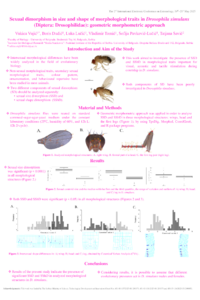
Sexual dimorphism (SD) in different morphological traits (both non-sexual and secondary sexual traits), colour pattern, ornamentation, and behavioral repertoire has been analyzed in different animal species. It can be defined more precisely when its two different components, sexual size dimorphism (SSD) and sexual shape dimorphism (SShD), are analyzed separately. In spite of the fact that SSD and SShD are equally relevant components of sexual dimorphism, SShD has not been the subject of a large number of zoological studies. Both SSD and SShD in some morphological traits have been poorly analyzed in Drosophila simulans. Therefore, the aim of the present study was to investigate the presence of SSD and SShD in three morphological structures (the head, the wing, and the leg) in D. simulans. To analyze SSD and SShD in the abovementioned morphological traits, the geometric morphometric approach was applied. D. simulans flies were reared on a standard cornmeal–agar–yeast medium under constant laboratory conditions (25⁰C, humidity of 60%, and 12h L: 12h D cycle). Fifty individuals per sex were analyzed. TpsDig software was used to digitize different landmark points placed on the morphological structure: 12 landmarks were placed on the head, 15 landmarks were placed on each wing, and 28 landmarks were placed on each leg. The SShD of the aforementioned morphological structures was analyzed using Canonical Variate Analysis in MorphoJ program, whereas their SSD was evaluated using the CoordGen6 program. All statistical analyses of CS variation were conducted using the R program. Sexual shape dimorphism was significant in all morphological structures: the head (p < 0.0001), the wing (p < 0.0001), and the leg (p = 0.0027). Also, sexual size dimorphism was expressed and significant for all investigated structures (p < 0.0001). The significant sexual size and shape differences in all the analyzed morphological structures indicate that different evolutionary pressures are present in D. simulans males and females.
Keywords
Drosophila simulans
morphological traits
sexual size dimorphism (SSD)
sexual shape dimorphism (SShD)
geometric morphometrics
Poster
Vujic et al 1F.pdf
The Evolutionary Dynamics of Lysozyme-like Genes Across the Insecta Class
New data on Eurylomata picturata Blanchard (Hemiptera: Heteroptera)