Event submissions
Published
This submission belongs to the session S5. Pest Management, Pesticide Resistance, and Toxicology of the event The 2nd International Electronic Conference on Entomology
Published date
17 May, 2025
Academic Editor
'%3e%3cpath%20d='M12.6657%2010.9104C12.4185%2010.325%2012.0599%209.79327%2011.6097%209.34482C11.1609%208.89508%2010.6293%208.5365%2010.0442%208.28888C10.0389%208.28626%2010.0337%208.28495%2010.0285%208.28233C10.8446%207.69279%2011.3752%206.73249%2011.3752%205.64904C11.3752%203.8542%209.92103%202.39999%208.1262%202.39999C6.33136%202.39999%204.87715%203.8542%204.87715%205.64904C4.87715%206.73249%205.40774%207.69279%206.22393%208.28364C6.21869%208.28626%206.21345%208.28757%206.20821%208.29019C5.62129%208.5378%205.09463%208.89284%204.64265%209.34613C4.1929%209.79493%203.83432%2010.3266%203.58671%2010.9117C3.34345%2011.4845%203.21226%2012.0987%203.20023%2012.7209C3.19988%2012.7349%203.20233%2012.7488%203.20744%2012.7619C3.21255%2012.7749%203.22022%2012.7867%203.22998%2012.7968C3.23975%2012.8068%203.25142%2012.8147%203.26431%2012.8202C3.2772%2012.8256%203.29105%2012.8284%203.30504%2012.8284H4.09109C4.14874%2012.8284%204.19459%2012.7825%204.1959%2012.7262C4.2221%2011.7148%204.62823%2010.7676%205.34617%2010.0497C6.08899%209.30683%207.0755%208.89808%208.1262%208.89808C9.17689%208.89808%2010.1634%209.30683%2010.9062%2010.0497C11.6242%2010.7676%2012.0303%2011.7148%2012.0565%2012.7262C12.0578%2012.7838%2012.1037%2012.8284%2012.1613%2012.8284H12.9474C12.9613%2012.8284%2012.9752%2012.8256%2012.9881%2012.8202C13.001%2012.8147%2013.0126%2012.8068%2013.0224%2012.7968C13.0322%2012.7867%2013.0398%2012.7749%2013.0449%2012.7619C13.0501%2012.7488%2013.0525%2012.7349%2013.0522%2012.7209C13.0391%2012.0947%2012.9094%2011.4855%2012.6657%2010.9104ZM8.1262%207.9024C7.52486%207.9024%206.9589%207.6679%206.53312%207.24211C6.10733%206.81633%205.87283%206.25037%205.87283%205.64904C5.87283%205.0477%206.10733%204.48174%206.53312%204.05596C6.9589%203.63018%207.52486%203.39567%208.1262%203.39567C8.72753%203.39567%209.29349%203.63018%209.71927%204.05596C10.1451%204.48174%2010.3796%205.0477%2010.3796%205.64904C10.3796%206.25037%2010.1451%206.81633%209.71927%207.24211C9.29349%207.6679%208.72753%207.9024%208.1262%207.9024Z'%20fill='%235D1EE1'/%3e%3c/g%3e%3c/svg%3e) Louis Hesler
Louis HeslerCitation
Nnennaya Iheanyi Obasi, Kehinde O. K. Popoola, Adedapo O. Adeogun, Tolulope A. Oyeniyi, Pyrethroid Resistance in Anopheles gambiae s.l. from Oyo State, Nigeria: Mechanisms and Implications for Malaria Control, in Proceedings of The 2nd International Electronic Conference on Entomology, 19 May–21 May 2025, MDPI: Basel, Switzerland
Share
Email
Facebook
Twitter
LinkedIn
Pyrethroid Resistance in Anopheles gambiae s.l. from Oyo State, Nigeria: Mechanisms and Implications for Malaria Control
'%3e%3cpath%20d='M12.6647%2010.9104C12.4176%2010.325%2012.0589%209.7933%2011.6088%209.34485C11.16%208.89511%2010.6283%208.53653%2010.0432%208.28891C10.038%208.28629%2010.0327%208.28498%2010.0275%208.28236C10.8437%207.69282%2011.3743%206.73252%2011.3743%205.64907C11.3743%203.85423%209.92005%202.40002%208.12522%202.40002C6.33038%202.40002%204.87618%203.85423%204.87618%205.64907C4.87618%206.73252%205.40677%207.69282%206.22296%208.28367C6.21772%208.28629%206.21248%208.2876%206.20724%208.29022C5.62031%208.53783%205.09365%208.89287%204.64167%209.34616C4.19192%209.79496%203.83334%2010.3266%203.58573%2010.9117C3.34247%2011.4846%203.21128%2012.0987%203.19925%2012.721C3.1989%2012.735%203.20135%2012.7489%203.20646%2012.7619C3.21157%2012.7749%203.21924%2012.7868%203.22901%2012.7968C3.23877%2012.8068%203.25045%2012.8148%203.26334%2012.8202C3.27623%2012.8256%203.29007%2012.8284%203.30406%2012.8284H4.09012C4.14776%2012.8284%204.19362%2012.7825%204.19493%2012.7262C4.22113%2011.7148%204.62726%2010.7676%205.34519%2010.0497C6.08802%209.30686%207.07452%208.89811%208.12522%208.89811C9.17592%208.89811%2010.1624%209.30686%2010.9052%2010.0497C11.6232%2010.7676%2012.0293%2011.7148%2012.0555%2012.7262C12.0568%2012.7839%2012.1027%2012.8284%2012.1603%2012.8284H12.9464C12.9604%2012.8284%2012.9742%2012.8256%2012.9871%2012.8202C13%2012.8148%2013.0117%2012.8068%2013.0214%2012.7968C13.0312%2012.7868%2013.0389%2012.7749%2013.044%2012.7619C13.0491%2012.7489%2013.0515%2012.735%2013.0512%2012.721C13.0381%2012.0947%2012.9084%2011.4856%2012.6647%2010.9104ZM8.12522%207.90243C7.52388%207.90243%206.95792%207.66793%206.53214%207.24215C6.10636%206.81636%205.87185%206.2504%205.87185%205.64907C5.87185%205.04773%206.10636%204.48177%206.53214%204.05599C6.95792%203.63021%207.52388%203.3957%208.12522%203.3957C8.72655%203.3957%209.29252%203.63021%209.7183%204.05599C10.1441%204.48177%2010.3786%205.04773%2010.3786%205.64907C10.3786%206.2504%2010.1441%206.81636%209.7183%207.24215C9.29252%207.66793%208.72655%207.90243%208.12522%207.90243Z'%20fill='%235D1EE1'/%3e%3c/g%3e%3c/svg%3e)
Nnennaya Iheanyi Obasi 1
Kehinde O. K. Popoola 1
Adedapo O. Adeogun 2
Tolulope A. Oyeniyi 3
1. Entomology Unit Department of Zoology University of Ibadan Oyo State Nigeria
2. Molecular Entomology and Vector Control Unit of Nigerian Institute of Medical Research (NIMR), Yaba Lagos State Nigeria
3. Molecular Entomology and Vector Control Unit of Nigerian Institute of Medical Research (NIMR), Yaba Lagos State
Abstract
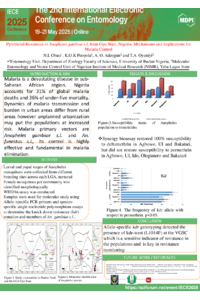
Background: Insecticide resistance among malaria vectors threatens control strategies that are reliant on insecticidal interventions. This study assessed pyrethroid resistance in Anopheles gambiae s.l. populations across Ibadan North (IBN) and Ido LGAs, Oyo State, Nigeria, to elucidate resistance mechanisms and their implications for vector control.
Methods: Larvae and pupae from both LGAs were collected using the dipping method and reared to adulthood in the University of Ibadan Insectary. Molecular identification of An. gambiae complex members was conducted. Three- to five-day-old adult females (n=25/insecticide) were exposed to permethrin, deltamethrin, bendiocarb, and pirimiphos-methyl using WHO susceptibility tests. Synergist assays with Piperonyl Butoxide (PBO) were used to assess the metabolic resistance. kdr (L1014F/S) mutations were detected via allele-specific PCR (TaqMan) at the Nigerian Institute of Medical Research (NIMR), Lagos. Data were analyzed using descriptive statistics and ANOVA (α=0.05).
Results: An. coluzzii predominated in IBN (96.0%) compared with Ido (78.7%), while An. gambiae s.s. was higher in Ido (21.3%) than in IBN (3.3%). An. arabiensis was only recorded in IBN (0.7%). While bendiocarb and pirimiphos-methyl susceptibility was high (98.0 - 100.0%), pyrethroid resistance was widespread (25.0 - 95.0%). PBO restored deltamethrin susceptibility in IBN and one Ido community, suggesting cytochrome P450-mediated metabolic resistance. However, permethrin resistance persisted post-synergist exposure, indicating voltage-gated sodium channel mutations. Only kdr-w (L1014F) was detected, with the allelic frequencies nearing fixation (0.61 in Ido; 01 in IBN).
Conclusion: This study confirms significant pyrethroid resistance in An. gambiae s.l., driven by kdr-w (L1014F) mutations and metabolic resistance. Our findings highlight the urgent need for molecular surveillance and alternative vector control strategies to sustain malaria prevention efforts.
Keywords
Keywords: Insecticide resistance
Anopheles gambiae
kdr mutation
metabolic resistance
malaria control.
Poster
sciforum-118305_nnennaya.pdf
Study on the polytene chromosomes of Chironomus spp. (Diptera: Chironomidae) in the wetlands of the Savar region, Dhaka district, Bangladesh
FAMILY-SPECIFIC COX1 PRIMERS FOR IDENTIFYING APHIDS FROM DEGRADED SAMPLES