Event submissions
Published
This submission belongs to the session S7. Social Insects of the event The 2nd International Electronic Conference on Entomology
Published date
17 May, 2025
Academic Editor
'%3e%3cpath%20d='M12.6657%2010.9104C12.4185%2010.325%2012.0599%209.79327%2011.6097%209.34482C11.1609%208.89508%2010.6293%208.5365%2010.0442%208.28888C10.0389%208.28626%2010.0337%208.28495%2010.0285%208.28233C10.8446%207.69279%2011.3752%206.73249%2011.3752%205.64904C11.3752%203.8542%209.92103%202.39999%208.1262%202.39999C6.33136%202.39999%204.87715%203.8542%204.87715%205.64904C4.87715%206.73249%205.40774%207.69279%206.22393%208.28364C6.21869%208.28626%206.21345%208.28757%206.20821%208.29019C5.62129%208.5378%205.09463%208.89284%204.64265%209.34613C4.1929%209.79493%203.83432%2010.3266%203.58671%2010.9117C3.34345%2011.4845%203.21226%2012.0987%203.20023%2012.7209C3.19988%2012.7349%203.20233%2012.7488%203.20744%2012.7619C3.21255%2012.7749%203.22022%2012.7867%203.22998%2012.7968C3.23975%2012.8068%203.25142%2012.8147%203.26431%2012.8202C3.2772%2012.8256%203.29105%2012.8284%203.30504%2012.8284H4.09109C4.14874%2012.8284%204.19459%2012.7825%204.1959%2012.7262C4.2221%2011.7148%204.62823%2010.7676%205.34617%2010.0497C6.08899%209.30683%207.0755%208.89808%208.1262%208.89808C9.17689%208.89808%2010.1634%209.30683%2010.9062%2010.0497C11.6242%2010.7676%2012.0303%2011.7148%2012.0565%2012.7262C12.0578%2012.7838%2012.1037%2012.8284%2012.1613%2012.8284H12.9474C12.9613%2012.8284%2012.9752%2012.8256%2012.9881%2012.8202C13.001%2012.8147%2013.0126%2012.8068%2013.0224%2012.7968C13.0322%2012.7867%2013.0398%2012.7749%2013.0449%2012.7619C13.0501%2012.7488%2013.0525%2012.7349%2013.0522%2012.7209C13.0391%2012.0947%2012.9094%2011.4855%2012.6657%2010.9104ZM8.1262%207.9024C7.52486%207.9024%206.9589%207.6679%206.53312%207.24211C6.10733%206.81633%205.87283%206.25037%205.87283%205.64904C5.87283%205.0477%206.10733%204.48174%206.53312%204.05596C6.9589%203.63018%207.52486%203.39567%208.1262%203.39567C8.72753%203.39567%209.29349%203.63018%209.71927%204.05596C10.1451%204.48174%2010.3796%205.0477%2010.3796%205.64904C10.3796%206.25037%2010.1451%206.81633%209.71927%207.24211C9.29349%207.6679%208.72753%207.9024%208.1262%207.9024Z'%20fill='%235D1EE1'/%3e%3c/g%3e%3c/svg%3e) Ljubiša Stanisavljević
Ljubiša StanisavljevićCitation
Sabrina de Leo, Laura Zulian, Fulvio Bordin, Giovanni Federico, Paolo Zucca, Charles Spiteri, Franco Mutinelli, Anna Granato, Bee pathogens in Apis florea samples accidentally introduced into Malta and Italy, in Proceedings of The 2nd International Electronic Conference on Entomology, 19 May–21 May 2025, MDPI: Basel, Switzerland
Share
Email
Facebook
Twitter
LinkedIn
Bee pathogens in Apis florea samples accidentally introduced into Malta and Italy
'%3e%3cpath%20d='M12.6647%2010.9104C12.4176%2010.325%2012.0589%209.7933%2011.6088%209.34485C11.16%208.89511%2010.6283%208.53653%2010.0432%208.28891C10.038%208.28629%2010.0327%208.28498%2010.0275%208.28236C10.8437%207.69282%2011.3743%206.73252%2011.3743%205.64907C11.3743%203.85423%209.92005%202.40002%208.12522%202.40002C6.33038%202.40002%204.87618%203.85423%204.87618%205.64907C4.87618%206.73252%205.40677%207.69282%206.22296%208.28367C6.21772%208.28629%206.21248%208.2876%206.20724%208.29022C5.62031%208.53783%205.09365%208.89287%204.64167%209.34616C4.19192%209.79496%203.83334%2010.3266%203.58573%2010.9117C3.34247%2011.4846%203.21128%2012.0987%203.19925%2012.721C3.1989%2012.735%203.20135%2012.7489%203.20646%2012.7619C3.21157%2012.7749%203.21924%2012.7868%203.22901%2012.7968C3.23877%2012.8068%203.25045%2012.8148%203.26334%2012.8202C3.27623%2012.8256%203.29007%2012.8284%203.30406%2012.8284H4.09012C4.14776%2012.8284%204.19362%2012.7825%204.19493%2012.7262C4.22113%2011.7148%204.62726%2010.7676%205.34519%2010.0497C6.08802%209.30686%207.07452%208.89811%208.12522%208.89811C9.17592%208.89811%2010.1624%209.30686%2010.9052%2010.0497C11.6232%2010.7676%2012.0293%2011.7148%2012.0555%2012.7262C12.0568%2012.7839%2012.1027%2012.8284%2012.1603%2012.8284H12.9464C12.9604%2012.8284%2012.9742%2012.8256%2012.9871%2012.8202C13%2012.8148%2013.0117%2012.8068%2013.0214%2012.7968C13.0312%2012.7868%2013.0389%2012.7749%2013.044%2012.7619C13.0491%2012.7489%2013.0515%2012.735%2013.0512%2012.721C13.0381%2012.0947%2012.9084%2011.4856%2012.6647%2010.9104ZM8.12522%207.90243C7.52388%207.90243%206.95792%207.66793%206.53214%207.24215C6.10636%206.81636%205.87185%206.2504%205.87185%205.64907C5.87185%205.04773%206.10636%204.48177%206.53214%204.05599C6.95792%203.63021%207.52388%203.3957%208.12522%203.3957C8.72655%203.3957%209.29252%203.63021%209.7183%204.05599C10.1441%204.48177%2010.3786%205.04773%2010.3786%205.64907C10.3786%206.2504%2010.1441%206.81636%209.7183%207.24215C9.29252%207.66793%208.72655%207.90243%208.12522%207.90243Z'%20fill='%235D1EE1'/%3e%3c/g%3e%3c/svg%3e)
Sabrina de Leo 1
Laura Zulian 1
Fulvio Bordin 1
Giovanni Federico 2

Paolo Zucca 3
Charles Spiteri 4

Franco Mutinelli 1
Anna Granato 1
1. National Reference Laboratory for Honey bee Health, Istituto Zooprofilattico Sperimentale delle Venezie, Viale dell’Università 10, 35020 Legnaro (Padova), Italy
2. Istituto Zooprofilattico Sperimentale del Mezzogiorno, Località Catona, Via Figurella, snc 89135 Reggio di Calabria, Italy
3. Central Directorate for Health, Social Policies and Disabilities, Friuli Venezia Giulia Region, Trieste, Italy
4. Animal Health and Welfare Department, Ministry for Agriculture, Fisheries and Animal Rights, Abattoir Street, Albert Town, Marsa, Malta
Abstract
Introduction
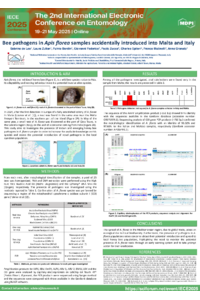
Apis florea, the red dwarf honey bee, is a wild bee species native to Asia. Its adaptability and nesting behaviour make it a potential alien invasive species, raising concerns about its competition with Apis mellifera and the introduction of novel pathogens. This study investigates the presence of known and emerging honey bee pathogens in A. florea to increase the available knowledge on this species.
Methods
In 2024, after the first detection in Europe of a fully established colony of A. florea in Malta, a small nest was found in the same area, near the Malta Freeport Terminals, a very busy cargo and transhipment port in the southern part of the island. In May of the same year, in Italy (port of Gioia Tauro, Calabria region), a small nest of A. florea was discovered on the wall of a container coming from India. Specimens of A. florea, collected from both locations before the destruction of the nests, were analysed for species identification by the sequencing of a cytochrome c oxidase subunit I (COI) region of mitochondrial DNA, and for the presence of possible honey bee pathogens (fungi, viruses and trypasonomatids).
Results
The sequencing of the COI region confirmed the species A. florea in both samples and only bee viruses were detected. Whereas viral co-infections (DWV, ABPV, SBV, BQCV and AmFV) were present in samples from Malta, only SBV was found in A. florea from Italy.
Conclusion
The spread of A. florea in the Mediterranean region due to global trade poses an ecological risk to local biodiversity. Furthermore, the presence of pathogens in the A. florea populations raises concerns about their potential spread to local honey bee populations, highlighting the need to monitor the potential presence of A. florea nests through an early warning system and to take prompt action for their eradication.
Keywords
Apis florea
alien species
bee pathogens
Poster
Poster IECE 2025_finale.pdf
From Urban to Mountainous Regions: Impact of Various Factors on Butterfly Species Richness, their Prediction, and Habitat Shifts Induced by Climate Change in Jinan, China
Ticks and Tick-Borne Microorganisms in the United Arab Emirates: Diversity, Abundance, and Research Gaps