Event submissions
Published
This submission belongs to the session S4. Biodiversity, Climate Change, Conservation, Ecology, and Evolution of the event The 2nd International Electronic Conference on Entomology
Published date
17 May, 2025
Academic Editor
'%3e%3cpath%20d='M12.6657%2010.9104C12.4185%2010.325%2012.0599%209.79327%2011.6097%209.34482C11.1609%208.89508%2010.6293%208.5365%2010.0442%208.28888C10.0389%208.28626%2010.0337%208.28495%2010.0285%208.28233C10.8446%207.69279%2011.3752%206.73249%2011.3752%205.64904C11.3752%203.8542%209.92103%202.39999%208.1262%202.39999C6.33136%202.39999%204.87715%203.8542%204.87715%205.64904C4.87715%206.73249%205.40774%207.69279%206.22393%208.28364C6.21869%208.28626%206.21345%208.28757%206.20821%208.29019C5.62129%208.5378%205.09463%208.89284%204.64265%209.34613C4.1929%209.79493%203.83432%2010.3266%203.58671%2010.9117C3.34345%2011.4845%203.21226%2012.0987%203.20023%2012.7209C3.19988%2012.7349%203.20233%2012.7488%203.20744%2012.7619C3.21255%2012.7749%203.22022%2012.7867%203.22998%2012.7968C3.23975%2012.8068%203.25142%2012.8147%203.26431%2012.8202C3.2772%2012.8256%203.29105%2012.8284%203.30504%2012.8284H4.09109C4.14874%2012.8284%204.19459%2012.7825%204.1959%2012.7262C4.2221%2011.7148%204.62823%2010.7676%205.34617%2010.0497C6.08899%209.30683%207.0755%208.89808%208.1262%208.89808C9.17689%208.89808%2010.1634%209.30683%2010.9062%2010.0497C11.6242%2010.7676%2012.0303%2011.7148%2012.0565%2012.7262C12.0578%2012.7838%2012.1037%2012.8284%2012.1613%2012.8284H12.9474C12.9613%2012.8284%2012.9752%2012.8256%2012.9881%2012.8202C13.001%2012.8147%2013.0126%2012.8068%2013.0224%2012.7968C13.0322%2012.7867%2013.0398%2012.7749%2013.0449%2012.7619C13.0501%2012.7488%2013.0525%2012.7349%2013.0522%2012.7209C13.0391%2012.0947%2012.9094%2011.4855%2012.6657%2010.9104ZM8.1262%207.9024C7.52486%207.9024%206.9589%207.6679%206.53312%207.24211C6.10733%206.81633%205.87283%206.25037%205.87283%205.64904C5.87283%205.0477%206.10733%204.48174%206.53312%204.05596C6.9589%203.63018%207.52486%203.39567%208.1262%203.39567C8.72753%203.39567%209.29349%203.63018%209.71927%204.05596C10.1451%204.48174%2010.3796%205.0477%2010.3796%205.64904C10.3796%206.25037%2010.1451%206.81633%209.71927%207.24211C9.29349%207.6679%208.72753%207.9024%208.1262%207.9024Z'%20fill='%235D1EE1'/%3e%3c/g%3e%3c/svg%3e) António Soares
António SoaresCitation
F. Javier Peris-Felipo, David López-Peña, José Vicente Falcó-Garí, Mantids and associated Chalcidoidea parasitoids in natural areas from Eastern Spain, in Proceedings of The 2nd International Electronic Conference on Entomology, 19 May–21 May 2025, MDPI: Basel, Switzerland
Share
Email
Facebook
Twitter
LinkedIn
Mantids and associated Chalcidoidea parasitoids in natural areas from Eastern Spain
'%3e%3cpath%20d='M12.6647%2010.9104C12.4176%2010.325%2012.0589%209.7933%2011.6088%209.34485C11.16%208.89511%2010.6283%208.53653%2010.0432%208.28891C10.038%208.28629%2010.0327%208.28498%2010.0275%208.28236C10.8437%207.69282%2011.3743%206.73252%2011.3743%205.64907C11.3743%203.85423%209.92005%202.40002%208.12522%202.40002C6.33038%202.40002%204.87618%203.85423%204.87618%205.64907C4.87618%206.73252%205.40677%207.69282%206.22296%208.28367C6.21772%208.28629%206.21248%208.2876%206.20724%208.29022C5.62031%208.53783%205.09365%208.89287%204.64167%209.34616C4.19192%209.79496%203.83334%2010.3266%203.58573%2010.9117C3.34247%2011.4846%203.21128%2012.0987%203.19925%2012.721C3.1989%2012.735%203.20135%2012.7489%203.20646%2012.7619C3.21157%2012.7749%203.21924%2012.7868%203.22901%2012.7968C3.23877%2012.8068%203.25045%2012.8148%203.26334%2012.8202C3.27623%2012.8256%203.29007%2012.8284%203.30406%2012.8284H4.09012C4.14776%2012.8284%204.19362%2012.7825%204.19493%2012.7262C4.22113%2011.7148%204.62726%2010.7676%205.34519%2010.0497C6.08802%209.30686%207.07452%208.89811%208.12522%208.89811C9.17592%208.89811%2010.1624%209.30686%2010.9052%2010.0497C11.6232%2010.7676%2012.0293%2011.7148%2012.0555%2012.7262C12.0568%2012.7839%2012.1027%2012.8284%2012.1603%2012.8284H12.9464C12.9604%2012.8284%2012.9742%2012.8256%2012.9871%2012.8202C13%2012.8148%2013.0117%2012.8068%2013.0214%2012.7968C13.0312%2012.7868%2013.0389%2012.7749%2013.044%2012.7619C13.0491%2012.7489%2013.0515%2012.735%2013.0512%2012.721C13.0381%2012.0947%2012.9084%2011.4856%2012.6647%2010.9104ZM8.12522%207.90243C7.52388%207.90243%206.95792%207.66793%206.53214%207.24215C6.10636%206.81636%205.87185%206.2504%205.87185%205.64907C5.87185%205.04773%206.10636%204.48177%206.53214%204.05599C6.95792%203.63021%207.52388%203.3957%208.12522%203.3957C8.72655%203.3957%209.29252%203.63021%209.7183%204.05599C10.1441%204.48177%2010.3786%205.04773%2010.3786%205.64907C10.3786%206.2504%2010.1441%206.81636%209.7183%207.24215C9.29252%207.66793%208.72655%207.90243%208.12522%207.90243Z'%20fill='%235D1EE1'/%3e%3c/g%3e%3c/svg%3e)
F. Javier Peris-Felipo 1
David López-Peña 2
José Vicente Falcó-Garí 3
1. Syngenta Crop Protection, Basel
2. Laboratory of Entomology and Pest Control, Cavanilles Institute of Biodiversity and Evolutionary Biology (ICBiBE), University of Valencia (Spain).
3. Laboratory of Entomology and Pest Control, Cavanilles Institute of Biodiversity and Evolutionary Biology. University of Valencia.
Abstract
Mantids (Mantodea) are generalist predatory insects in their nymph and adult stages. The female lays her eggs into an ootheca, which is made of structural proteins and tanning agents, in order to create a protective egg case. Some families of hymenoptera belonging to Chalcidoidea are known as mantid ootheca parasitoids. The vast majority of Torymidae are entomophagous species attacking Coleoptera, Lepidoptera, and the gall-formers Diptera and Hymenoptera, but the whole tribe Podagrionini is strictly associated with mantid oothecae, and a few species from Microdontomerini also attack mantid egg cases. Eupelmidae are mainly parasitoids of Coleoptera, Diptera, Hemiptera, Hymenoptera, Lepidoptera, and Neuroptera, but some species from the subfamily Eupelminae have a range of hosts, including spider sac eggs, Orthoptera egg pods, and the oothecae of Blattodea and Mantodea. The aim of this study is to provide information about the Torymidae and Eupelmidae wasps that act as parasitoids of the mantid species found in several natural parks of the province of Valencia in Eastern Spain. Several mantid oothecae were collected on garrigue vegetation, glued to bushes, in several periods between 2016 and 2024. The oothecae were stored in boxes at room temperature until the emergence of mantid nymphs and parasitoid wasps. Nymphs were returned to their territories. The egg cases belonged to the mantid species Iris oratoria (L., 1758), Mantis religiosa (L., 1758), and Sphodromantis viridis (Forskal, 1775). The parasitoids were species of the torymid genera Podagrion Spinola and Podagrionella Girault and the eupelmid genus Anastatus Motschulsky. Podagrion bouceki Delvare, 2005 was reared from S. viridis, with this being a new parasitoid–host relationship discovered in Spain, while Anastatus maculosus Askew, 2004 was recorded for the first time, emerging from the egg case of I. oratoria. The mantid–parasitoid relationships were indicated.
Keywords
Mantodea
Torymidae
Eupelmidae
ootheca parasitoids
Spain
Poster
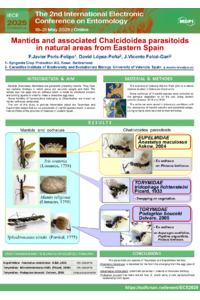
sciforum_118429_Mantids_and_associated_Chalcidoidea.pdf
Ticks and Tick-Borne Microorganisms in the United Arab Emirates: Diversity, Abundance, and Research Gaps
Contribution to the Study of Hygienic Behavior and honey production of the Honeybee Apis mellifera intermissa in a mountainous region of Algeria