Event submissions
Published
This submission belongs to the session S2. Biochemistry, Biotechnology, Genetics, and Genomics of the event The 2nd International Electronic Conference on Entomology
Published date
17 May, 2025
Academic Editor
'%3e%3cpath%20d='M12.6657%2010.9104C12.4185%2010.325%2012.0599%209.79327%2011.6097%209.34482C11.1609%208.89508%2010.6293%208.5365%2010.0442%208.28888C10.0389%208.28626%2010.0337%208.28495%2010.0285%208.28233C10.8446%207.69279%2011.3752%206.73249%2011.3752%205.64904C11.3752%203.8542%209.92103%202.39999%208.1262%202.39999C6.33136%202.39999%204.87715%203.8542%204.87715%205.64904C4.87715%206.73249%205.40774%207.69279%206.22393%208.28364C6.21869%208.28626%206.21345%208.28757%206.20821%208.29019C5.62129%208.5378%205.09463%208.89284%204.64265%209.34613C4.1929%209.79493%203.83432%2010.3266%203.58671%2010.9117C3.34345%2011.4845%203.21226%2012.0987%203.20023%2012.7209C3.19988%2012.7349%203.20233%2012.7488%203.20744%2012.7619C3.21255%2012.7749%203.22022%2012.7867%203.22998%2012.7968C3.23975%2012.8068%203.25142%2012.8147%203.26431%2012.8202C3.2772%2012.8256%203.29105%2012.8284%203.30504%2012.8284H4.09109C4.14874%2012.8284%204.19459%2012.7825%204.1959%2012.7262C4.2221%2011.7148%204.62823%2010.7676%205.34617%2010.0497C6.08899%209.30683%207.0755%208.89808%208.1262%208.89808C9.17689%208.89808%2010.1634%209.30683%2010.9062%2010.0497C11.6242%2010.7676%2012.0303%2011.7148%2012.0565%2012.7262C12.0578%2012.7838%2012.1037%2012.8284%2012.1613%2012.8284H12.9474C12.9613%2012.8284%2012.9752%2012.8256%2012.9881%2012.8202C13.001%2012.8147%2013.0126%2012.8068%2013.0224%2012.7968C13.0322%2012.7867%2013.0398%2012.7749%2013.0449%2012.7619C13.0501%2012.7488%2013.0525%2012.7349%2013.0522%2012.7209C13.0391%2012.0947%2012.9094%2011.4855%2012.6657%2010.9104ZM8.1262%207.9024C7.52486%207.9024%206.9589%207.6679%206.53312%207.24211C6.10733%206.81633%205.87283%206.25037%205.87283%205.64904C5.87283%205.0477%206.10733%204.48174%206.53312%204.05596C6.9589%203.63018%207.52486%203.39567%208.1262%203.39567C8.72753%203.39567%209.29349%203.63018%209.71927%204.05596C10.1451%204.48174%2010.3796%205.0477%2010.3796%205.64904C10.3796%206.25037%2010.1451%206.81633%209.71927%207.24211C9.29349%207.6679%208.72753%207.9024%208.1262%207.9024Z'%20fill='%235D1EE1'/%3e%3c/g%3e%3c/svg%3e) Nickolas Kavallieratos
Nickolas KavallieratosCitation
Farzana Yesmin, Md Nazim Uddin, David Haymer, Tahera Hossain, Md. Hasanuzzaman, Telomeres in the polytene genome of Bactrocera zonata and Zeugodacus tau (Diptera: Tephritidae) detected by the C-banding technique, in Proceedings of The 2nd International Electronic Conference on Entomology, 19 May–21 May 2025, MDPI: Basel, Switzerland
Share
Email
Facebook
Twitter
LinkedIn
Telomeres in the polytene genome of Bactrocera zonata and Zeugodacus tau (Diptera: Tephritidae) detected by the C-banding technique
'%3e%3cpath%20d='M12.6647%2010.9104C12.4176%2010.325%2012.0589%209.7933%2011.6088%209.34485C11.16%208.89511%2010.6283%208.53653%2010.0432%208.28891C10.038%208.28629%2010.0327%208.28498%2010.0275%208.28236C10.8437%207.69282%2011.3743%206.73252%2011.3743%205.64907C11.3743%203.85423%209.92005%202.40002%208.12522%202.40002C6.33038%202.40002%204.87618%203.85423%204.87618%205.64907C4.87618%206.73252%205.40677%207.69282%206.22296%208.28367C6.21772%208.28629%206.21248%208.2876%206.20724%208.29022C5.62031%208.53783%205.09365%208.89287%204.64167%209.34616C4.19192%209.79496%203.83334%2010.3266%203.58573%2010.9117C3.34247%2011.4846%203.21128%2012.0987%203.19925%2012.721C3.1989%2012.735%203.20135%2012.7489%203.20646%2012.7619C3.21157%2012.7749%203.21924%2012.7868%203.22901%2012.7968C3.23877%2012.8068%203.25045%2012.8148%203.26334%2012.8202C3.27623%2012.8256%203.29007%2012.8284%203.30406%2012.8284H4.09012C4.14776%2012.8284%204.19362%2012.7825%204.19493%2012.7262C4.22113%2011.7148%204.62726%2010.7676%205.34519%2010.0497C6.08802%209.30686%207.07452%208.89811%208.12522%208.89811C9.17592%208.89811%2010.1624%209.30686%2010.9052%2010.0497C11.6232%2010.7676%2012.0293%2011.7148%2012.0555%2012.7262C12.0568%2012.7839%2012.1027%2012.8284%2012.1603%2012.8284H12.9464C12.9604%2012.8284%2012.9742%2012.8256%2012.9871%2012.8202C13%2012.8148%2013.0117%2012.8068%2013.0214%2012.7968C13.0312%2012.7868%2013.0389%2012.7749%2013.044%2012.7619C13.0491%2012.7489%2013.0515%2012.735%2013.0512%2012.721C13.0381%2012.0947%2012.9084%2011.4856%2012.6647%2010.9104ZM8.12522%207.90243C7.52388%207.90243%206.95792%207.66793%206.53214%207.24215C6.10636%206.81636%205.87185%206.2504%205.87185%205.64907C5.87185%205.04773%206.10636%204.48177%206.53214%204.05599C6.95792%203.63021%207.52388%203.3957%208.12522%203.3957C8.72655%203.3957%209.29252%203.63021%209.7183%204.05599C10.1441%204.48177%2010.3786%205.04773%2010.3786%205.64907C10.3786%206.2504%2010.1441%206.81636%209.7183%207.24215C9.29252%207.66793%208.72655%207.90243%208.12522%207.90243Z'%20fill='%235D1EE1'/%3e%3c/g%3e%3c/svg%3e)
Farzana Yesmin 1
Md Nazim Uddin 1,2

David Haymer 3
Tahera Hossain 1
Md. Hasanuzzaman 1
1. Cytology and Biocontrol Research (CBR), Radiation Entomology and Acarology Division (READ), Institute of Food and Radiation Biology (IFRB), Bangladesh Atomic Energy Commission (BAEC), GPO Box 3787, Dhaka 1000, Bangladesh.
2. Department of Zoology, Darshana Govt. College, Chuadanga, Bangladesh
3. Department of Cell and Molecular Biology, University of Hawaii, Honolulu HI, USA
Abstract
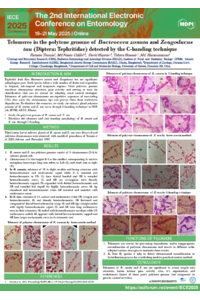
Telomeres are repetitive sequences of non-coding DNA found at the ends of eukaryotic chromosomes. Here, telomere banding patterns were detected in the salivary gland polytene chromosomes of Bactrocera zonata and Zeugodacus tau by C-banding technique. Both species infest a wide number of fruits and vegetables in tropical, sub-tropical and temperate regions of the world. Studies of polytene genomes of these and other tephritid fruit flies have been of great value in elucidating aspects of chromosome structure, gene activity and serving as tools for identification that can be critical for adoption novel control strategies to control these pests. Polytene genome of these species consists of five (2-6) banded chromosomes with ten polytene arms. Long arms are abbreviated as Left (L) and short arms as Right (R). In B. zonata, 2L telomere is slightly swollen with a combination of heterochromatic and euchromatic parts, 2R is totally heterochromatic. 3L tip has dotted heterochromatic cover, while 3R tip is rounded heterochromatic. 4L and 4R telomeres are rectangular with dense heterochromatic accumulation in ending caps. 5L telomere is expanded with dotted heterochromatic, 5R is rounded with heavily heterochromatic cap. 6L telomere is rhomboid and heterochromatic, while 6R is rounded and euchromatic. In Z. tau, 2L telomere is convex and euchromatic, 2R is straight and heterochromatic. 3L telomere is densely heterochromatic, 3R is comparatively flattened with dotted heterochromatic material. 4L and 4R tips are straight and highly heterochromatic. 5L and 5R have extensive euchromatic telomeres, but 5L end is heterochromatic, 5R is euchromatic. 6L is expanded and largely heterochromatic, whereas 6R telomere largely euchromatic. In fruit flies, telomeres of polytene chromosomes may serve as a cover for chromosome tips to protect them from nucleolytic degradation, recombination, repair and interchromosomal fusion. Thus, they play a vital role in maintaining chromosomal stability and preserving information in the genome.
Keywords
Telomere banding pattern
Tephritidae
Chromosome stability
Poster
sciforum-111237_Yesmin.pdf
New Records of bristle flies (Diptera: Tachinidae) from Morocco: Expanding the Geographic Distribution of the family
Over-time changes in the plant transcriptomic profile during the incompatible interaction of Mi-1-gene-carrying tomato with the whitefly Bemisia tabaci