Event submissions
Published
This submission belongs to the session S5. Pest Management, Pesticide Resistance, and Toxicology of the event The 2nd International Electronic Conference on Entomology
Published date
17 May, 2025
Academic Editor
'%3e%3cpath%20d='M12.6657%2010.9104C12.4185%2010.325%2012.0599%209.79327%2011.6097%209.34482C11.1609%208.89508%2010.6293%208.5365%2010.0442%208.28888C10.0389%208.28626%2010.0337%208.28495%2010.0285%208.28233C10.8446%207.69279%2011.3752%206.73249%2011.3752%205.64904C11.3752%203.8542%209.92103%202.39999%208.1262%202.39999C6.33136%202.39999%204.87715%203.8542%204.87715%205.64904C4.87715%206.73249%205.40774%207.69279%206.22393%208.28364C6.21869%208.28626%206.21345%208.28757%206.20821%208.29019C5.62129%208.5378%205.09463%208.89284%204.64265%209.34613C4.1929%209.79493%203.83432%2010.3266%203.58671%2010.9117C3.34345%2011.4845%203.21226%2012.0987%203.20023%2012.7209C3.19988%2012.7349%203.20233%2012.7488%203.20744%2012.7619C3.21255%2012.7749%203.22022%2012.7867%203.22998%2012.7968C3.23975%2012.8068%203.25142%2012.8147%203.26431%2012.8202C3.2772%2012.8256%203.29105%2012.8284%203.30504%2012.8284H4.09109C4.14874%2012.8284%204.19459%2012.7825%204.1959%2012.7262C4.2221%2011.7148%204.62823%2010.7676%205.34617%2010.0497C6.08899%209.30683%207.0755%208.89808%208.1262%208.89808C9.17689%208.89808%2010.1634%209.30683%2010.9062%2010.0497C11.6242%2010.7676%2012.0303%2011.7148%2012.0565%2012.7262C12.0578%2012.7838%2012.1037%2012.8284%2012.1613%2012.8284H12.9474C12.9613%2012.8284%2012.9752%2012.8256%2012.9881%2012.8202C13.001%2012.8147%2013.0126%2012.8068%2013.0224%2012.7968C13.0322%2012.7867%2013.0398%2012.7749%2013.0449%2012.7619C13.0501%2012.7488%2013.0525%2012.7349%2013.0522%2012.7209C13.0391%2012.0947%2012.9094%2011.4855%2012.6657%2010.9104ZM8.1262%207.9024C7.52486%207.9024%206.9589%207.6679%206.53312%207.24211C6.10733%206.81633%205.87283%206.25037%205.87283%205.64904C5.87283%205.0477%206.10733%204.48174%206.53312%204.05596C6.9589%203.63018%207.52486%203.39567%208.1262%203.39567C8.72753%203.39567%209.29349%203.63018%209.71927%204.05596C10.1451%204.48174%2010.3796%205.0477%2010.3796%205.64904C10.3796%206.25037%2010.1451%206.81633%209.71927%207.24211C9.29349%207.6679%208.72753%207.9024%208.1262%207.9024Z'%20fill='%235D1EE1'/%3e%3c/g%3e%3c/svg%3e) Louis Hesler
Louis HeslerCitation
Ana Lia Gayan-Quijano, Oscar Aguado-Martin, Maria Fuentes-Diaz, F. Javier Peris-Felipo, Jose Vicente Falco-Gari, Implementation of multifunctional areas as tool to improve natural enemy populations in stone fruit fields in Spain, in Proceedings of The 2nd International Electronic Conference on Entomology, 19 May–21 May 2025, MDPI: Basel, Switzerland
Share
Email
Facebook
Twitter
LinkedIn
Implementation of multifunctional areas as tool to improve natural enemy populations in stone fruit fields in Spain
'%3e%3cpath%20d='M12.6647%2010.9104C12.4176%2010.325%2012.0589%209.7933%2011.6088%209.34485C11.16%208.89511%2010.6283%208.53653%2010.0432%208.28891C10.038%208.28629%2010.0327%208.28498%2010.0275%208.28236C10.8437%207.69282%2011.3743%206.73252%2011.3743%205.64907C11.3743%203.85423%209.92005%202.40002%208.12522%202.40002C6.33038%202.40002%204.87618%203.85423%204.87618%205.64907C4.87618%206.73252%205.40677%207.69282%206.22296%208.28367C6.21772%208.28629%206.21248%208.2876%206.20724%208.29022C5.62031%208.53783%205.09365%208.89287%204.64167%209.34616C4.19192%209.79496%203.83334%2010.3266%203.58573%2010.9117C3.34247%2011.4846%203.21128%2012.0987%203.19925%2012.721C3.1989%2012.735%203.20135%2012.7489%203.20646%2012.7619C3.21157%2012.7749%203.21924%2012.7868%203.22901%2012.7968C3.23877%2012.8068%203.25045%2012.8148%203.26334%2012.8202C3.27623%2012.8256%203.29007%2012.8284%203.30406%2012.8284H4.09012C4.14776%2012.8284%204.19362%2012.7825%204.19493%2012.7262C4.22113%2011.7148%204.62726%2010.7676%205.34519%2010.0497C6.08802%209.30686%207.07452%208.89811%208.12522%208.89811C9.17592%208.89811%2010.1624%209.30686%2010.9052%2010.0497C11.6232%2010.7676%2012.0293%2011.7148%2012.0555%2012.7262C12.0568%2012.7839%2012.1027%2012.8284%2012.1603%2012.8284H12.9464C12.9604%2012.8284%2012.9742%2012.8256%2012.9871%2012.8202C13%2012.8148%2013.0117%2012.8068%2013.0214%2012.7968C13.0312%2012.7868%2013.0389%2012.7749%2013.044%2012.7619C13.0491%2012.7489%2013.0515%2012.735%2013.0512%2012.721C13.0381%2012.0947%2012.9084%2011.4856%2012.6647%2010.9104ZM8.12522%207.90243C7.52388%207.90243%206.95792%207.66793%206.53214%207.24215C6.10636%206.81636%205.87185%206.2504%205.87185%205.64907C5.87185%205.04773%206.10636%204.48177%206.53214%204.05599C6.95792%203.63021%207.52388%203.3957%208.12522%203.3957C8.72655%203.3957%209.29252%203.63021%209.7183%204.05599C10.1441%204.48177%2010.3786%205.04773%2010.3786%205.64907C10.3786%206.2504%2010.1441%206.81636%209.7183%207.24215C9.29252%207.66793%208.72655%207.90243%208.12522%207.90243Z'%20fill='%235D1EE1'/%3e%3c/g%3e%3c/svg%3e)
Ana Lia Gayan-Quijano 1
Oscar Aguado-Martin 2
Maria Fuentes-Diaz 3
F. Javier Peris-Felipo 1
Jose Vicente Falco-Gari 4
1. Syngenta Crop Protection AG, Basel (Switzerland)
2. Andrena Iniciativas y Estudios Medioambientales S.L., Valladolid (Spain)
3. Syngenta Crop Protection, Jealott’s Hill (UK)
4. Laboratory of Entomology and Pest Control, Cavanilles Institute of Biodiversity and Evolutionary Biology (ICBiBE), University of Valencia (Spain).
Abstract
The mid-20th century saw significant shifts in land use, transforming diverse agricultural landscapes into uniform expanses. This consolidation drastically reduced or eliminated crucial ecological niches like field borders, disrupting habitats for various species. The consequences were far-reaching, altering the composition of local natural communities of birds, insects, and mammals.
Beneficial insects, such as pollinators and natural enemies, have been severely affected and have suffered the greatest decline, reaching up to 50%. Reviews demonstrate that six key factors explain the reduction in insect abundance and diversity: habitat loss, fragmentation, and degradation; invasive species; parasites and diseases; unsustainable use of pesticides; extinction cascades; and climate change.
Following the LIVINGRO® protocol, which promotes regenerative agriculture practices with the aim of protecting biodiversity and improving soil health while ensuring crop yields, insect biodiversity studies were conducted in productive (non-experimental) stone fruit orchards in Spain over the years 2020–2024.
In each field, we investigated which groups of insects are attracted and what the impact of multifunctional areas is on insect biodiversity. Additionally, populations of pests and beneficial insects, especially predators and parasitoids, have been compared. Malaise traps and sweep nets were used as sampling methods.
The studies revealed higher concentrations of insects, especially beneficial species, in areas featuring diverse vegetation corridors. This early evidence suggests that modern agricultural practices can coexist with biodiversity conservation efforts, paving the way for food systems that are equitable, health-promoting, and environmentally sustainable.
Keywords
biodiversity
natural enemies
regenerative agriculture
integrated pest management
Poster
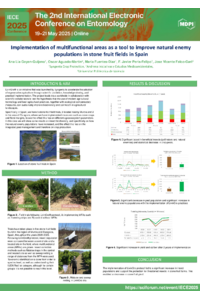
sciforum-118360_Ana Lia Gayan.pdf
The Impact of the Invasive Teak Defoliator Hyblaea puera on Coastal Mangrove Ecosystems in Kannur District, Kerala, India
First Record of Apefly (Spalgis epius) (Lepidoptera: Lycaenidae) Predation on Gooseberry Mealybug Nipaecoccus viridis (Newstead) (Hemiptera: Pseudococcidae) in India