Event submissions
Published
This submission belongs to the session S5. Pest Management, Pesticide Resistance, and Toxicology of the event The 2nd International Electronic Conference on Entomology
Published date
17 May, 2025
Academic Editor
'%3e%3cpath%20d='M12.6657%2010.9104C12.4185%2010.325%2012.0599%209.79327%2011.6097%209.34482C11.1609%208.89508%2010.6293%208.5365%2010.0442%208.28888C10.0389%208.28626%2010.0337%208.28495%2010.0285%208.28233C10.8446%207.69279%2011.3752%206.73249%2011.3752%205.64904C11.3752%203.8542%209.92103%202.39999%208.1262%202.39999C6.33136%202.39999%204.87715%203.8542%204.87715%205.64904C4.87715%206.73249%205.40774%207.69279%206.22393%208.28364C6.21869%208.28626%206.21345%208.28757%206.20821%208.29019C5.62129%208.5378%205.09463%208.89284%204.64265%209.34613C4.1929%209.79493%203.83432%2010.3266%203.58671%2010.9117C3.34345%2011.4845%203.21226%2012.0987%203.20023%2012.7209C3.19988%2012.7349%203.20233%2012.7488%203.20744%2012.7619C3.21255%2012.7749%203.22022%2012.7867%203.22998%2012.7968C3.23975%2012.8068%203.25142%2012.8147%203.26431%2012.8202C3.2772%2012.8256%203.29105%2012.8284%203.30504%2012.8284H4.09109C4.14874%2012.8284%204.19459%2012.7825%204.1959%2012.7262C4.2221%2011.7148%204.62823%2010.7676%205.34617%2010.0497C6.08899%209.30683%207.0755%208.89808%208.1262%208.89808C9.17689%208.89808%2010.1634%209.30683%2010.9062%2010.0497C11.6242%2010.7676%2012.0303%2011.7148%2012.0565%2012.7262C12.0578%2012.7838%2012.1037%2012.8284%2012.1613%2012.8284H12.9474C12.9613%2012.8284%2012.9752%2012.8256%2012.9881%2012.8202C13.001%2012.8147%2013.0126%2012.8068%2013.0224%2012.7968C13.0322%2012.7867%2013.0398%2012.7749%2013.0449%2012.7619C13.0501%2012.7488%2013.0525%2012.7349%2013.0522%2012.7209C13.0391%2012.0947%2012.9094%2011.4855%2012.6657%2010.9104ZM8.1262%207.9024C7.52486%207.9024%206.9589%207.6679%206.53312%207.24211C6.10733%206.81633%205.87283%206.25037%205.87283%205.64904C5.87283%205.0477%206.10733%204.48174%206.53312%204.05596C6.9589%203.63018%207.52486%203.39567%208.1262%203.39567C8.72753%203.39567%209.29349%203.63018%209.71927%204.05596C10.1451%204.48174%2010.3796%205.0477%2010.3796%205.64904C10.3796%206.25037%2010.1451%206.81633%209.71927%207.24211C9.29349%207.6679%208.72753%207.9024%208.1262%207.9024Z'%20fill='%235D1EE1'/%3e%3c/g%3e%3c/svg%3e) Louis Hesler
Louis HeslerCitation
W.H.K.E. Senevirathne, W.D.T.A. Sandeepanie, J.M.M.B.T. Premarathna, J.S. Wickramasinghe, A.G.W.U. Perera, R.S. Diyabalanage, Synergistic integration of Citrus aurantium essential oil and gamma radiation: A strategy for optimizing radiation in the effective control of Sitophilus oryzae and Tribolium castaneum, in Proceedings of The 2nd International Electronic Conference on Entomology, 19 May–21 May 2025, MDPI: Basel, Switzerland
Share
Email
Facebook
Twitter
LinkedIn
Synergistic integration of Citrus aurantium essential oil and gamma radiation: A strategy for optimizing radiation in the effective control of Sitophilus oryzae and Tribolium castaneum
'%3e%3cpath%20d='M12.6647%2010.9104C12.4176%2010.325%2012.0589%209.7933%2011.6088%209.34485C11.16%208.89511%2010.6283%208.53653%2010.0432%208.28891C10.038%208.28629%2010.0327%208.28498%2010.0275%208.28236C10.8437%207.69282%2011.3743%206.73252%2011.3743%205.64907C11.3743%203.85423%209.92005%202.40002%208.12522%202.40002C6.33038%202.40002%204.87618%203.85423%204.87618%205.64907C4.87618%206.73252%205.40677%207.69282%206.22296%208.28367C6.21772%208.28629%206.21248%208.2876%206.20724%208.29022C5.62031%208.53783%205.09365%208.89287%204.64167%209.34616C4.19192%209.79496%203.83334%2010.3266%203.58573%2010.9117C3.34247%2011.4846%203.21128%2012.0987%203.19925%2012.721C3.1989%2012.735%203.20135%2012.7489%203.20646%2012.7619C3.21157%2012.7749%203.21924%2012.7868%203.22901%2012.7968C3.23877%2012.8068%203.25045%2012.8148%203.26334%2012.8202C3.27623%2012.8256%203.29007%2012.8284%203.30406%2012.8284H4.09012C4.14776%2012.8284%204.19362%2012.7825%204.19493%2012.7262C4.22113%2011.7148%204.62726%2010.7676%205.34519%2010.0497C6.08802%209.30686%207.07452%208.89811%208.12522%208.89811C9.17592%208.89811%2010.1624%209.30686%2010.9052%2010.0497C11.6232%2010.7676%2012.0293%2011.7148%2012.0555%2012.7262C12.0568%2012.7839%2012.1027%2012.8284%2012.1603%2012.8284H12.9464C12.9604%2012.8284%2012.9742%2012.8256%2012.9871%2012.8202C13%2012.8148%2013.0117%2012.8068%2013.0214%2012.7968C13.0312%2012.7868%2013.0389%2012.7749%2013.044%2012.7619C13.0491%2012.7489%2013.0515%2012.735%2013.0512%2012.721C13.0381%2012.0947%2012.9084%2011.4856%2012.6647%2010.9104ZM8.12522%207.90243C7.52388%207.90243%206.95792%207.66793%206.53214%207.24215C6.10636%206.81636%205.87185%206.2504%205.87185%205.64907C5.87185%205.04773%206.10636%204.48177%206.53214%204.05599C6.95792%203.63021%207.52388%203.3957%208.12522%203.3957C8.72655%203.3957%209.29252%203.63021%209.7183%204.05599C10.1441%204.48177%2010.3786%205.04773%2010.3786%205.64907C10.3786%206.2504%2010.1441%206.81636%209.7183%207.24215C9.29252%207.66793%208.72655%207.90243%208.12522%207.90243Z'%20fill='%235D1EE1'/%3e%3c/g%3e%3c/svg%3e)
W.H.K.E. Senevirathne 1
W.D.T.A. Sandeepanie 1
J.M.M.B.T. Premarathna 1
J.S. Wickramasinghe 2
A.G.W.U. Perera 1

R.S. Diyabalanage 3,4
1. Department of Zoology, Faculty of Applied Sciences, University of Sri Jayewardenepura, Sri Lanka
2. Department of Nuclear Science, Faculty of Science, University of Colombo, Sri Lanka
3. Instrument Centre, Faculty of Applied Sciences, University of Sri Jayewardenepura, Sri Lanka
4. Ecosphere Resilience Research Center, Faculty of Applied Sciences, University of Sri Jayewardenepura, Sri Lanka
Abstract
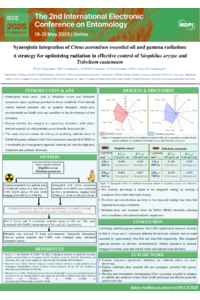
The management of stored-grain insect pests, Sitophilus oryzae and Tribolium castaneum, can be enhanced through combined gamma radiation and plant-derived essential oils. This study assesses the potential of Cobalt-60 γ-radiation together with Citrus aurantium essential oil (CAEO) as an alternative to synthetic fumigants. Lethality was assessed for single γ-radiation treatments, applied at 20 doses (100-2000 Gy at 3.98 kGy/h), and CAEO fumigation at five concentrations (16.66-100 µL/L air). Combined effects were evaluated using sublethal CAEO concentrations (S. oryzae: LC5: 8.87 µL/L air; LC10: 15.40 µL/L air; T. castaneum: LC5: 6.45 µL/L air; LC10: 15.68 µL/L air) with sublethal γ-radiation doses (S. oryzae: LD5: 260 Gy; LD10: 305 Gy; T. castaneum: LD5: 598 Gy; LD10: 710 Gy). After 72 h, mortality rates for S. oryzae following single γ-radiation treatments were 14% (100–500 Gy), 82% (600–1000 Gy), and 100% (1100-2000 Gy), while for T. castaneum, they were 2% (100–500 Gy), 16.4% (600–1000 Gy), 34.8% (1100-1500 Gy), and 84% (1500-2000 Gy). CAEO alone induced 12-50% mortality. Combined treatments significantly increased mortality (66-86% for S. oryzae and 44-58% for T. castaneum), demonstrating synergistic effects and notably reducing the required radiation dose by ~4-fold for S. oryzae and ~3-fold for T. castaneum. For S. oryzae, LD5(γ) combined with LC5(CAEO) and LC10(CAEO) yielded synergism indices of 0.489 and 0.469, while LD10(γ) combinations produced indices of 0.492 and 0.474. For T. castaneum, LD5(γ) with LC5(CAEO) and LC10(CAEO) resulted in synergism indices of 0.482 and 0.530, and LD10(γ) yielded 0.560 and 0.567 in combination. The radiation doses in this study remained well below the IAEA’s recommended 1000 Gy threshold for stored-grain pest disinfestation. Combining sublethal radiation doses with CAEO enhanced insect mortality, suggesting that lower radiation doses could be used effectively, potentially reducing concerns about high-dose irradiation and offering a sustainable alternative to synthetic fumigants for managing stored-grain pests.
Keywords
Gamma radiation
Sitophilus oryzae
Tribolium castaneum
Citrus aurantium
Essential oil
Combined treatment
Synergistic effect
Lethality
Poster
sciforum-118320.pdf
Resistance of Cabbage varieties for management of Diamondback Moth (Plutelila xylostella) under field conditions
A temperature-dependent phenology model for Plutella xylostella