Event submissions
Published
This submission belongs to the session S5. Pest Management, Pesticide Resistance, and Toxicology of the event The 2nd International Electronic Conference on Entomology
Published date
17 May, 2025
Academic Editor
'%3e%3cpath%20d='M12.6657%2010.9104C12.4185%2010.325%2012.0599%209.79327%2011.6097%209.34482C11.1609%208.89508%2010.6293%208.5365%2010.0442%208.28888C10.0389%208.28626%2010.0337%208.28495%2010.0285%208.28233C10.8446%207.69279%2011.3752%206.73249%2011.3752%205.64904C11.3752%203.8542%209.92103%202.39999%208.1262%202.39999C6.33136%202.39999%204.87715%203.8542%204.87715%205.64904C4.87715%206.73249%205.40774%207.69279%206.22393%208.28364C6.21869%208.28626%206.21345%208.28757%206.20821%208.29019C5.62129%208.5378%205.09463%208.89284%204.64265%209.34613C4.1929%209.79493%203.83432%2010.3266%203.58671%2010.9117C3.34345%2011.4845%203.21226%2012.0987%203.20023%2012.7209C3.19988%2012.7349%203.20233%2012.7488%203.20744%2012.7619C3.21255%2012.7749%203.22022%2012.7867%203.22998%2012.7968C3.23975%2012.8068%203.25142%2012.8147%203.26431%2012.8202C3.2772%2012.8256%203.29105%2012.8284%203.30504%2012.8284H4.09109C4.14874%2012.8284%204.19459%2012.7825%204.1959%2012.7262C4.2221%2011.7148%204.62823%2010.7676%205.34617%2010.0497C6.08899%209.30683%207.0755%208.89808%208.1262%208.89808C9.17689%208.89808%2010.1634%209.30683%2010.9062%2010.0497C11.6242%2010.7676%2012.0303%2011.7148%2012.0565%2012.7262C12.0578%2012.7838%2012.1037%2012.8284%2012.1613%2012.8284H12.9474C12.9613%2012.8284%2012.9752%2012.8256%2012.9881%2012.8202C13.001%2012.8147%2013.0126%2012.8068%2013.0224%2012.7968C13.0322%2012.7867%2013.0398%2012.7749%2013.0449%2012.7619C13.0501%2012.7488%2013.0525%2012.7349%2013.0522%2012.7209C13.0391%2012.0947%2012.9094%2011.4855%2012.6657%2010.9104ZM8.1262%207.9024C7.52486%207.9024%206.9589%207.6679%206.53312%207.24211C6.10733%206.81633%205.87283%206.25037%205.87283%205.64904C5.87283%205.0477%206.10733%204.48174%206.53312%204.05596C6.9589%203.63018%207.52486%203.39567%208.1262%203.39567C8.72753%203.39567%209.29349%203.63018%209.71927%204.05596C10.1451%204.48174%2010.3796%205.0477%2010.3796%205.64904C10.3796%206.25037%2010.1451%206.81633%209.71927%207.24211C9.29349%207.6679%208.72753%207.9024%208.1262%207.9024Z'%20fill='%235D1EE1'/%3e%3c/g%3e%3c/svg%3e) Louis Hesler
Louis HeslerCitation
NIRAJ KUMAR PRAJAPATI, Sanjay Kumar, Awaneesh Chandra, Anjali Anjali, Early Detection and Monitoring of Pesticide Resistance in Cole Crop Pests, in Proceedings of The 2nd International Electronic Conference on Entomology, 19 May–21 May 2025, MDPI: Basel, Switzerland
Share
Email
Facebook
Twitter
LinkedIn
Early Detection and Monitoring of Pesticide Resistance in Cole Crop Pests

NIRAJ KUMAR PRAJAPATI 1
'%3e%3cpath%20d='M12.6647%2010.9104C12.4176%2010.325%2012.0589%209.7933%2011.6088%209.34485C11.16%208.89511%2010.6283%208.53653%2010.0432%208.28891C10.038%208.28629%2010.0327%208.28498%2010.0275%208.28236C10.8437%207.69282%2011.3743%206.73252%2011.3743%205.64907C11.3743%203.85423%209.92005%202.40002%208.12522%202.40002C6.33038%202.40002%204.87618%203.85423%204.87618%205.64907C4.87618%206.73252%205.40677%207.69282%206.22296%208.28367C6.21772%208.28629%206.21248%208.2876%206.20724%208.29022C5.62031%208.53783%205.09365%208.89287%204.64167%209.34616C4.19192%209.79496%203.83334%2010.3266%203.58573%2010.9117C3.34247%2011.4846%203.21128%2012.0987%203.19925%2012.721C3.1989%2012.735%203.20135%2012.7489%203.20646%2012.7619C3.21157%2012.7749%203.21924%2012.7868%203.22901%2012.7968C3.23877%2012.8068%203.25045%2012.8148%203.26334%2012.8202C3.27623%2012.8256%203.29007%2012.8284%203.30406%2012.8284H4.09012C4.14776%2012.8284%204.19362%2012.7825%204.19493%2012.7262C4.22113%2011.7148%204.62726%2010.7676%205.34519%2010.0497C6.08802%209.30686%207.07452%208.89811%208.12522%208.89811C9.17592%208.89811%2010.1624%209.30686%2010.9052%2010.0497C11.6232%2010.7676%2012.0293%2011.7148%2012.0555%2012.7262C12.0568%2012.7839%2012.1027%2012.8284%2012.1603%2012.8284H12.9464C12.9604%2012.8284%2012.9742%2012.8256%2012.9871%2012.8202C13%2012.8148%2013.0117%2012.8068%2013.0214%2012.7968C13.0312%2012.7868%2013.0389%2012.7749%2013.044%2012.7619C13.0491%2012.7489%2013.0515%2012.735%2013.0512%2012.721C13.0381%2012.0947%2012.9084%2011.4856%2012.6647%2010.9104ZM8.12522%207.90243C7.52388%207.90243%206.95792%207.66793%206.53214%207.24215C6.10636%206.81636%205.87185%206.2504%205.87185%205.64907C5.87185%205.04773%206.10636%204.48177%206.53214%204.05599C6.95792%203.63021%207.52388%203.3957%208.12522%203.3957C8.72655%203.3957%209.29252%203.63021%209.7183%204.05599C10.1441%204.48177%2010.3786%205.04773%2010.3786%205.64907C10.3786%206.2504%2010.1441%206.81636%209.7183%207.24215C9.29252%207.66793%208.72655%207.90243%208.12522%207.90243Z'%20fill='%235D1EE1'/%3e%3c/g%3e%3c/svg%3e)
Sanjay Kumar 2
Awaneesh Chandra 3
Anjali Anjali 4
1. Department of Horticulture, SAST, Babasaheb Bhimrao Ambedkar University, Lucknow (U.P.) - 226025
2. Department of Horticulture, School of Agricultural Sciences and Technology, Babasaheb Bhimrao Ambedkar University (A Central University), Lucknow (U.P.) – 226025
3. Government Degree College, Jakhini, Varanasi (U.P.) – 221305
4. Department of Horticulture, School of Agricultural Sciences and Technology, Babasaheb Bhimrao Ambedkar University (A Central University), Lucknow (U.P.) – 226025, India
Abstract
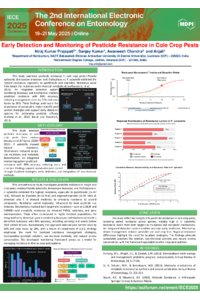
The emergence of pesticide resistance in major cole crop pests poses a significant threat to global Brassica production, with annual losses exceeding USD 4.5 billion worldwide. This study investigated resistance patterns in three primary pest species—Plutella xylostella (diamondback moth), Brevicoryne brassicae (cabbage aphid), and Trichoplusia ni (cabbage looper)—across 87 commercial farms in major cole crop-producing regions during 2020-2023. Bioassays were conducted using five commonly applied pesticide classes: pyrethroids, organophosphates, carbamates, diamides, and Bacillus thuringiensis (Bt) formulations. The results revealed significant resistance development, with P. xylostella showing 15-fold to 87-fold resistance to pyrethroids and 8-fold to 23-fold resistance to diamides. B. brassicae populations exhibited moderate resistance levels (5-fold to 12-fold) to organophosphates, while T. ni demonstrated emerging resistance to Bt products (3-fold to 7-fold). Molecular analysis identified key resistance mechanisms, including target-site mutations in the sodium channel gene (kdr) and enhanced metabolic detoxification through elevated P450 and esterase activity. The implementation of a novel resistance monitoring protocol, integrating biochemical markers and field-based bioassays, enabled the early detection of resistance development with 89% accuracy. Economic analysis indicated that early resistance detection reduced pest management costs by 32% through timely intervention strategies. This research establishes a comprehensive framework for proactive resistance management in cole crops, emphasizing the importance of regular monitoring and resistance mechanism characterization for sustainable pest control.
Keywords
Pesticide resistance
Cole crops
Plutella xylostella
Molecular mechanisms
Bioassays
Resistance monitoring
Integrated pest management
Metabolic resistance
Economic threshold.
Poster
Flash poster NirajKP.pdf
Strategies for the Sustainable Protection and Enhancement of Indigenous Bumblebee (Bombus haemorrhoidalis) Populations to Support Mountain Food Systems in Azad Jammu and Kashmir
Toxicity of insecticidal gel baits against several developmental stages of American cockroach Periplaneta americana (Blattodea: Blattidae)