Event submissions
Published
This submission belongs to the session S5. Pest Management, Pesticide Resistance, and Toxicology of the event The 2nd International Electronic Conference on Entomology
Published date
17 May, 2025
Academic Editor
'%3e%3cpath%20d='M12.6657%2010.9104C12.4185%2010.325%2012.0599%209.79327%2011.6097%209.34482C11.1609%208.89508%2010.6293%208.5365%2010.0442%208.28888C10.0389%208.28626%2010.0337%208.28495%2010.0285%208.28233C10.8446%207.69279%2011.3752%206.73249%2011.3752%205.64904C11.3752%203.8542%209.92103%202.39999%208.1262%202.39999C6.33136%202.39999%204.87715%203.8542%204.87715%205.64904C4.87715%206.73249%205.40774%207.69279%206.22393%208.28364C6.21869%208.28626%206.21345%208.28757%206.20821%208.29019C5.62129%208.5378%205.09463%208.89284%204.64265%209.34613C4.1929%209.79493%203.83432%2010.3266%203.58671%2010.9117C3.34345%2011.4845%203.21226%2012.0987%203.20023%2012.7209C3.19988%2012.7349%203.20233%2012.7488%203.20744%2012.7619C3.21255%2012.7749%203.22022%2012.7867%203.22998%2012.7968C3.23975%2012.8068%203.25142%2012.8147%203.26431%2012.8202C3.2772%2012.8256%203.29105%2012.8284%203.30504%2012.8284H4.09109C4.14874%2012.8284%204.19459%2012.7825%204.1959%2012.7262C4.2221%2011.7148%204.62823%2010.7676%205.34617%2010.0497C6.08899%209.30683%207.0755%208.89808%208.1262%208.89808C9.17689%208.89808%2010.1634%209.30683%2010.9062%2010.0497C11.6242%2010.7676%2012.0303%2011.7148%2012.0565%2012.7262C12.0578%2012.7838%2012.1037%2012.8284%2012.1613%2012.8284H12.9474C12.9613%2012.8284%2012.9752%2012.8256%2012.9881%2012.8202C13.001%2012.8147%2013.0126%2012.8068%2013.0224%2012.7968C13.0322%2012.7867%2013.0398%2012.7749%2013.0449%2012.7619C13.0501%2012.7488%2013.0525%2012.7349%2013.0522%2012.7209C13.0391%2012.0947%2012.9094%2011.4855%2012.6657%2010.9104ZM8.1262%207.9024C7.52486%207.9024%206.9589%207.6679%206.53312%207.24211C6.10733%206.81633%205.87283%206.25037%205.87283%205.64904C5.87283%205.0477%206.10733%204.48174%206.53312%204.05596C6.9589%203.63018%207.52486%203.39567%208.1262%203.39567C8.72753%203.39567%209.29349%203.63018%209.71927%204.05596C10.1451%204.48174%2010.3796%205.0477%2010.3796%205.64904C10.3796%206.25037%2010.1451%206.81633%209.71927%207.24211C9.29349%207.6679%208.72753%207.9024%208.1262%207.9024Z'%20fill='%235D1EE1'/%3e%3c/g%3e%3c/svg%3e) Louis Hesler
Louis HeslerCitation
Gisele Ivonne Antonuccio, Diego Herman Sauka, Sublethal effects of an Argentine Bacillus thuringiensis strain on the development and fitness of Alphitobius diaperinus (Coleoptera: Tenebrionidae), in Proceedings of The 2nd International Electronic Conference on Entomology, 19 May–21 May 2025, MDPI: Basel, Switzerland
Share
Email
Facebook
Twitter
LinkedIn
Sublethal effects of an Argentine Bacillus thuringiensis strain on the development and fitness of Alphitobius diaperinus (Coleoptera: Tenebrionidae)

Gisele Ivonne Antonuccio 1,2

Diego Herman Sauka 1,3
1. 1Instituto Nacional de Tecnología Agropecuaria (INTA), Instituto de Microbiología y Zoología Agrícola (IMYZA), Hurlingham, Buenos Aires, Argentina
2. 2 Servicio Nacional de Sanidad y Calidad Agroalimentaria (SENASA), Buenos Aires, Argentina
3. 3Consejo Nacional de Investigaciones Científicas y Técnicas (CONICET), Argentina
Abstract
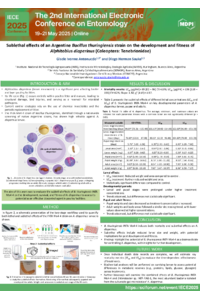
Alphitobius diaperinus, the lesser mealworm, is a key pest of poultry in broiler and layer facilities. The highly virulent INTA Mo4-4 strain of Bacillus thuringiensis is the most effective choice for controlling larval A. diaperinus. This study evaluated its sublethal effects on development, survival and fitness. Initially, six concentrations of INTA Mo4-4 spores and crystals were incorporated into the diet of A. diaperinus starting with 4-day-old larvae to assess virulence. Mortality was recorded after 14 d at 28 °C, and LC30 and LC50 were determined from four independent bioassays, yielding values of 69 and 136 µg/ml, respectively. Subsequently, sublethal bioassays using the LC30 and LC50, alongside a control group, determined the effects on surviving larvae. After 14 d at 28 °C, 791 larvae from five independent bioassays were analyzed. Their weights and larval areas were measured and later monitored to determine the durations of their larval and pupal stages, as well as their pupal and adult weights and body areas. Sublethal effects were clear in the LC30 and LC50 treatments, showing significantly reduced weights/areas per larva (0.25 mg/0.97 mm² and 0.20 mg/0.82 mm², respectively) compared to controls (0.37 mg/1.32 mm²). Although these trends persisted, differences were no longer statistically significant for developmental periods, pupae or adult fitness traits. Average larval (76.7, 83.1 and 104.6 days) and pupal periods (5.7, 6.4 and 7.0 days) and pupal (10.08 mg/9.32 mm², 8.75 mg/8.44 mm² and 8.12 mg/7.80 mm²) and adult weights/areas (8.97 mg/9.63 mm²; 7.65 mg/8.54 mm²; and 6.96 mg/7.95 mm²) per specimen followed similar trends across the control, LC30, and LC50 treatments, respectively. This study showed that INTA Mo4-4 induces both mortality and sublethal effects that could affect the development and fitness of A. diaperinus, offering valuable insights for bioinsecticide development targeting this pest.
Keywords
Alphitobius diaperinus
Bacillus thuringiensis
virulence
sublethal effects.
Poster
Poster MDPI Entomology Antonuccio & Sauka (23-04-2025).pdf
Toxicity of insecticidal gel baits against several developmental stages of American cockroach Periplaneta americana (Blattodea: Blattidae)
Evaluation of the freezing and drying process on the physicochemical properties of the agave white worm (Aegiale hesperiaris).