Event submissions
Published
This submission belongs to the session S8. Medical and Veterinary Entomology of the event The 2nd International Electronic Conference on Entomology
Published date
17 May, 2025
Academic Editor
'%3e%3cpath%20d='M12.6657%2010.9104C12.4185%2010.325%2012.0599%209.79327%2011.6097%209.34482C11.1609%208.89508%2010.6293%208.5365%2010.0442%208.28888C10.0389%208.28626%2010.0337%208.28495%2010.0285%208.28233C10.8446%207.69279%2011.3752%206.73249%2011.3752%205.64904C11.3752%203.8542%209.92103%202.39999%208.1262%202.39999C6.33136%202.39999%204.87715%203.8542%204.87715%205.64904C4.87715%206.73249%205.40774%207.69279%206.22393%208.28364C6.21869%208.28626%206.21345%208.28757%206.20821%208.29019C5.62129%208.5378%205.09463%208.89284%204.64265%209.34613C4.1929%209.79493%203.83432%2010.3266%203.58671%2010.9117C3.34345%2011.4845%203.21226%2012.0987%203.20023%2012.7209C3.19988%2012.7349%203.20233%2012.7488%203.20744%2012.7619C3.21255%2012.7749%203.22022%2012.7867%203.22998%2012.7968C3.23975%2012.8068%203.25142%2012.8147%203.26431%2012.8202C3.2772%2012.8256%203.29105%2012.8284%203.30504%2012.8284H4.09109C4.14874%2012.8284%204.19459%2012.7825%204.1959%2012.7262C4.2221%2011.7148%204.62823%2010.7676%205.34617%2010.0497C6.08899%209.30683%207.0755%208.89808%208.1262%208.89808C9.17689%208.89808%2010.1634%209.30683%2010.9062%2010.0497C11.6242%2010.7676%2012.0303%2011.7148%2012.0565%2012.7262C12.0578%2012.7838%2012.1037%2012.8284%2012.1613%2012.8284H12.9474C12.9613%2012.8284%2012.9752%2012.8256%2012.9881%2012.8202C13.001%2012.8147%2013.0126%2012.8068%2013.0224%2012.7968C13.0322%2012.7867%2013.0398%2012.7749%2013.0449%2012.7619C13.0501%2012.7488%2013.0525%2012.7349%2013.0522%2012.7209C13.0391%2012.0947%2012.9094%2011.4855%2012.6657%2010.9104ZM8.1262%207.9024C7.52486%207.9024%206.9589%207.6679%206.53312%207.24211C6.10733%206.81633%205.87283%206.25037%205.87283%205.64904C5.87283%205.0477%206.10733%204.48174%206.53312%204.05596C6.9589%203.63018%207.52486%203.39567%208.1262%203.39567C8.72753%203.39567%209.29349%203.63018%209.71927%204.05596C10.1451%204.48174%2010.3796%205.0477%2010.3796%205.64904C10.3796%206.25037%2010.1451%206.81633%209.71927%207.24211C9.29349%207.6679%208.72753%207.9024%208.1262%207.9024Z'%20fill='%235D1EE1'/%3e%3c/g%3e%3c/svg%3e) Rui-De Xue
Rui-De XueCitation
Florence Oluwaponmile Ajayi, Kolade T. Ibrahim, Victor Oguayo, Chiaka I. Anumudu, Mekeu Aline Edith Noutcha, Malaria Vector Composition, Abundance, and Plasmodium Infection Rates in Rural Southwestern Nigeria: Implications for Targeted Control Strategies., in Proceedings of The 2nd International Electronic Conference on Entomology, 19 May–21 May 2025, MDPI: Basel, Switzerland
Share
Email
Facebook
Twitter
LinkedIn
Malaria Vector Composition, Abundance, and Plasmodium Infection Rates in Rural Southwestern Nigeria: Implications for Targeted Control Strategies.
'%3e%3cpath%20d='M12.6647%2010.9104C12.4176%2010.325%2012.0589%209.7933%2011.6088%209.34485C11.16%208.89511%2010.6283%208.53653%2010.0432%208.28891C10.038%208.28629%2010.0327%208.28498%2010.0275%208.28236C10.8437%207.69282%2011.3743%206.73252%2011.3743%205.64907C11.3743%203.85423%209.92005%202.40002%208.12522%202.40002C6.33038%202.40002%204.87618%203.85423%204.87618%205.64907C4.87618%206.73252%205.40677%207.69282%206.22296%208.28367C6.21772%208.28629%206.21248%208.2876%206.20724%208.29022C5.62031%208.53783%205.09365%208.89287%204.64167%209.34616C4.19192%209.79496%203.83334%2010.3266%203.58573%2010.9117C3.34247%2011.4846%203.21128%2012.0987%203.19925%2012.721C3.1989%2012.735%203.20135%2012.7489%203.20646%2012.7619C3.21157%2012.7749%203.21924%2012.7868%203.22901%2012.7968C3.23877%2012.8068%203.25045%2012.8148%203.26334%2012.8202C3.27623%2012.8256%203.29007%2012.8284%203.30406%2012.8284H4.09012C4.14776%2012.8284%204.19362%2012.7825%204.19493%2012.7262C4.22113%2011.7148%204.62726%2010.7676%205.34519%2010.0497C6.08802%209.30686%207.07452%208.89811%208.12522%208.89811C9.17592%208.89811%2010.1624%209.30686%2010.9052%2010.0497C11.6232%2010.7676%2012.0293%2011.7148%2012.0555%2012.7262C12.0568%2012.7839%2012.1027%2012.8284%2012.1603%2012.8284H12.9464C12.9604%2012.8284%2012.9742%2012.8256%2012.9871%2012.8202C13%2012.8148%2013.0117%2012.8068%2013.0214%2012.7968C13.0312%2012.7868%2013.0389%2012.7749%2013.044%2012.7619C13.0491%2012.7489%2013.0515%2012.735%2013.0512%2012.721C13.0381%2012.0947%2012.9084%2011.4856%2012.6647%2010.9104ZM8.12522%207.90243C7.52388%207.90243%206.95792%207.66793%206.53214%207.24215C6.10636%206.81636%205.87185%206.2504%205.87185%205.64907C5.87185%205.04773%206.10636%204.48177%206.53214%204.05599C6.95792%203.63021%207.52388%203.3957%208.12522%203.3957C8.72655%203.3957%209.29252%203.63021%209.7183%204.05599C10.1441%204.48177%2010.3786%205.04773%2010.3786%205.64907C10.3786%206.2504%2010.1441%206.81636%209.7183%207.24215C9.29252%207.66793%208.72655%207.90243%208.12522%207.90243Z'%20fill='%235D1EE1'/%3e%3c/g%3e%3c/svg%3e)
Florence Oluwaponmile Ajayi 1,2
Kolade T. Ibrahim 1,2
Victor Oguayo 1,2
Chiaka I. Anumudu 1,2
Mekeu Aline Edith Noutcha 3,4
1. Zoology, University of Ibadan, 20005
2. Zoology, University of Ibadan, 20005, Nigeria
3. Department of Animal & Environmental Biology, University of Port Harcourt, 500272
4. Department of Animal & Environmental Biology, University of Port Harcourt, 500272, Nigeria
Abstract
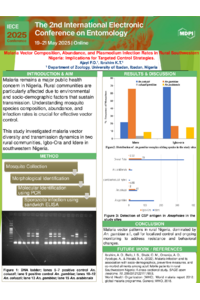
Background: Malaria remains a major public health concern in Nigeria, particularly in rural communities where environmental and socio-demographic factors drive sustained transmission. Understanding mosquito species composition, abundance, and infection rates is essential for effective vector control interventions.
Methods: This study investigated malaria vector diversity and transmission dynamics in two rural communities, Igbo-Ora and Idere, in southwestern Nigeria. Indoor-resting mosquitoes were collected monthly during the 2022 rainy season using pyrethroid spray collection methods. Collected specimens were morphologically and molecularly identified, and circumsporozoite protein (CSP) ELISA was performed to detect Plasmodium infection.
Results: A total of 739 mosquitoes belonging to three genera (Anopheles, Culex, and Aedes) were collected, with Anopheles species being the most abundant (57.2%). Molecular identification of the Anopheles gambiae complex revealed three sibling species, An. gambiae s.s. (56%), An. coluzzii (31.2%), and An. arabiensis (10.1%), with hybrid forms also detected. An. gambiae s.l. was the primary malaria vector, comprising 70.4% of the Anopheles mosquitoes. Vector density varied between locations, with higher indoor resting density (IRD: 0.45) and man-biting rate (MBR: 0.11) in Idere compared to Igbo-Ora (IRD: 0.04; MBR: 0.01). Sporozoite infection rates were low, with only two An. coluzzii testing positive for Plasmodium falciparum CSP antigen in Igbo-Ora (2.53% infection rate).
Conclusion: The findings highlight the ecological factors influencing malaria vector distribution and transmission dynamics in rural Nigeria. The dominance of An. gambiae s.l. and localized differences in vector abundance emphasize the need for site-specific, adaptive vector control strategies. Continuous surveillance is essential, particularly in the context of insecticide resistance and evolving vector behavior, to enhance malaria intervention programs in endemic regions.
Keywords
Malaria vectors
Anopheles gambiae complex
Plasmodium infection
Vector surveillance
Nigeria
Poster
Ajayi Florence O._IECE2025.pdf
Evaluation of the freezing and drying process on the physicochemical properties of the agave white worm (Aegiale hesperiaris).
Public Perceptions of Insect Pollinators in Morocco: Bridging Awareness Gaps for Effective Conservation