Event submissions
Published
This submission belongs to the session S4. Biodiversity, Climate Change, Conservation, Ecology, and Evolution of the event The 2nd International Electronic Conference on Entomology
Published date
17 May, 2025
Academic Editor
'%3e%3cpath%20d='M12.6657%2010.9104C12.4185%2010.325%2012.0599%209.79327%2011.6097%209.34482C11.1609%208.89508%2010.6293%208.5365%2010.0442%208.28888C10.0389%208.28626%2010.0337%208.28495%2010.0285%208.28233C10.8446%207.69279%2011.3752%206.73249%2011.3752%205.64904C11.3752%203.8542%209.92103%202.39999%208.1262%202.39999C6.33136%202.39999%204.87715%203.8542%204.87715%205.64904C4.87715%206.73249%205.40774%207.69279%206.22393%208.28364C6.21869%208.28626%206.21345%208.28757%206.20821%208.29019C5.62129%208.5378%205.09463%208.89284%204.64265%209.34613C4.1929%209.79493%203.83432%2010.3266%203.58671%2010.9117C3.34345%2011.4845%203.21226%2012.0987%203.20023%2012.7209C3.19988%2012.7349%203.20233%2012.7488%203.20744%2012.7619C3.21255%2012.7749%203.22022%2012.7867%203.22998%2012.7968C3.23975%2012.8068%203.25142%2012.8147%203.26431%2012.8202C3.2772%2012.8256%203.29105%2012.8284%203.30504%2012.8284H4.09109C4.14874%2012.8284%204.19459%2012.7825%204.1959%2012.7262C4.2221%2011.7148%204.62823%2010.7676%205.34617%2010.0497C6.08899%209.30683%207.0755%208.89808%208.1262%208.89808C9.17689%208.89808%2010.1634%209.30683%2010.9062%2010.0497C11.6242%2010.7676%2012.0303%2011.7148%2012.0565%2012.7262C12.0578%2012.7838%2012.1037%2012.8284%2012.1613%2012.8284H12.9474C12.9613%2012.8284%2012.9752%2012.8256%2012.9881%2012.8202C13.001%2012.8147%2013.0126%2012.8068%2013.0224%2012.7968C13.0322%2012.7867%2013.0398%2012.7749%2013.0449%2012.7619C13.0501%2012.7488%2013.0525%2012.7349%2013.0522%2012.7209C13.0391%2012.0947%2012.9094%2011.4855%2012.6657%2010.9104ZM8.1262%207.9024C7.52486%207.9024%206.9589%207.6679%206.53312%207.24211C6.10733%206.81633%205.87283%206.25037%205.87283%205.64904C5.87283%205.0477%206.10733%204.48174%206.53312%204.05596C6.9589%203.63018%207.52486%203.39567%208.1262%203.39567C8.72753%203.39567%209.29349%203.63018%209.71927%204.05596C10.1451%204.48174%2010.3796%205.0477%2010.3796%205.64904C10.3796%206.25037%2010.1451%206.81633%209.71927%207.24211C9.29349%207.6679%208.72753%207.9024%208.1262%207.9024Z'%20fill='%235D1EE1'/%3e%3c/g%3e%3c/svg%3e) António Soares
António SoaresCitation
Teodora Marius Teofilova, Nikolay D. Kodzhabashev, Ecological and zoogeographical structure of the communities of the endangered and protected Carabus hungaricus Fabricius, 1792 (Coleoptera: Carabidae), in Bulgaria, in Proceedings of The 2nd International Electronic Conference on Entomology, 19 May–21 May 2025, MDPI: Basel, Switzerland
Share
Email
Facebook
Twitter
LinkedIn
Ecological and zoogeographical structure of the communities of the endangered and protected Carabus hungaricus Fabricius, 1792 (Coleoptera: Carabidae), in Bulgaria

Teodora Marius Teofilova 1
'%3e%3cpath%20d='M12.6647%2010.9104C12.4176%2010.325%2012.0589%209.7933%2011.6088%209.34485C11.16%208.89511%2010.6283%208.53653%2010.0432%208.28891C10.038%208.28629%2010.0327%208.28498%2010.0275%208.28236C10.8437%207.69282%2011.3743%206.73252%2011.3743%205.64907C11.3743%203.85423%209.92005%202.40002%208.12522%202.40002C6.33038%202.40002%204.87618%203.85423%204.87618%205.64907C4.87618%206.73252%205.40677%207.69282%206.22296%208.28367C6.21772%208.28629%206.21248%208.2876%206.20724%208.29022C5.62031%208.53783%205.09365%208.89287%204.64167%209.34616C4.19192%209.79496%203.83334%2010.3266%203.58573%2010.9117C3.34247%2011.4846%203.21128%2012.0987%203.19925%2012.721C3.1989%2012.735%203.20135%2012.7489%203.20646%2012.7619C3.21157%2012.7749%203.21924%2012.7868%203.22901%2012.7968C3.23877%2012.8068%203.25045%2012.8148%203.26334%2012.8202C3.27623%2012.8256%203.29007%2012.8284%203.30406%2012.8284H4.09012C4.14776%2012.8284%204.19362%2012.7825%204.19493%2012.7262C4.22113%2011.7148%204.62726%2010.7676%205.34519%2010.0497C6.08802%209.30686%207.07452%208.89811%208.12522%208.89811C9.17592%208.89811%2010.1624%209.30686%2010.9052%2010.0497C11.6232%2010.7676%2012.0293%2011.7148%2012.0555%2012.7262C12.0568%2012.7839%2012.1027%2012.8284%2012.1603%2012.8284H12.9464C12.9604%2012.8284%2012.9742%2012.8256%2012.9871%2012.8202C13%2012.8148%2013.0117%2012.8068%2013.0214%2012.7968C13.0312%2012.7868%2013.0389%2012.7749%2013.044%2012.7619C13.0491%2012.7489%2013.0515%2012.735%2013.0512%2012.721C13.0381%2012.0947%2012.9084%2011.4856%2012.6647%2010.9104ZM8.12522%207.90243C7.52388%207.90243%206.95792%207.66793%206.53214%207.24215C6.10636%206.81636%205.87185%206.2504%205.87185%205.64907C5.87185%205.04773%206.10636%204.48177%206.53214%204.05599C6.95792%203.63021%207.52388%203.3957%208.12522%203.3957C8.72655%203.3957%209.29252%203.63021%209.7183%204.05599C10.1441%204.48177%2010.3786%205.04773%2010.3786%205.64907C10.3786%206.2504%2010.1441%206.81636%209.7183%207.24215C9.29252%207.66793%208.72655%207.90243%208.12522%207.90243Z'%20fill='%235D1EE1'/%3e%3c/g%3e%3c/svg%3e)
Nikolay D. Kodzhabashev 2
1. Institute of Biodiversity and Ecosystem Research (IBER), Bulgarian Academy of Sciences (BAS), 1 Tsar Osvoboditel Blvd., 1000 Sofia, Bulgaria
2. University of Forestry, Faculty of Forestry, Department of Hunting and Game Management, 10 Kliment Ohridski Blvd., 1756 Sofia, Bulgaria
Abstract
The endangered ground beetle Carabus hungaricus Fabricius, 1792 (Coleoptera: Carabidae), is protected in Bulgaria, but little is known about its ecological and zoogeographical features, and this study aimed at clarifying these aspects of its communities. With 252 pitfall traps, in the period May 2021–December 2023, we surveyed 42 sample plots in central-western Bulgaria. Carabus hungaricus was established in only seven of them, with a total of 198 specimens. In these sites, we found 57 species from 23 genera. The beetles belonged to 18 categories from the five main faunal types of Bulgarian carabids. The European–Asiatic complex prevailed (17 species, 30%), followed by the Northern Holarctic European–Siberian (15 species) and Mediterranean complexes (12 species). The European complex consisted of nine species (16%). The Endemic complex was only represented by two Balkan endemics and two Balkan subendemics. Most represented were the European–Neareastern (17.5%), Palaearctic and European–Central Asian (10.5% each) elements. The two classes of life forms had almost equal proportions, namely, 28 (49.1%) Zoophagous and 29 (50.9%) Mixophytophagous species, which is extraordinary for Bulgaria, but typical for the steppe zone of Eurasia. Such predominance of the mixophytophages (even weak) has never been established in Bulgaria. Macropterous were 32 species (56%), brachypterous (hind wings shorter than elytra, or missing) were 14 species (25%), and di(poly)morphic (some individuals with fully developed, others with vestigial wings) were 11 species (19%). The relatively low number of winged species is comparable only with typical montane habitats. In relation to their humidity preferences, mesoxerophilous carabids had the largest share (25 species, 44%). Mesophilous were 15 species and 6 species were eurybiontic. Xerophilous and mesohygrophilous groups included five species each. Hygrophilous was only one species. In relation to its ground beetle fauna, the studied complex of habitats is quite remarkable for Bulgaria and appears to be stable and characteristic for the steppe biome.
Keywords
Carabus hungaricus
central-western Bulgaria
zoogeography
ecology
ground beetles
life forms
steppe refugium
wing morphology
Poster
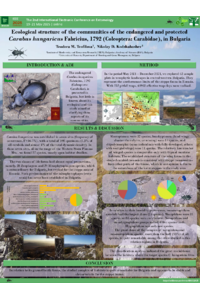
Poster_2025_IECE_Carabus hungaricus_Bulgaria_ecology_sciforum-112585.pdf
Efficacy of low-copper-content and silicate-based particle film products against olive fruit fly (Bactrocera oleae Rossi) infestations in olive groves
Molecular identification of termite assemblages at the source of the Okavango Delta in the Angola highlands