Event submissions
Published
This submission belongs to the session S8. Medical and Veterinary Entomology of the event The 2nd International Electronic Conference on Entomology
Published date
17 May, 2025
Academic Editor
'%3e%3cpath%20d='M12.6657%2010.9104C12.4185%2010.325%2012.0599%209.79327%2011.6097%209.34482C11.1609%208.89508%2010.6293%208.5365%2010.0442%208.28888C10.0389%208.28626%2010.0337%208.28495%2010.0285%208.28233C10.8446%207.69279%2011.3752%206.73249%2011.3752%205.64904C11.3752%203.8542%209.92103%202.39999%208.1262%202.39999C6.33136%202.39999%204.87715%203.8542%204.87715%205.64904C4.87715%206.73249%205.40774%207.69279%206.22393%208.28364C6.21869%208.28626%206.21345%208.28757%206.20821%208.29019C5.62129%208.5378%205.09463%208.89284%204.64265%209.34613C4.1929%209.79493%203.83432%2010.3266%203.58671%2010.9117C3.34345%2011.4845%203.21226%2012.0987%203.20023%2012.7209C3.19988%2012.7349%203.20233%2012.7488%203.20744%2012.7619C3.21255%2012.7749%203.22022%2012.7867%203.22998%2012.7968C3.23975%2012.8068%203.25142%2012.8147%203.26431%2012.8202C3.2772%2012.8256%203.29105%2012.8284%203.30504%2012.8284H4.09109C4.14874%2012.8284%204.19459%2012.7825%204.1959%2012.7262C4.2221%2011.7148%204.62823%2010.7676%205.34617%2010.0497C6.08899%209.30683%207.0755%208.89808%208.1262%208.89808C9.17689%208.89808%2010.1634%209.30683%2010.9062%2010.0497C11.6242%2010.7676%2012.0303%2011.7148%2012.0565%2012.7262C12.0578%2012.7838%2012.1037%2012.8284%2012.1613%2012.8284H12.9474C12.9613%2012.8284%2012.9752%2012.8256%2012.9881%2012.8202C13.001%2012.8147%2013.0126%2012.8068%2013.0224%2012.7968C13.0322%2012.7867%2013.0398%2012.7749%2013.0449%2012.7619C13.0501%2012.7488%2013.0525%2012.7349%2013.0522%2012.7209C13.0391%2012.0947%2012.9094%2011.4855%2012.6657%2010.9104ZM8.1262%207.9024C7.52486%207.9024%206.9589%207.6679%206.53312%207.24211C6.10733%206.81633%205.87283%206.25037%205.87283%205.64904C5.87283%205.0477%206.10733%204.48174%206.53312%204.05596C6.9589%203.63018%207.52486%203.39567%208.1262%203.39567C8.72753%203.39567%209.29349%203.63018%209.71927%204.05596C10.1451%204.48174%2010.3796%205.0477%2010.3796%205.64904C10.3796%206.25037%2010.1451%206.81633%209.71927%207.24211C9.29349%207.6679%208.72753%207.9024%208.1262%207.9024Z'%20fill='%235D1EE1'/%3e%3c/g%3e%3c/svg%3e) Rui-De Xue
Rui-De XueCitation
Athanasios Giatropoulos, Chrisanthos Lymperopoulos, Konstantina Konidari, Ilias Kioulos, Antonios Michaelakis, Georgios Balatsos, George Koliopoulos, Evaluating the impact of the ovitrap size and substrate on the collection of Aedes albopictus (Diptera: Culicidae) eggs in a field study in Athens, Greece, in Proceedings of The 2nd International Electronic Conference on Entomology, 19 May–21 May 2025, MDPI: Basel, Switzerland
Share
Email
Facebook
Twitter
LinkedIn
Evaluating the impact of the ovitrap size and substrate on the collection of Aedes albopictus (Diptera: Culicidae) eggs in a field study in Athens, Greece

Athanasios Giatropoulos 1

Chrisanthos Lymperopoulos 2
'%3e%3cpath%20d='M12.6647%2010.9104C12.4176%2010.325%2012.0589%209.7933%2011.6088%209.34485C11.16%208.89511%2010.6283%208.53653%2010.0432%208.28891C10.038%208.28629%2010.0327%208.28498%2010.0275%208.28236C10.8437%207.69282%2011.3743%206.73252%2011.3743%205.64907C11.3743%203.85423%209.92005%202.40002%208.12522%202.40002C6.33038%202.40002%204.87618%203.85423%204.87618%205.64907C4.87618%206.73252%205.40677%207.69282%206.22296%208.28367C6.21772%208.28629%206.21248%208.2876%206.20724%208.29022C5.62031%208.53783%205.09365%208.89287%204.64167%209.34616C4.19192%209.79496%203.83334%2010.3266%203.58573%2010.9117C3.34247%2011.4846%203.21128%2012.0987%203.19925%2012.721C3.1989%2012.735%203.20135%2012.7489%203.20646%2012.7619C3.21157%2012.7749%203.21924%2012.7868%203.22901%2012.7968C3.23877%2012.8068%203.25045%2012.8148%203.26334%2012.8202C3.27623%2012.8256%203.29007%2012.8284%203.30406%2012.8284H4.09012C4.14776%2012.8284%204.19362%2012.7825%204.19493%2012.7262C4.22113%2011.7148%204.62726%2010.7676%205.34519%2010.0497C6.08802%209.30686%207.07452%208.89811%208.12522%208.89811C9.17592%208.89811%2010.1624%209.30686%2010.9052%2010.0497C11.6232%2010.7676%2012.0293%2011.7148%2012.0555%2012.7262C12.0568%2012.7839%2012.1027%2012.8284%2012.1603%2012.8284H12.9464C12.9604%2012.8284%2012.9742%2012.8256%2012.9871%2012.8202C13%2012.8148%2013.0117%2012.8068%2013.0214%2012.7968C13.0312%2012.7868%2013.0389%2012.7749%2013.044%2012.7619C13.0491%2012.7489%2013.0515%2012.735%2013.0512%2012.721C13.0381%2012.0947%2012.9084%2011.4856%2012.6647%2010.9104ZM8.12522%207.90243C7.52388%207.90243%206.95792%207.66793%206.53214%207.24215C6.10636%206.81636%205.87185%206.2504%205.87185%205.64907C5.87185%205.04773%206.10636%204.48177%206.53214%204.05599C6.95792%203.63021%207.52388%203.3957%208.12522%203.3957C8.72655%203.3957%209.29252%203.63021%209.7183%204.05599C10.1441%204.48177%2010.3786%205.04773%2010.3786%205.64907C10.3786%206.2504%2010.1441%206.81636%209.7183%207.24215C9.29252%207.66793%208.72655%207.90243%208.12522%207.90243Z'%20fill='%235D1EE1'/%3e%3c/g%3e%3c/svg%3e)
Konstantina Konidari 2
Ilias Kioulos 3

Antonios Michaelakis 4
Georgios Balatsos 4
George Koliopoulos 5
1. Laboratory of Efficacy Control of Pesticides, Benaki Phytopathological Institute, Kifissia, Greece
2. Laboratory of Agricultural Zoology and Entomology, Faculty of Crop Science, Agricultural University of Athens, Athens, Greece
3. Laboratory of Pesticide Science, Faculty of Crop Science, Agricultural University of Athens, Athens, Greece
4. Laboratory of Insects and Parasites of Medical Importance, Benaki Phytopathological Institute, Kifissia, Greece
5. Assistant Professor, Laboratory of Agricultural Zoology and Entomology, Faculty of Crop Science of Agricultural University of Athens
Abstract
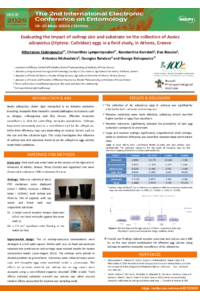
Aedes albopictus, known as the Asian tiger mosquito, is an invasive mosquito species and a key vector of several mosquito-borne diseases. Since its first record in Greece in 2003-2004, it has been established in almost all areas of the country, including Athens. Effective mosquito surveillance is vital for controlling mosquito populations. Ovitraps have been extensively used as a surveillance tool for Ae. albopictus, while their efficiency may vary depending on various factors such as the size and the substrate type. This study investigates the influence of trap size and substrate material on Ae. albopictus egg catches under field conditions. Over a 12-week period, a network of ovitraps of three different sizes —350 mL (small), 600 mL (medium), and 1100 mL (large)— were set up at the campus of the Agricultural University of Athens, Greece. Each trap was filled to three-quarters of its capacity with water and equipped with one of two types of substrates: a wooden strip or styrofoam. The traps were monitored weekly, using a 6 × 6 Latin square design for trap rotation. A zero-inflated negative binomial model was utilized to analyze the egg count data. The results showed a significant effect of both substrate and trap size on the collection of Ae. albopictus eggs. Wooden substrates were more effective, collecting almost double the number of eggs than styrofoam. Regarding the trap size, large and medium traps significantly outperformed small traps, catching a mean of 38.5 (± 5.06), 44.4 (± 5.98), and 24.7 (± 5.03) eggs per week, respectively, while no profound difference was identified between large and medium sizes. Our findings demonstrate that wooden substrates and larger trap sizes are the most effective combination for Aedes albopictus egg collection. This study provides insights from the field for optimizing ovitrap design to improve mosquito population surveillance and control strategies.
Keywords
Aedes albopictus
mosquito surveillance
ovitrap
substrate material
trap size
negative binomial GLMM
zero-inflated model
egg counts
vector control
mosquito population monitoring
Poster
sciforum-118227-Koliopoulos.pdf
Communities of the endangered and protected Carabus hungaricus Fabricius, 1792 (Coleoptera: Carabidae) in Bulgaria
The conservation status and prospects of the endangered and protected Carabus hungaricus Fabricius, 1792 (Coleoptera: Carabidae) in Bulgaria