Event submissions
Published
This submission belongs to the session S8. Medical and Veterinary Entomology of the event The 2nd International Electronic Conference on Entomology
Published date
17 May, 2025
Academic Editor
'%3e%3cpath%20d='M12.6657%2010.9104C12.4185%2010.325%2012.0599%209.79327%2011.6097%209.34482C11.1609%208.89508%2010.6293%208.5365%2010.0442%208.28888C10.0389%208.28626%2010.0337%208.28495%2010.0285%208.28233C10.8446%207.69279%2011.3752%206.73249%2011.3752%205.64904C11.3752%203.8542%209.92103%202.39999%208.1262%202.39999C6.33136%202.39999%204.87715%203.8542%204.87715%205.64904C4.87715%206.73249%205.40774%207.69279%206.22393%208.28364C6.21869%208.28626%206.21345%208.28757%206.20821%208.29019C5.62129%208.5378%205.09463%208.89284%204.64265%209.34613C4.1929%209.79493%203.83432%2010.3266%203.58671%2010.9117C3.34345%2011.4845%203.21226%2012.0987%203.20023%2012.7209C3.19988%2012.7349%203.20233%2012.7488%203.20744%2012.7619C3.21255%2012.7749%203.22022%2012.7867%203.22998%2012.7968C3.23975%2012.8068%203.25142%2012.8147%203.26431%2012.8202C3.2772%2012.8256%203.29105%2012.8284%203.30504%2012.8284H4.09109C4.14874%2012.8284%204.19459%2012.7825%204.1959%2012.7262C4.2221%2011.7148%204.62823%2010.7676%205.34617%2010.0497C6.08899%209.30683%207.0755%208.89808%208.1262%208.89808C9.17689%208.89808%2010.1634%209.30683%2010.9062%2010.0497C11.6242%2010.7676%2012.0303%2011.7148%2012.0565%2012.7262C12.0578%2012.7838%2012.1037%2012.8284%2012.1613%2012.8284H12.9474C12.9613%2012.8284%2012.9752%2012.8256%2012.9881%2012.8202C13.001%2012.8147%2013.0126%2012.8068%2013.0224%2012.7968C13.0322%2012.7867%2013.0398%2012.7749%2013.0449%2012.7619C13.0501%2012.7488%2013.0525%2012.7349%2013.0522%2012.7209C13.0391%2012.0947%2012.9094%2011.4855%2012.6657%2010.9104ZM8.1262%207.9024C7.52486%207.9024%206.9589%207.6679%206.53312%207.24211C6.10733%206.81633%205.87283%206.25037%205.87283%205.64904C5.87283%205.0477%206.10733%204.48174%206.53312%204.05596C6.9589%203.63018%207.52486%203.39567%208.1262%203.39567C8.72753%203.39567%209.29349%203.63018%209.71927%204.05596C10.1451%204.48174%2010.3796%205.0477%2010.3796%205.64904C10.3796%206.25037%2010.1451%206.81633%209.71927%207.24211C9.29349%207.6679%208.72753%207.9024%208.1262%207.9024Z'%20fill='%235D1EE1'/%3e%3c/g%3e%3c/svg%3e) Nickolas Kavallieratos
Nickolas KavallieratosCitation
Michela Bertola, Franco Mutinelli, Italy as a Hotspot for Honey Bee Threats, in Proceedings of The 2nd International Electronic Conference on Entomology, 19 May–21 May 2025, MDPI: Basel, Switzerland
Share
Email
Facebook
Twitter
LinkedIn
Italy as a Hotspot for Honey Bee Threats

Michela Bertola 1

Franco Mutinelli 1
1. National Reference Laboratory for Honey Bee Health, Istituto Zooprofilattico Sperimentale delle Venezie, Legnaro (PD), 35020 , Italy
Abstract
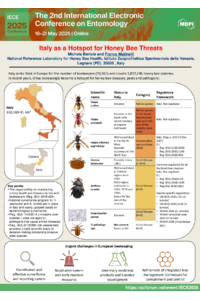
Italy is increasingly a hotspot for honey bee pests and predators, facing threats from Varroa destructor (1981), Aethina tumida (Small Hive Beetle, SHB) (2014), invasive Vespa velutina (2012), and the expanding native Vespa orientalis (2018). Adding to these concerns, Tropilaelaps spp. are emerging as a potential new threat to European beekeeping.
Tropilaelaps mercedesae mites, established since 2021 in Russia’s Krasnodar region and more recently in Georgia’s Samegrelo-Zemo Svaneti region (2024), pose significant challenges due to their rapid reproductive cycle and lack of effective control options. Unlike in Asia, where Tropilaelaps is well known, European beekeeping differs in hive management and honey bee species, requiring tailored surveillance and mitigation strategies.
Infestations spread quickly through direct contact between bees and the movement of infested bees or brood. Left undetected, mite populations grow rapidly, causing high hive mortality and acting as vectors for honey bee viruses.
The presence of exotic pests in Italy highlights the need for proactive measures. With Varroa, SHB, and Tropilaelaps all regulated under the Animal Health Law (EU 2016/429), Italy already faces three of the four listed honey bee diseases (EU 2018/1629). Key challenges include identifying effective surveillance methods, developing veterinary medicinal products (currently unavailable in Italy), and refining hive management techniques for containment and control.
The responsibility for maintaining colony health and biosecurity lies with beekeepers, but a science-based strategy is urgently needed. Managing Varroa, SHB, and invasive wasps demands integrated pest management and coordinated monitoring. Addressing the absence of approved Tropilaelaps treatments in Italy is critical to safeguarding European apiculture.
Keywords
beekeeping
control strategy
preparedness
mite infestation
Poster
Italy_Hotspot_Mutinelli.pdf
EDAX-Based Elemental Analysis of Okra Genotypes and Their Impact on Leafhopper Infestation
Macroscale morphological features of Jurassic European coleorrhynchans (Hemiptera)