Event submissions
Published
This submission belongs to the session S5. Pest Management, Pesticide Resistance, and Toxicology of the event The 2nd International Electronic Conference on Entomology
Published date
17 May, 2025
Academic Editor
'%3e%3cpath%20d='M12.6657%2010.9104C12.4185%2010.325%2012.0599%209.79327%2011.6097%209.34482C11.1609%208.89508%2010.6293%208.5365%2010.0442%208.28888C10.0389%208.28626%2010.0337%208.28495%2010.0285%208.28233C10.8446%207.69279%2011.3752%206.73249%2011.3752%205.64904C11.3752%203.8542%209.92103%202.39999%208.1262%202.39999C6.33136%202.39999%204.87715%203.8542%204.87715%205.64904C4.87715%206.73249%205.40774%207.69279%206.22393%208.28364C6.21869%208.28626%206.21345%208.28757%206.20821%208.29019C5.62129%208.5378%205.09463%208.89284%204.64265%209.34613C4.1929%209.79493%203.83432%2010.3266%203.58671%2010.9117C3.34345%2011.4845%203.21226%2012.0987%203.20023%2012.7209C3.19988%2012.7349%203.20233%2012.7488%203.20744%2012.7619C3.21255%2012.7749%203.22022%2012.7867%203.22998%2012.7968C3.23975%2012.8068%203.25142%2012.8147%203.26431%2012.8202C3.2772%2012.8256%203.29105%2012.8284%203.30504%2012.8284H4.09109C4.14874%2012.8284%204.19459%2012.7825%204.1959%2012.7262C4.2221%2011.7148%204.62823%2010.7676%205.34617%2010.0497C6.08899%209.30683%207.0755%208.89808%208.1262%208.89808C9.17689%208.89808%2010.1634%209.30683%2010.9062%2010.0497C11.6242%2010.7676%2012.0303%2011.7148%2012.0565%2012.7262C12.0578%2012.7838%2012.1037%2012.8284%2012.1613%2012.8284H12.9474C12.9613%2012.8284%2012.9752%2012.8256%2012.9881%2012.8202C13.001%2012.8147%2013.0126%2012.8068%2013.0224%2012.7968C13.0322%2012.7867%2013.0398%2012.7749%2013.0449%2012.7619C13.0501%2012.7488%2013.0525%2012.7349%2013.0522%2012.7209C13.0391%2012.0947%2012.9094%2011.4855%2012.6657%2010.9104ZM8.1262%207.9024C7.52486%207.9024%206.9589%207.6679%206.53312%207.24211C6.10733%206.81633%205.87283%206.25037%205.87283%205.64904C5.87283%205.0477%206.10733%204.48174%206.53312%204.05596C6.9589%203.63018%207.52486%203.39567%208.1262%203.39567C8.72753%203.39567%209.29349%203.63018%209.71927%204.05596C10.1451%204.48174%2010.3796%205.0477%2010.3796%205.64904C10.3796%206.25037%2010.1451%206.81633%209.71927%207.24211C9.29349%207.6679%208.72753%207.9024%208.1262%207.9024Z'%20fill='%235D1EE1'/%3e%3c/g%3e%3c/svg%3e) Louis Hesler
Louis HeslerCitation
Anum Feroz, Abdul Rauf Shakoori, Farah Rauf Shakoori, Modulations in the Activities of Digestive Enzymes and Phosphatases in Trogoderma granarium Larvae Following Exposure to Bifenthrin, Chlorpyrifos, and Their Combinations., in Proceedings of The 2nd International Electronic Conference on Entomology, 19 May–21 May 2025, MDPI: Basel, Switzerland
Share
Email
Facebook
Twitter
LinkedIn
Modulations in the Activities of Digestive Enzymes and Phosphatases in Trogoderma granarium Larvae Following Exposure to Bifenthrin, Chlorpyrifos, and Their Combinations.
'%3e%3cpath%20d='M12.6647%2010.9104C12.4176%2010.325%2012.0589%209.7933%2011.6088%209.34485C11.16%208.89511%2010.6283%208.53653%2010.0432%208.28891C10.038%208.28629%2010.0327%208.28498%2010.0275%208.28236C10.8437%207.69282%2011.3743%206.73252%2011.3743%205.64907C11.3743%203.85423%209.92005%202.40002%208.12522%202.40002C6.33038%202.40002%204.87618%203.85423%204.87618%205.64907C4.87618%206.73252%205.40677%207.69282%206.22296%208.28367C6.21772%208.28629%206.21248%208.2876%206.20724%208.29022C5.62031%208.53783%205.09365%208.89287%204.64167%209.34616C4.19192%209.79496%203.83334%2010.3266%203.58573%2010.9117C3.34247%2011.4846%203.21128%2012.0987%203.19925%2012.721C3.1989%2012.735%203.20135%2012.7489%203.20646%2012.7619C3.21157%2012.7749%203.21924%2012.7868%203.22901%2012.7968C3.23877%2012.8068%203.25045%2012.8148%203.26334%2012.8202C3.27623%2012.8256%203.29007%2012.8284%203.30406%2012.8284H4.09012C4.14776%2012.8284%204.19362%2012.7825%204.19493%2012.7262C4.22113%2011.7148%204.62726%2010.7676%205.34519%2010.0497C6.08802%209.30686%207.07452%208.89811%208.12522%208.89811C9.17592%208.89811%2010.1624%209.30686%2010.9052%2010.0497C11.6232%2010.7676%2012.0293%2011.7148%2012.0555%2012.7262C12.0568%2012.7839%2012.1027%2012.8284%2012.1603%2012.8284H12.9464C12.9604%2012.8284%2012.9742%2012.8256%2012.9871%2012.8202C13%2012.8148%2013.0117%2012.8068%2013.0214%2012.7968C13.0312%2012.7868%2013.0389%2012.7749%2013.044%2012.7619C13.0491%2012.7489%2013.0515%2012.735%2013.0512%2012.721C13.0381%2012.0947%2012.9084%2011.4856%2012.6647%2010.9104ZM8.12522%207.90243C7.52388%207.90243%206.95792%207.66793%206.53214%207.24215C6.10636%206.81636%205.87185%206.2504%205.87185%205.64907C5.87185%205.04773%206.10636%204.48177%206.53214%204.05599C6.95792%203.63021%207.52388%203.3957%208.12522%203.3957C8.72655%203.3957%209.29252%203.63021%209.7183%204.05599C10.1441%204.48177%2010.3786%205.04773%2010.3786%205.64907C10.3786%206.2504%2010.1441%206.81636%209.7183%207.24215C9.29252%207.66793%208.72655%207.90243%208.12522%207.90243Z'%20fill='%235D1EE1'/%3e%3c/g%3e%3c/svg%3e)
Anum Feroz 1
Abdul Rauf Shakoori 2
Farah Rauf Shakoori 1
1. Institute of Zoology, University of the Punjab, Quaid-i-Azam Campus, Lahore, PAKISTAN
2. School of Biological Sciences, University of the Punjab, Quaid-i-Azam Campus, Lahore PAKISTAN
Abstract
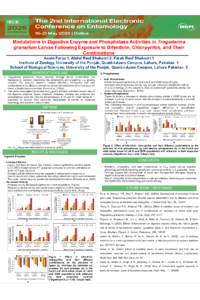
Introduction: Trogoderma granarium larvae severely damage stored commodities, but their resistance to common insecticides like deltamethrin and phosphine is a growing concern. Our previous research showed bifenthrin, chlorpyrifos, and their combinations to be effective alternatives at low concentrations which may pose no threat to health and the environment. This study investigates the impact of these neurotoxic insecticides on the digestive enzymes and phosphatases of T. granarium larvae to uncover their secondary mechanisms of toxicity on nutritional physiology and xenobiotic detoxification.
Methods: In the present study, 48 hours of exposure to LC20 (ppm) of bifenthrin, chlorpyrifos, and their combinations (3:1 and 1:3 bifenthrin:chlorpyrifos) were used to investigate the enzymatic responses of fourth and sixth instar T. granarium larvae. The study utilized both insecticide-susceptible (Lab-S) and deltamethrin-resistant (GUW) populations. Biochemical analyses were conducted to assess the activities of digestive enzymes (lipase, invertase, trehalase, amylase, and protease) and phosphatases (acid and alkaline phosphatase) in the exposed larvae.
Results: Exposure to bifenthrin, chlorpyrifos, and their combinations significantly (p ≤ 0.05) elevated the specific activities of lipase, invertase, trehalase, amylase, and acid phosphatase in comparison to control (untreated) in both susceptible and resistant populations of T. granarium larvae. The treatments decreased protease activity significantly. Alkaline phosphatase activity was decreased significantly in GUW larvae, but increased significantly in Lab-S larvae, except for some treatments that decreased activity in sixth instar Lab-S larvae.
Conclusions: The findings of this study suggest that bifenthrin, chlorpyrifos, and their combinations at low LC20 levels can affect the digestive physiology of T. granarium larvae, potentially leading to impaired growth and increased mortality. These results have implications for the development of novel pest management strategies targeting digestive enzymes and phosphatases, and provide further evidence for safe and effective use of chlorpyrifos at low concentrations, minimizing environmental and health risks while maintaining its pest control efficacy.
Keywords
Bifenthrin
Chlorpyrifos
Bifenthrin:Chlorpyrifos combinations
invertase
protease
acid phosphatase
Poster
poster1.pdf
The Plasticity of the national surveillance plan for Aethina tumida in Italy
Pterostichus montanus population dinamics: the impact of climate and cyclicity in Northern Baikal