Event submissions
Published
This submission belongs to the session S4. Biodiversity, Climate Change, Conservation, Ecology, and Evolution of the event The 2nd International Electronic Conference on Entomology
Published date
17 May, 2025
Academic Editor
'%3e%3cpath%20d='M12.6657%2010.9104C12.4185%2010.325%2012.0599%209.79327%2011.6097%209.34482C11.1609%208.89508%2010.6293%208.5365%2010.0442%208.28888C10.0389%208.28626%2010.0337%208.28495%2010.0285%208.28233C10.8446%207.69279%2011.3752%206.73249%2011.3752%205.64904C11.3752%203.8542%209.92103%202.39999%208.1262%202.39999C6.33136%202.39999%204.87715%203.8542%204.87715%205.64904C4.87715%206.73249%205.40774%207.69279%206.22393%208.28364C6.21869%208.28626%206.21345%208.28757%206.20821%208.29019C5.62129%208.5378%205.09463%208.89284%204.64265%209.34613C4.1929%209.79493%203.83432%2010.3266%203.58671%2010.9117C3.34345%2011.4845%203.21226%2012.0987%203.20023%2012.7209C3.19988%2012.7349%203.20233%2012.7488%203.20744%2012.7619C3.21255%2012.7749%203.22022%2012.7867%203.22998%2012.7968C3.23975%2012.8068%203.25142%2012.8147%203.26431%2012.8202C3.2772%2012.8256%203.29105%2012.8284%203.30504%2012.8284H4.09109C4.14874%2012.8284%204.19459%2012.7825%204.1959%2012.7262C4.2221%2011.7148%204.62823%2010.7676%205.34617%2010.0497C6.08899%209.30683%207.0755%208.89808%208.1262%208.89808C9.17689%208.89808%2010.1634%209.30683%2010.9062%2010.0497C11.6242%2010.7676%2012.0303%2011.7148%2012.0565%2012.7262C12.0578%2012.7838%2012.1037%2012.8284%2012.1613%2012.8284H12.9474C12.9613%2012.8284%2012.9752%2012.8256%2012.9881%2012.8202C13.001%2012.8147%2013.0126%2012.8068%2013.0224%2012.7968C13.0322%2012.7867%2013.0398%2012.7749%2013.0449%2012.7619C13.0501%2012.7488%2013.0525%2012.7349%2013.0522%2012.7209C13.0391%2012.0947%2012.9094%2011.4855%2012.6657%2010.9104ZM8.1262%207.9024C7.52486%207.9024%206.9589%207.6679%206.53312%207.24211C6.10733%206.81633%205.87283%206.25037%205.87283%205.64904C5.87283%205.0477%206.10733%204.48174%206.53312%204.05596C6.9589%203.63018%207.52486%203.39567%208.1262%203.39567C8.72753%203.39567%209.29349%203.63018%209.71927%204.05596C10.1451%204.48174%2010.3796%205.0477%2010.3796%205.64904C10.3796%206.25037%2010.1451%206.81633%209.71927%207.24211C9.29349%207.6679%208.72753%207.9024%208.1262%207.9024Z'%20fill='%235D1EE1'/%3e%3c/g%3e%3c/svg%3e) António Soares
António SoaresCitation
Tatiana Lvovna Ananina, Alexander Afanasyevich Ananin, Pterostichus montanus population dinamics: the impact of climate and cyclicity in Northern Baikal, in Proceedings of The 2nd International Electronic Conference on Entomology, 19 May–21 May 2025, MDPI: Basel, Switzerland
Share
Email
Facebook
Twitter
LinkedIn
Pterostichus montanus population dinamics: the impact of climate and cyclicity in Northern Baikal
'%3e%3cpath%20d='M12.6647%2010.9104C12.4176%2010.325%2012.0589%209.7933%2011.6088%209.34485C11.16%208.89511%2010.6283%208.53653%2010.0432%208.28891C10.038%208.28629%2010.0327%208.28498%2010.0275%208.28236C10.8437%207.69282%2011.3743%206.73252%2011.3743%205.64907C11.3743%203.85423%209.92005%202.40002%208.12522%202.40002C6.33038%202.40002%204.87618%203.85423%204.87618%205.64907C4.87618%206.73252%205.40677%207.69282%206.22296%208.28367C6.21772%208.28629%206.21248%208.2876%206.20724%208.29022C5.62031%208.53783%205.09365%208.89287%204.64167%209.34616C4.19192%209.79496%203.83334%2010.3266%203.58573%2010.9117C3.34247%2011.4846%203.21128%2012.0987%203.19925%2012.721C3.1989%2012.735%203.20135%2012.7489%203.20646%2012.7619C3.21157%2012.7749%203.21924%2012.7868%203.22901%2012.7968C3.23877%2012.8068%203.25045%2012.8148%203.26334%2012.8202C3.27623%2012.8256%203.29007%2012.8284%203.30406%2012.8284H4.09012C4.14776%2012.8284%204.19362%2012.7825%204.19493%2012.7262C4.22113%2011.7148%204.62726%2010.7676%205.34519%2010.0497C6.08802%209.30686%207.07452%208.89811%208.12522%208.89811C9.17592%208.89811%2010.1624%209.30686%2010.9052%2010.0497C11.6232%2010.7676%2012.0293%2011.7148%2012.0555%2012.7262C12.0568%2012.7839%2012.1027%2012.8284%2012.1603%2012.8284H12.9464C12.9604%2012.8284%2012.9742%2012.8256%2012.9871%2012.8202C13%2012.8148%2013.0117%2012.8068%2013.0214%2012.7968C13.0312%2012.7868%2013.0389%2012.7749%2013.044%2012.7619C13.0491%2012.7489%2013.0515%2012.735%2013.0512%2012.721C13.0381%2012.0947%2012.9084%2011.4856%2012.6647%2010.9104ZM8.12522%207.90243C7.52388%207.90243%206.95792%207.66793%206.53214%207.24215C6.10636%206.81636%205.87185%206.2504%205.87185%205.64907C5.87185%205.04773%206.10636%204.48177%206.53214%204.05599C6.95792%203.63021%207.52388%203.3957%208.12522%203.3957C8.72655%203.3957%209.29252%203.63021%209.7183%204.05599C10.1441%204.48177%2010.3786%205.04773%2010.3786%205.64907C10.3786%206.2504%2010.1441%206.81636%209.7183%207.24215C9.29252%207.66793%208.72655%207.90243%208.12522%207.90243Z'%20fill='%235D1EE1'/%3e%3c/g%3e%3c/svg%3e)
Tatiana Lvovna Ananina 1
Alexander Afanasyevich Ananin 2,3
1. United Administration of Barguzinsky State Nature
Biosphere Reserve and Zabaikalsky National Park, Ulan Ude, Russia
2. United Administration of Barguzinsky State Nature
Biosphere Reserve and Zabaikalsky National Park, Ulan-Ude, Russia
3. Institute of General and Experimental Biology SB RAS, Ulan-Ude, Russia
Abstract
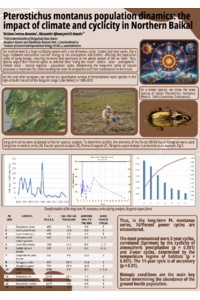
The diversity of life and the complexity of ecosystems are rooted in cyclicity—an order that ensures the functioning of biological processes. In various industries that utilize natural resources, it is crucial to consider the characteristics of natural cyclicity and make corresponding forecasts. In our study, we approached this task by analyzing the cyclicity of long-term numerical series of insects. As a model species, we selected a widespread species of the ground beetle family, Pterostichus montanus. From 1988 to 2020, we conducted quantitative surveys from May to September at 14 stationary sites located along a 30-kilometer transect stretching from the shore of Lake Baikal to a mountain peak of the Barguzinsky ridge. Simultaneously, we recorded average the monthly air temperature and total monthly precipitation.
For the visualization and interpretation of the long-term series, we used spectral analysis and elements of fractal geometry, specifically Pareto histograms, which rank factor categories in descending order and allow us to identify the most significant factors influencing the entire process. These methods enabled us to detect cycles and determine the most important factors affecting the abundance of ground beetles.
In the long-term series of the model species, we identified eight cycles of varying strength. The most pronounced were the two-year cycles associated with the cyclicity of atmospheric precipitation (p = 0.001) and the three-year cycles determined by temperature regimes (p = 0.001). Longer cycles with a frequency of 8-11 years were of secondary importance (p = 0.1). We also found that the abundance of this species does not decrease with increasing altitude. Favorable conditions for the abundance of ground beetles include a pronounced litter layer, moderate light, and moisture. The studied species primarily coordinates its population dynamics with the cyclicity of meteorological parameters, highlighting the importance of studying cyclicity and its impact on natural ecosystems.
Keywords
Ground beetles
series
cycles
temperature
precipitation
Northern Baikal
Barguzinsky ridge.
Poster
Плакат для Ананиной Т.Л._2.pdf
Modulations in the Activities of Digestive Enzymes and Phosphatases in Trogoderma granarium Larvae Following Exposure to Bifenthrin, Chlorpyrifos, and Their Combinations.
Integrative Taxonomy of a New Species of the Genus Coriophagus Kinzelbach from West Bengal, India, with a tentative phylogenetic relationship within the genus (Strepsiptera: Halictophagidae)