Event submissions
Published
This submission belongs to the session S6. Forest Entomology and Urban Entomology of the event The 2nd International Electronic Conference on Entomology
Published date
17 May, 2025
Academic Editor
'%3e%3cpath%20d='M12.6657%2010.9104C12.4185%2010.325%2012.0599%209.79327%2011.6097%209.34482C11.1609%208.89508%2010.6293%208.5365%2010.0442%208.28888C10.0389%208.28626%2010.0337%208.28495%2010.0285%208.28233C10.8446%207.69279%2011.3752%206.73249%2011.3752%205.64904C11.3752%203.8542%209.92103%202.39999%208.1262%202.39999C6.33136%202.39999%204.87715%203.8542%204.87715%205.64904C4.87715%206.73249%205.40774%207.69279%206.22393%208.28364C6.21869%208.28626%206.21345%208.28757%206.20821%208.29019C5.62129%208.5378%205.09463%208.89284%204.64265%209.34613C4.1929%209.79493%203.83432%2010.3266%203.58671%2010.9117C3.34345%2011.4845%203.21226%2012.0987%203.20023%2012.7209C3.19988%2012.7349%203.20233%2012.7488%203.20744%2012.7619C3.21255%2012.7749%203.22022%2012.7867%203.22998%2012.7968C3.23975%2012.8068%203.25142%2012.8147%203.26431%2012.8202C3.2772%2012.8256%203.29105%2012.8284%203.30504%2012.8284H4.09109C4.14874%2012.8284%204.19459%2012.7825%204.1959%2012.7262C4.2221%2011.7148%204.62823%2010.7676%205.34617%2010.0497C6.08899%209.30683%207.0755%208.89808%208.1262%208.89808C9.17689%208.89808%2010.1634%209.30683%2010.9062%2010.0497C11.6242%2010.7676%2012.0303%2011.7148%2012.0565%2012.7262C12.0578%2012.7838%2012.1037%2012.8284%2012.1613%2012.8284H12.9474C12.9613%2012.8284%2012.9752%2012.8256%2012.9881%2012.8202C13.001%2012.8147%2013.0126%2012.8068%2013.0224%2012.7968C13.0322%2012.7867%2013.0398%2012.7749%2013.0449%2012.7619C13.0501%2012.7488%2013.0525%2012.7349%2013.0522%2012.7209C13.0391%2012.0947%2012.9094%2011.4855%2012.6657%2010.9104ZM8.1262%207.9024C7.52486%207.9024%206.9589%207.6679%206.53312%207.24211C6.10733%206.81633%205.87283%206.25037%205.87283%205.64904C5.87283%205.0477%206.10733%204.48174%206.53312%204.05596C6.9589%203.63018%207.52486%203.39567%208.1262%203.39567C8.72753%203.39567%209.29349%203.63018%209.71927%204.05596C10.1451%204.48174%2010.3796%205.0477%2010.3796%205.64904C10.3796%206.25037%2010.1451%206.81633%209.71927%207.24211C9.29349%207.6679%208.72753%207.9024%208.1262%207.9024Z'%20fill='%235D1EE1'/%3e%3c/g%3e%3c/svg%3e) Antonella Di Palma
Antonella Di PalmaCitation
Jorge M. S. Faria, Luís Bonifácio, Maria L. Inácio, Dora Martins Teixeira, Edmundo Sousa, Tracing potential pinewood nematode semiochemicals emitted by its insect vector Monochamus galloprovincialis, in Proceedings of The 2nd International Electronic Conference on Entomology, 19 May–21 May 2025, MDPI: Basel, Switzerland
Share
Email
Facebook
Twitter
LinkedIn
Tracing potential pinewood nematode semiochemicals emitted by its insect vector Monochamus galloprovincialis

Jorge M. S. Faria 1,2
'%3e%3cpath%20d='M12.6647%2010.9104C12.4176%2010.325%2012.0589%209.7933%2011.6088%209.34485C11.16%208.89511%2010.6283%208.53653%2010.0432%208.28891C10.038%208.28629%2010.0327%208.28498%2010.0275%208.28236C10.8437%207.69282%2011.3743%206.73252%2011.3743%205.64907C11.3743%203.85423%209.92005%202.40002%208.12522%202.40002C6.33038%202.40002%204.87618%203.85423%204.87618%205.64907C4.87618%206.73252%205.40677%207.69282%206.22296%208.28367C6.21772%208.28629%206.21248%208.2876%206.20724%208.29022C5.62031%208.53783%205.09365%208.89287%204.64167%209.34616C4.19192%209.79496%203.83334%2010.3266%203.58573%2010.9117C3.34247%2011.4846%203.21128%2012.0987%203.19925%2012.721C3.1989%2012.735%203.20135%2012.7489%203.20646%2012.7619C3.21157%2012.7749%203.21924%2012.7868%203.22901%2012.7968C3.23877%2012.8068%203.25045%2012.8148%203.26334%2012.8202C3.27623%2012.8256%203.29007%2012.8284%203.30406%2012.8284H4.09012C4.14776%2012.8284%204.19362%2012.7825%204.19493%2012.7262C4.22113%2011.7148%204.62726%2010.7676%205.34519%2010.0497C6.08802%209.30686%207.07452%208.89811%208.12522%208.89811C9.17592%208.89811%2010.1624%209.30686%2010.9052%2010.0497C11.6232%2010.7676%2012.0293%2011.7148%2012.0555%2012.7262C12.0568%2012.7839%2012.1027%2012.8284%2012.1603%2012.8284H12.9464C12.9604%2012.8284%2012.9742%2012.8256%2012.9871%2012.8202C13%2012.8148%2013.0117%2012.8068%2013.0214%2012.7968C13.0312%2012.7868%2013.0389%2012.7749%2013.044%2012.7619C13.0491%2012.7489%2013.0515%2012.735%2013.0512%2012.721C13.0381%2012.0947%2012.9084%2011.4856%2012.6647%2010.9104ZM8.12522%207.90243C7.52388%207.90243%206.95792%207.66793%206.53214%207.24215C6.10636%206.81636%205.87185%206.2504%205.87185%205.64907C5.87185%205.04773%206.10636%204.48177%206.53214%204.05599C6.95792%203.63021%207.52388%203.3957%208.12522%203.3957C8.72655%203.3957%209.29252%203.63021%209.7183%204.05599C10.1441%204.48177%2010.3786%205.04773%2010.3786%205.64907C10.3786%206.2504%2010.1441%206.81636%209.7183%207.24215C9.29252%207.66793%208.72655%207.90243%208.12522%207.90243Z'%20fill='%235D1EE1'/%3e%3c/g%3e%3c/svg%3e)
Luís Bonifácio 1,2

Maria L. Inácio 2,3
Dora Martins Teixeira 4,5
Edmundo Sousa 1,2
1. INIAV, I.P., National Institute for Agrarian and Veterinarian Research, Quinta do Marquês, 2780-159 Oeiras, Portugal.
2. GREEN-IT Bioresources for Sustainability, Instituto de Tecnologia Química e Biológica, Universidade Nova de Lisboa (ITQB NOVA), Av. da República, 2780-157 Oeiras, Portugal
3. INIAV, I.P., National Institute for Agrarian and Veterinarian Research, Quinta do Marquês, 2780-159 Oeiras, Portugal
4. HERCULES Laboratory, Évora University, Largo Marquês de Marialva 8, 7000-809 Évora, Portugal.
5. Science and Technology School of Évora University, Rua Romão Ramalho nº59, 7000-671 Évora, Portugal.
Abstract
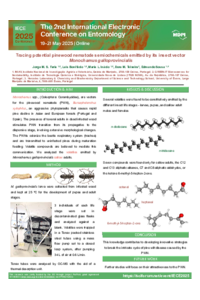
Monochamus spp., commonly known as sawyer beetles (Coleoptera: Cerambycidae), are conifer wood borers capable of causing decreases in wood value of up to 40 % due to the tunnels built by their larvae in freshly cut logs. However, the greatest impact on pine forests comes from their phoretic association with the pinewood nematode (PWN), Bursaphelenchus xylophilus, an aggressive phytoparasite that causes rapid pine decline in Asian and European forests (Portugal and Spain). Beetles become vectors for the PWN during the callow adult stage while still inside the pupal chambers, deep in infected pine wood. The presence of teneral adults in dead infected wood stimulates PWN's transition from the propagative to the dispersive stage (Dauer juveniles), involving extensive morphological changes. The colonized beetles transport PWNs in their respiratory system (trachea) and transmit them to uninfected pines during maturation feeding. The interaction between these two different organisms is still not completely understood, but volatile compounds are believed to mediate their communication. The present work aimed at profiling the volatiles emitted by different life stages of the European pine sawyer beetle Monochamus galloprovincialis through solid-phase microextraction (SPME) using sorbent packed tubes to capture emitted volatiles and thermal desorption coupled to gas chromatography–mass spectrometry (TD-GC-MS) for compound identification. Several volatiles were found to be constitutively emitted by the different insect life stages (larvae, pupae, and callow adult males and females); however, seven compounds were found in callow adults only, e.g., C12 and C13 aliphatic alkanes, C7 and C8 aliphatic aldehydes, or the ketone 6-methyl-5-hepten-2-one. Further studies will focus on their attractiveness to the PWN. This knowledge will contribute to developing innovative strategies to break the intricate cycle of pine wilt disease caused by the PWN.
This research was partly funded by the EU through project PurPest, grant agreement 101060634 (https://doi.org/10.3030/101060634) and PWNUK2022.
Keywords
Bursaphelenchus xylophilus
Monochamus
pinewood nematode
pine wilt disease
solid phase microextraction
volatiles
Poster
2025 Faria et al Poster.pdf
Apis cerana Honey Production and Colony Behavior: A Study on Hive Material Variations
Assessing the ability of Aedes albopictus and Aedes cretinus (Diptera: Culicidae) adults to survive winter under sheltered microclimatic conditions in northern Attica, Greece