Event submissions
Published
This submission belongs to the session S8. Medical and Veterinary Entomology of the event The 2nd International Electronic Conference on Entomology
Published date
17 May, 2025
Academic Editor
'%3e%3cpath%20d='M12.6657%2010.9104C12.4185%2010.325%2012.0599%209.79327%2011.6097%209.34482C11.1609%208.89508%2010.6293%208.5365%2010.0442%208.28888C10.0389%208.28626%2010.0337%208.28495%2010.0285%208.28233C10.8446%207.69279%2011.3752%206.73249%2011.3752%205.64904C11.3752%203.8542%209.92103%202.39999%208.1262%202.39999C6.33136%202.39999%204.87715%203.8542%204.87715%205.64904C4.87715%206.73249%205.40774%207.69279%206.22393%208.28364C6.21869%208.28626%206.21345%208.28757%206.20821%208.29019C5.62129%208.5378%205.09463%208.89284%204.64265%209.34613C4.1929%209.79493%203.83432%2010.3266%203.58671%2010.9117C3.34345%2011.4845%203.21226%2012.0987%203.20023%2012.7209C3.19988%2012.7349%203.20233%2012.7488%203.20744%2012.7619C3.21255%2012.7749%203.22022%2012.7867%203.22998%2012.7968C3.23975%2012.8068%203.25142%2012.8147%203.26431%2012.8202C3.2772%2012.8256%203.29105%2012.8284%203.30504%2012.8284H4.09109C4.14874%2012.8284%204.19459%2012.7825%204.1959%2012.7262C4.2221%2011.7148%204.62823%2010.7676%205.34617%2010.0497C6.08899%209.30683%207.0755%208.89808%208.1262%208.89808C9.17689%208.89808%2010.1634%209.30683%2010.9062%2010.0497C11.6242%2010.7676%2012.0303%2011.7148%2012.0565%2012.7262C12.0578%2012.7838%2012.1037%2012.8284%2012.1613%2012.8284H12.9474C12.9613%2012.8284%2012.9752%2012.8256%2012.9881%2012.8202C13.001%2012.8147%2013.0126%2012.8068%2013.0224%2012.7968C13.0322%2012.7867%2013.0398%2012.7749%2013.0449%2012.7619C13.0501%2012.7488%2013.0525%2012.7349%2013.0522%2012.7209C13.0391%2012.0947%2012.9094%2011.4855%2012.6657%2010.9104ZM8.1262%207.9024C7.52486%207.9024%206.9589%207.6679%206.53312%207.24211C6.10733%206.81633%205.87283%206.25037%205.87283%205.64904C5.87283%205.0477%206.10733%204.48174%206.53312%204.05596C6.9589%203.63018%207.52486%203.39567%208.1262%203.39567C8.72753%203.39567%209.29349%203.63018%209.71927%204.05596C10.1451%204.48174%2010.3796%205.0477%2010.3796%205.64904C10.3796%206.25037%2010.1451%206.81633%209.71927%207.24211C9.29349%207.6679%208.72753%207.9024%208.1262%207.9024Z'%20fill='%235D1EE1'/%3e%3c/g%3e%3c/svg%3e) Rui-De Xue
Rui-De XueCitation
Athanasios Giatropoulos, Chrisanthos Lymperopoulos, Ilias Kioulos, Antonios Michaelakis, Georgios Balatsos, Dimitrios Papachristos, George Koliopoulos, Assessing the ability of Aedes albopictus and Aedes cretinus (Diptera: Culicidae) adults to survive winter under sheltered microclimatic conditions in northern Attica, Greece, in Proceedings of The 2nd International Electronic Conference on Entomology, 19 May–21 May 2025, MDPI: Basel, Switzerland
Share
Email
Facebook
Twitter
LinkedIn
Assessing the ability of Aedes albopictus and Aedes cretinus (Diptera: Culicidae) adults to survive winter under sheltered microclimatic conditions in northern Attica, Greece

Athanasios Giatropoulos 1

Chrisanthos Lymperopoulos 2
'%3e%3cpath%20d='M12.6647%2010.9104C12.4176%2010.325%2012.0589%209.7933%2011.6088%209.34485C11.16%208.89511%2010.6283%208.53653%2010.0432%208.28891C10.038%208.28629%2010.0327%208.28498%2010.0275%208.28236C10.8437%207.69282%2011.3743%206.73252%2011.3743%205.64907C11.3743%203.85423%209.92005%202.40002%208.12522%202.40002C6.33038%202.40002%204.87618%203.85423%204.87618%205.64907C4.87618%206.73252%205.40677%207.69282%206.22296%208.28367C6.21772%208.28629%206.21248%208.2876%206.20724%208.29022C5.62031%208.53783%205.09365%208.89287%204.64167%209.34616C4.19192%209.79496%203.83334%2010.3266%203.58573%2010.9117C3.34247%2011.4846%203.21128%2012.0987%203.19925%2012.721C3.1989%2012.735%203.20135%2012.7489%203.20646%2012.7619C3.21157%2012.7749%203.21924%2012.7868%203.22901%2012.7968C3.23877%2012.8068%203.25045%2012.8148%203.26334%2012.8202C3.27623%2012.8256%203.29007%2012.8284%203.30406%2012.8284H4.09012C4.14776%2012.8284%204.19362%2012.7825%204.19493%2012.7262C4.22113%2011.7148%204.62726%2010.7676%205.34519%2010.0497C6.08802%209.30686%207.07452%208.89811%208.12522%208.89811C9.17592%208.89811%2010.1624%209.30686%2010.9052%2010.0497C11.6232%2010.7676%2012.0293%2011.7148%2012.0555%2012.7262C12.0568%2012.7839%2012.1027%2012.8284%2012.1603%2012.8284H12.9464C12.9604%2012.8284%2012.9742%2012.8256%2012.9871%2012.8202C13%2012.8148%2013.0117%2012.8068%2013.0214%2012.7968C13.0312%2012.7868%2013.0389%2012.7749%2013.044%2012.7619C13.0491%2012.7489%2013.0515%2012.735%2013.0512%2012.721C13.0381%2012.0947%2012.9084%2011.4856%2012.6647%2010.9104ZM8.12522%207.90243C7.52388%207.90243%206.95792%207.66793%206.53214%207.24215C6.10636%206.81636%205.87185%206.2504%205.87185%205.64907C5.87185%205.04773%206.10636%204.48177%206.53214%204.05599C6.95792%203.63021%207.52388%203.3957%208.12522%203.3957C8.72655%203.3957%209.29252%203.63021%209.7183%204.05599C10.1441%204.48177%2010.3786%205.04773%2010.3786%205.64907C10.3786%206.2504%2010.1441%206.81636%209.7183%207.24215C9.29252%207.66793%208.72655%207.90243%208.12522%207.90243Z'%20fill='%235D1EE1'/%3e%3c/g%3e%3c/svg%3e)
Ilias Kioulos 3

Antonios Michaelakis 4
Georgios Balatsos 4
Dimitrios Papachristos 5
George Koliopoulos 6
1. Laboratory of Efficacy Control of Pesticides, Benaki Phytopathological Institute, Kifissia, Greece
2. Laboratory of Agricultural Zoology and Entomology, Faculty of Crop Science, Agricultural University of Athens, Athens, Greece
3. Laboratory of Pesticide Science, Faculty of Crop Science, Agricultural University of Athens, Athens, Greece
4. Laboratory of Insects and Parasites of Medical Importance, Benaki Phytopathological Institute, Kifissia, Greece
5. Laboratory of Agricultural Entomology, Benaki Phytopathological Institute, Kifissia, Greece
6. Assistant Professor, Laboratory of Agricultural Zoology and Entomology, Faculty of Crop Science of Agricultural University of Athens
Abstract
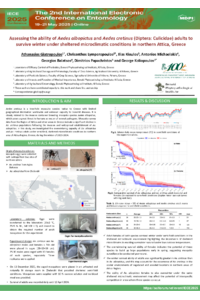
After the introduction of the invasive mosquito Aedes albopictus in the Attica Region and other areas of Greece, the native mosquito species Aedes cretinus has become scarce, while Ae. albopictus is widely distributed. The overwintering of mosquitoes determines their population dynamics in the next season. This study explored the survival ability of Ae. albopictus and Ae. cretinus adults in a sheltered environment in the northern area of the Attica Region, Greece, during the winter of 2023-2024. Male and female Aedes albopictus and Aedes cretinus were placed in cages within a sheltered environment in mid-December, and their survival was monitored continuously until mid-April. The results demonstrated that 11% of Ae. albopictus females and 21.1% of Ae. cretinus females were able to survive beyond the winter season (overwintering), indicating their potential to build up high populations early in the spring season. However, adult males of both species failed to overwinter. The capacity of adults to survive winter was significantly higher in Ae. cretinus than in Ae. albopictus, according to log-rank tests. This finding may justify the presence of Ae. cretinus in the cooler environments of vegetated and wooded locations in northern areas of Attica Region. However, the fact that Ae. albopictus females survived the winter under the same sheltered microclimatic environment underscores the potential of interspecific competition in these areas. This study emphasizes the need for extended monitoring of Ae. albopictus and Ae. cretinus populations during winter in sheltered places in Attica Region and other areas where these species co-exist to allow us to better understand their distribution patterns. Additionally, our results advocate targeted control measures for both mosquito species in sheltered places during winter to prevent early spring population growth.
Keywords
Aedes albopictus
Aedes cretinus
overwintering
native mosquito species
invasive mosquito species
winter adult survival
mosquito distribution
Poster
Giatropoulos et al Assessing the ability of Ae.albopictus & Ae.cretinus adults to survive winter.pdf
Tracing potential pinewood nematode semiochemicals emitted by its insect vector Monochamus galloprovincialis
Weather-Driven Mango Field Forecasting: Integrating the Prophet Model, Normalized Difference Vegetation Index, and Mealybug Dynamics for Precision Agriculture