Event submissions
Published
This submission belongs to the session S2. Biochemistry, Biotechnology, Genetics, and Genomics of the event The 2nd International Electronic Conference on Entomology
Published date
17 May, 2025
Academic Editor
'%3e%3cpath%20d='M12.6657%2010.9104C12.4185%2010.325%2012.0599%209.79327%2011.6097%209.34482C11.1609%208.89508%2010.6293%208.5365%2010.0442%208.28888C10.0389%208.28626%2010.0337%208.28495%2010.0285%208.28233C10.8446%207.69279%2011.3752%206.73249%2011.3752%205.64904C11.3752%203.8542%209.92103%202.39999%208.1262%202.39999C6.33136%202.39999%204.87715%203.8542%204.87715%205.64904C4.87715%206.73249%205.40774%207.69279%206.22393%208.28364C6.21869%208.28626%206.21345%208.28757%206.20821%208.29019C5.62129%208.5378%205.09463%208.89284%204.64265%209.34613C4.1929%209.79493%203.83432%2010.3266%203.58671%2010.9117C3.34345%2011.4845%203.21226%2012.0987%203.20023%2012.7209C3.19988%2012.7349%203.20233%2012.7488%203.20744%2012.7619C3.21255%2012.7749%203.22022%2012.7867%203.22998%2012.7968C3.23975%2012.8068%203.25142%2012.8147%203.26431%2012.8202C3.2772%2012.8256%203.29105%2012.8284%203.30504%2012.8284H4.09109C4.14874%2012.8284%204.19459%2012.7825%204.1959%2012.7262C4.2221%2011.7148%204.62823%2010.7676%205.34617%2010.0497C6.08899%209.30683%207.0755%208.89808%208.1262%208.89808C9.17689%208.89808%2010.1634%209.30683%2010.9062%2010.0497C11.6242%2010.7676%2012.0303%2011.7148%2012.0565%2012.7262C12.0578%2012.7838%2012.1037%2012.8284%2012.1613%2012.8284H12.9474C12.9613%2012.8284%2012.9752%2012.8256%2012.9881%2012.8202C13.001%2012.8147%2013.0126%2012.8068%2013.0224%2012.7968C13.0322%2012.7867%2013.0398%2012.7749%2013.0449%2012.7619C13.0501%2012.7488%2013.0525%2012.7349%2013.0522%2012.7209C13.0391%2012.0947%2012.9094%2011.4855%2012.6657%2010.9104ZM8.1262%207.9024C7.52486%207.9024%206.9589%207.6679%206.53312%207.24211C6.10733%206.81633%205.87283%206.25037%205.87283%205.64904C5.87283%205.0477%206.10733%204.48174%206.53312%204.05596C6.9589%203.63018%207.52486%203.39567%208.1262%203.39567C8.72753%203.39567%209.29349%203.63018%209.71927%204.05596C10.1451%204.48174%2010.3796%205.0477%2010.3796%205.64904C10.3796%206.25037%2010.1451%206.81633%209.71927%207.24211C9.29349%207.6679%208.72753%207.9024%208.1262%207.9024Z'%20fill='%235D1EE1'/%3e%3c/g%3e%3c/svg%3e) David Haymer
David HaymerCitation
Md Nazim Uddin, Md. Hasanuzzaman, Farzana Yesmin, Hybridization of Tephritid fruit flies: a cytogenetic study of Bactrocera zonata and Bactrocera dorsalis at lab conditions, in Proceedings of The 2nd International Electronic Conference on Entomology, 19 May–21 May 2025, MDPI: Basel, Switzerland
Share
Email
Facebook
Twitter
LinkedIn
Hybridization of Tephritid fruit flies: a cytogenetic study of Bactrocera zonata and Bactrocera dorsalis at lab conditions
'%3e%3cpath%20d='M12.6647%2010.9104C12.4176%2010.325%2012.0589%209.7933%2011.6088%209.34485C11.16%208.89511%2010.6283%208.53653%2010.0432%208.28891C10.038%208.28629%2010.0327%208.28498%2010.0275%208.28236C10.8437%207.69282%2011.3743%206.73252%2011.3743%205.64907C11.3743%203.85423%209.92005%202.40002%208.12522%202.40002C6.33038%202.40002%204.87618%203.85423%204.87618%205.64907C4.87618%206.73252%205.40677%207.69282%206.22296%208.28367C6.21772%208.28629%206.21248%208.2876%206.20724%208.29022C5.62031%208.53783%205.09365%208.89287%204.64167%209.34616C4.19192%209.79496%203.83334%2010.3266%203.58573%2010.9117C3.34247%2011.4846%203.21128%2012.0987%203.19925%2012.721C3.1989%2012.735%203.20135%2012.7489%203.20646%2012.7619C3.21157%2012.7749%203.21924%2012.7868%203.22901%2012.7968C3.23877%2012.8068%203.25045%2012.8148%203.26334%2012.8202C3.27623%2012.8256%203.29007%2012.8284%203.30406%2012.8284H4.09012C4.14776%2012.8284%204.19362%2012.7825%204.19493%2012.7262C4.22113%2011.7148%204.62726%2010.7676%205.34519%2010.0497C6.08802%209.30686%207.07452%208.89811%208.12522%208.89811C9.17592%208.89811%2010.1624%209.30686%2010.9052%2010.0497C11.6232%2010.7676%2012.0293%2011.7148%2012.0555%2012.7262C12.0568%2012.7839%2012.1027%2012.8284%2012.1603%2012.8284H12.9464C12.9604%2012.8284%2012.9742%2012.8256%2012.9871%2012.8202C13%2012.8148%2013.0117%2012.8068%2013.0214%2012.7968C13.0312%2012.7868%2013.0389%2012.7749%2013.044%2012.7619C13.0491%2012.7489%2013.0515%2012.735%2013.0512%2012.721C13.0381%2012.0947%2012.9084%2011.4856%2012.6647%2010.9104ZM8.12522%207.90243C7.52388%207.90243%206.95792%207.66793%206.53214%207.24215C6.10636%206.81636%205.87185%206.2504%205.87185%205.64907C5.87185%205.04773%206.10636%204.48177%206.53214%204.05599C6.95792%203.63021%207.52388%203.3957%208.12522%203.3957C8.72655%203.3957%209.29252%203.63021%209.7183%204.05599C10.1441%204.48177%2010.3786%205.04773%2010.3786%205.64907C10.3786%206.2504%2010.1441%206.81636%209.7183%207.24215C9.29252%207.66793%208.72655%207.90243%208.12522%207.90243Z'%20fill='%235D1EE1'/%3e%3c/g%3e%3c/svg%3e)
Md Nazim Uddin 1

Md. Hasanuzzaman 2
Farzana Yesmin 2
1. Department of Zoology, Darsana Govt. College, Chuadanga, Bangladesh
2. Cytology and Biocontrol Research (CBR), Radiation Entomology and Acarology Division (READ), Institute of Food and Radiation Biology (IFRB), Atomic Energy Research Establishment (AERE), Bangladesh Atomic Energy Commission (BAEC), Dhaka-1000, Bangladesh.
Abstract
Hybridization modifies the genetic structure of the individuals or populations and affects the phenotypic stability depending on the genetic diversity of closely related species. In some cases, it exposes strong heterotic characters or disrupts their developmental stabilities due to new interrogated and/or broken gene(s). To check these inferences, we crossed Bactrocera zonata ♂ and B. dorsalis ♀ at a 1:3 ratio and studied their mitotic metaphase chromosomes following air drying and C-banding techniques at the CBR lab, IFRB, AERE, Dhaka. We examined five pairs of autosomes and one pair of sex chromosomes (parents and the hybrid). Karyotype morphology and heterochromatin distribution in mitotic metaphase chromosomes of B. zonata were studied and have already been reported. The total chromosome length of B. dorsalis and the hybrid was 47.16 µm and 33.18 µm, respectively. Chromosome 2 was the longest and the sex chromosome (X) was smallest except in the hybrid where 6 was the smallest one. Chromosomes 4 and X were metacentric, and 5 and 6 were submetacentric in all cases. Chromosome 2 was metacentric and Chromosome 3 was submetacentric in B. dorsalis and the hybrid. The Y chromosome was dot-shaped and fully heterochromatic. The B. dorsalis female contained more heterochromatin block than its male while the opposite scenario was found in the hybrid. Chromosomes 2, 3 and 4 had pericentric and 5, 6 and X had centromeric heterochromatin block. The hybrid was composed of the largest telomeric band in the X chromosome long arm. Due to genetic introgression, the hybrid's resulting autosome's length of was similar to that of its parental father (B. zonata) and its morphology was similar to that of its parental mother (B. dorsalis). Genetic material transmission from B. zonata to B. dorsalis or vice versa was a positive sign that B. zonata would become a new member of the B. dorsalis species complex that mediates in active pest management program.
Keywords
Hybridization
Bactrocera zonata
Bactrocera dorsalis
karyotype
heterochromatin
gene introgression
Poster
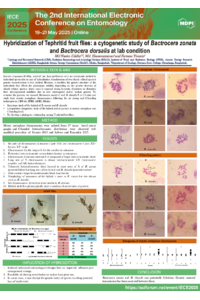
IECE 2025 Poster- 118112.pdf
Weather-Driven Mango Field Forecasting: Integrating the Prophet Model, Normalized Difference Vegetation Index, and Mealybug Dynamics for Precision Agriculture
The use of Galleria melonella larvae as an alternative animal model to evaluate the toxicity of the ethanolic extract of Schinus lentiscifolius