Event submissions
Published
This submission belongs to the session S3. Behaviour, Biology, and Physiology of the event The 2nd International Electronic Conference on Entomology
Published date
17 May, 2025
Academic Editor
'%3e%3cpath%20d='M12.6657%2010.9104C12.4185%2010.325%2012.0599%209.79327%2011.6097%209.34482C11.1609%208.89508%2010.6293%208.5365%2010.0442%208.28888C10.0389%208.28626%2010.0337%208.28495%2010.0285%208.28233C10.8446%207.69279%2011.3752%206.73249%2011.3752%205.64904C11.3752%203.8542%209.92103%202.39999%208.1262%202.39999C6.33136%202.39999%204.87715%203.8542%204.87715%205.64904C4.87715%206.73249%205.40774%207.69279%206.22393%208.28364C6.21869%208.28626%206.21345%208.28757%206.20821%208.29019C5.62129%208.5378%205.09463%208.89284%204.64265%209.34613C4.1929%209.79493%203.83432%2010.3266%203.58671%2010.9117C3.34345%2011.4845%203.21226%2012.0987%203.20023%2012.7209C3.19988%2012.7349%203.20233%2012.7488%203.20744%2012.7619C3.21255%2012.7749%203.22022%2012.7867%203.22998%2012.7968C3.23975%2012.8068%203.25142%2012.8147%203.26431%2012.8202C3.2772%2012.8256%203.29105%2012.8284%203.30504%2012.8284H4.09109C4.14874%2012.8284%204.19459%2012.7825%204.1959%2012.7262C4.2221%2011.7148%204.62823%2010.7676%205.34617%2010.0497C6.08899%209.30683%207.0755%208.89808%208.1262%208.89808C9.17689%208.89808%2010.1634%209.30683%2010.9062%2010.0497C11.6242%2010.7676%2012.0303%2011.7148%2012.0565%2012.7262C12.0578%2012.7838%2012.1037%2012.8284%2012.1613%2012.8284H12.9474C12.9613%2012.8284%2012.9752%2012.8256%2012.9881%2012.8202C13.001%2012.8147%2013.0126%2012.8068%2013.0224%2012.7968C13.0322%2012.7867%2013.0398%2012.7749%2013.0449%2012.7619C13.0501%2012.7488%2013.0525%2012.7349%2013.0522%2012.7209C13.0391%2012.0947%2012.9094%2011.4855%2012.6657%2010.9104ZM8.1262%207.9024C7.52486%207.9024%206.9589%207.6679%206.53312%207.24211C6.10733%206.81633%205.87283%206.25037%205.87283%205.64904C5.87283%205.0477%206.10733%204.48174%206.53312%204.05596C6.9589%203.63018%207.52486%203.39567%208.1262%203.39567C8.72753%203.39567%209.29349%203.63018%209.71927%204.05596C10.1451%204.48174%2010.3796%205.0477%2010.3796%205.64904C10.3796%206.25037%2010.1451%206.81633%209.71927%207.24211C9.29349%207.6679%208.72753%207.9024%208.1262%207.9024Z'%20fill='%235D1EE1'/%3e%3c/g%3e%3c/svg%3e) Kristopher Giles
Kristopher GilesCitation
Kaushik Kumar Das, Surender Singh Yadav, Varun Saini, The Effect of Temperature on the Development and Life Cycle of the Melon Fruit Fly (Zeugodacus cucurbitae), in Proceedings of The 2nd International Electronic Conference on Entomology, 19 May–21 May 2025, MDPI: Basel, Switzerland
Share
Email
Facebook
Twitter
LinkedIn
The Effect of Temperature on the Development and Life Cycle of the Melon Fruit Fly (Zeugodacus cucurbitae)
'%3e%3cpath%20d='M12.6647%2010.9104C12.4176%2010.325%2012.0589%209.7933%2011.6088%209.34485C11.16%208.89511%2010.6283%208.53653%2010.0432%208.28891C10.038%208.28629%2010.0327%208.28498%2010.0275%208.28236C10.8437%207.69282%2011.3743%206.73252%2011.3743%205.64907C11.3743%203.85423%209.92005%202.40002%208.12522%202.40002C6.33038%202.40002%204.87618%203.85423%204.87618%205.64907C4.87618%206.73252%205.40677%207.69282%206.22296%208.28367C6.21772%208.28629%206.21248%208.2876%206.20724%208.29022C5.62031%208.53783%205.09365%208.89287%204.64167%209.34616C4.19192%209.79496%203.83334%2010.3266%203.58573%2010.9117C3.34247%2011.4846%203.21128%2012.0987%203.19925%2012.721C3.1989%2012.735%203.20135%2012.7489%203.20646%2012.7619C3.21157%2012.7749%203.21924%2012.7868%203.22901%2012.7968C3.23877%2012.8068%203.25045%2012.8148%203.26334%2012.8202C3.27623%2012.8256%203.29007%2012.8284%203.30406%2012.8284H4.09012C4.14776%2012.8284%204.19362%2012.7825%204.19493%2012.7262C4.22113%2011.7148%204.62726%2010.7676%205.34519%2010.0497C6.08802%209.30686%207.07452%208.89811%208.12522%208.89811C9.17592%208.89811%2010.1624%209.30686%2010.9052%2010.0497C11.6232%2010.7676%2012.0293%2011.7148%2012.0555%2012.7262C12.0568%2012.7839%2012.1027%2012.8284%2012.1603%2012.8284H12.9464C12.9604%2012.8284%2012.9742%2012.8256%2012.9871%2012.8202C13%2012.8148%2013.0117%2012.8068%2013.0214%2012.7968C13.0312%2012.7868%2013.0389%2012.7749%2013.044%2012.7619C13.0491%2012.7489%2013.0515%2012.735%2013.0512%2012.721C13.0381%2012.0947%2012.9084%2011.4856%2012.6647%2010.9104ZM8.12522%207.90243C7.52388%207.90243%206.95792%207.66793%206.53214%207.24215C6.10636%206.81636%205.87185%206.2504%205.87185%205.64907C5.87185%205.04773%206.10636%204.48177%206.53214%204.05599C6.95792%203.63021%207.52388%203.3957%208.12522%203.3957C8.72655%203.3957%209.29252%203.63021%209.7183%204.05599C10.1441%204.48177%2010.3786%205.04773%2010.3786%205.64907C10.3786%206.2504%2010.1441%206.81636%209.7183%207.24215C9.29252%207.66793%208.72655%207.90243%208.12522%207.90243Z'%20fill='%235D1EE1'/%3e%3c/g%3e%3c/svg%3e)
Kaushik Kumar Das 1
Surender Singh Yadav 1
Varun Saini 1
1. Department of Entomology, CCS Haryana Agricultural University, Hisar, Haryana, India-125004
Abstract
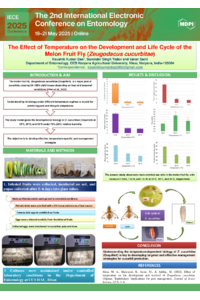
The melon fruit fly, Zeugodacus cucurbitae (Coquillett), is a major pest of cucurbit crops, causing economic losses of up to 30-100% depending on the severity of infestation. Temperature is a critical factor influencing its development, reproductive potential, and survival. This laboratory study was conducted at the Department of Entomology, Chaudhary Charan Singh Haryana Agricultural University, Hisar, Haryana, India, to evaluate the effect of different temperatures on its life cycle. Experiments were performed at three temperatures, 15°C, 25°C, and 35°C, under a controlled relative humidity of 75% (±5%), using infested cucumber fruits as the culture source. The incubation period was observed to besignificantly prolonged at 15°C (8.4 ± 0.63 days) compared to 25°C (0.72 ± 0.13 days) and 35°C (0.65 ± 0.13 days). The total maggot duration was the longest at 15°C (23.9 ± 1.71 days) compared to 25°C (5.08 ± 1.50 days) and 35°C (3.65 ± 1.27 days). Similarly, the pupal period was the longestat 15°C (34.3 ± 0.81 days), decreasing at 25°C (8.7 ± 0.68 days) and 35°C (8.0 ± 0.94 days). Adult longevity was significantly higher at 15°C (males: 46.3 ± 0.82 days; females: 48.1 ± 1.58 days) compared to 25°C (males: 23.3 ± 1.42 days; females: 25.3 ± 2.06 days) and 35°C (males: 16 ± 0.67 days; females: 20.2 ± 0.63 days). Female fecundity was the highest at 25°C (77.1 ± 3.21 eggs) compared to 15°C (70.3 ± 0.49 eggs) and 35°C (72.5 ± 2.84 eggs). A male-biased sex ratio was observed at all temperatures, with values of 1:0.64, 1:0.74, and 1:0.76 at 15°C, 25°C, and 35°C, respectively. These findings highlight the influence of temperature on the developmental biology of the melon fruit fly, which has important implications for its population dynamics and management.
Keywords
Fruit fly
Biology
Temperature
Development
Life cycle
Poster
Kaushik Kr Das.pdf
The use of Galleria melonella larvae as an alternative animal model to evaluate the toxicity of the ethanolic extract of Schinus lentiscifolius
Heat-Driven Adaptations: Temperature-Modulated Enzymatic Strategies in Mustard Aphid Morphs