Event submissions
Published
This submission belongs to the session S1. Morphology and Systematics of the event The 2nd International Electronic Conference on Entomology
Published date
17 May, 2025
Academic Editor
'%3e%3cpath%20d='M12.6657%2010.9104C12.4185%2010.325%2012.0599%209.79327%2011.6097%209.34482C11.1609%208.89508%2010.6293%208.5365%2010.0442%208.28888C10.0389%208.28626%2010.0337%208.28495%2010.0285%208.28233C10.8446%207.69279%2011.3752%206.73249%2011.3752%205.64904C11.3752%203.8542%209.92103%202.39999%208.1262%202.39999C6.33136%202.39999%204.87715%203.8542%204.87715%205.64904C4.87715%206.73249%205.40774%207.69279%206.22393%208.28364C6.21869%208.28626%206.21345%208.28757%206.20821%208.29019C5.62129%208.5378%205.09463%208.89284%204.64265%209.34613C4.1929%209.79493%203.83432%2010.3266%203.58671%2010.9117C3.34345%2011.4845%203.21226%2012.0987%203.20023%2012.7209C3.19988%2012.7349%203.20233%2012.7488%203.20744%2012.7619C3.21255%2012.7749%203.22022%2012.7867%203.22998%2012.7968C3.23975%2012.8068%203.25142%2012.8147%203.26431%2012.8202C3.2772%2012.8256%203.29105%2012.8284%203.30504%2012.8284H4.09109C4.14874%2012.8284%204.19459%2012.7825%204.1959%2012.7262C4.2221%2011.7148%204.62823%2010.7676%205.34617%2010.0497C6.08899%209.30683%207.0755%208.89808%208.1262%208.89808C9.17689%208.89808%2010.1634%209.30683%2010.9062%2010.0497C11.6242%2010.7676%2012.0303%2011.7148%2012.0565%2012.7262C12.0578%2012.7838%2012.1037%2012.8284%2012.1613%2012.8284H12.9474C12.9613%2012.8284%2012.9752%2012.8256%2012.9881%2012.8202C13.001%2012.8147%2013.0126%2012.8068%2013.0224%2012.7968C13.0322%2012.7867%2013.0398%2012.7749%2013.0449%2012.7619C13.0501%2012.7488%2013.0525%2012.7349%2013.0522%2012.7209C13.0391%2012.0947%2012.9094%2011.4855%2012.6657%2010.9104ZM8.1262%207.9024C7.52486%207.9024%206.9589%207.6679%206.53312%207.24211C6.10733%206.81633%205.87283%206.25037%205.87283%205.64904C5.87283%205.0477%206.10733%204.48174%206.53312%204.05596C6.9589%203.63018%207.52486%203.39567%208.1262%203.39567C8.72753%203.39567%209.29349%203.63018%209.71927%204.05596C10.1451%204.48174%2010.3796%205.0477%2010.3796%205.64904C10.3796%206.25037%2010.1451%206.81633%209.71927%207.24211C9.29349%207.6679%208.72753%207.9024%208.1262%207.9024Z'%20fill='%235D1EE1'/%3e%3c/g%3e%3c/svg%3e) Andjeljko Petrović
Andjeljko PetrovićCitation
Vukica Dragutin Vujić, Boris Dudić, Luka Lučić, Vladimir Tomić, Sofija Pavković-Lučić, Tatjana Savić, Temperature-related changes in wing size and shape in two sibling species, Drosophila melanogaster and D. simulans (Diptera: Drosophilidae), in Proceedings of The 2nd International Electronic Conference on Entomology, 19 May–21 May 2025, MDPI: Basel, Switzerland
Share
Email
Facebook
Twitter
LinkedIn
Temperature-related changes in wing size and shape in two sibling species, Drosophila melanogaster and D. simulans (Diptera: Drosophilidae)
'%3e%3cpath%20d='M12.6647%2010.9104C12.4176%2010.325%2012.0589%209.7933%2011.6088%209.34485C11.16%208.89511%2010.6283%208.53653%2010.0432%208.28891C10.038%208.28629%2010.0327%208.28498%2010.0275%208.28236C10.8437%207.69282%2011.3743%206.73252%2011.3743%205.64907C11.3743%203.85423%209.92005%202.40002%208.12522%202.40002C6.33038%202.40002%204.87618%203.85423%204.87618%205.64907C4.87618%206.73252%205.40677%207.69282%206.22296%208.28367C6.21772%208.28629%206.21248%208.2876%206.20724%208.29022C5.62031%208.53783%205.09365%208.89287%204.64167%209.34616C4.19192%209.79496%203.83334%2010.3266%203.58573%2010.9117C3.34247%2011.4846%203.21128%2012.0987%203.19925%2012.721C3.1989%2012.735%203.20135%2012.7489%203.20646%2012.7619C3.21157%2012.7749%203.21924%2012.7868%203.22901%2012.7968C3.23877%2012.8068%203.25045%2012.8148%203.26334%2012.8202C3.27623%2012.8256%203.29007%2012.8284%203.30406%2012.8284H4.09012C4.14776%2012.8284%204.19362%2012.7825%204.19493%2012.7262C4.22113%2011.7148%204.62726%2010.7676%205.34519%2010.0497C6.08802%209.30686%207.07452%208.89811%208.12522%208.89811C9.17592%208.89811%2010.1624%209.30686%2010.9052%2010.0497C11.6232%2010.7676%2012.0293%2011.7148%2012.0555%2012.7262C12.0568%2012.7839%2012.1027%2012.8284%2012.1603%2012.8284H12.9464C12.9604%2012.8284%2012.9742%2012.8256%2012.9871%2012.8202C13%2012.8148%2013.0117%2012.8068%2013.0214%2012.7968C13.0312%2012.7868%2013.0389%2012.7749%2013.044%2012.7619C13.0491%2012.7489%2013.0515%2012.735%2013.0512%2012.721C13.0381%2012.0947%2012.9084%2011.4856%2012.6647%2010.9104ZM8.12522%207.90243C7.52388%207.90243%206.95792%207.66793%206.53214%207.24215C6.10636%206.81636%205.87185%206.2504%205.87185%205.64907C5.87185%205.04773%206.10636%204.48177%206.53214%204.05599C6.95792%203.63021%207.52388%203.3957%208.12522%203.3957C8.72655%203.3957%209.29252%203.63021%209.7183%204.05599C10.1441%204.48177%2010.3786%205.04773%2010.3786%205.64907C10.3786%206.2504%2010.1441%206.81636%209.7183%207.24215C9.29252%207.66793%208.72655%207.90243%208.12522%207.90243Z'%20fill='%235D1EE1'/%3e%3c/g%3e%3c/svg%3e)
Vukica Dragutin Vujić 1
Boris Dudić 2
Luka Lučić 2
Vladimir Tomić 2
Sofija Pavković-Lučić 1
Tatjana Savić 3
1. Department of Genetics and Evolution, Faculty of Biology, University of Belgrade, 11 000 Belgrade, Serbia
2. Department of Animal Development, Faculty of Biology, University of Belgrade, 11 000 Belgrade, Serbia
3. Department of Genetics of Populations and Ecogenotoxicology, Institute for Biological Research "Siniša Stanković", University of Belgrade, 11 000 Belgrade, Serbia
Abstract
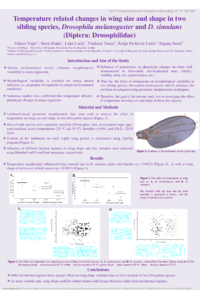
Introduction: Morphological and life-history traits represent characteristics influenced by various environmental factors that can contribute to adaptive variability in many organisms. Temperature is an important environmental factor that drives phenotypic change in different traits in Drosophila (developmental time, fertility, viability, body size, pigmentation, etc.). Therefore, the aim of this study was to investigate the effect of temperature on wing size and shape in two sibling species, Drosophila melanogaster and D. simulans. Methods: Differences in wing size and shape between D. melanogaster and D. simulans flies reared on different thermal regimes were analyzed using a geometric morphometric approach. Both Drosophila species were separately reared on cornmeal–sugar–agar–yeast substrates, at two temperatures (25°C and 19°C), a humidity of 60%, and 12h L–12h D cycle. Wing size and shape were analyzed in 400 individuals (200 individuals per species, i.e., 100 per sex). TpsDig software was used to mark fifteen landmarks per wing picture. The effect of different temperatures on wing shape in both Drosophila species was investigated by Canonical Variate Analysis using the MorphoJ program, while the influence of distinct temperatures on wing centroid size was analyzed in the program CoordGen6. Results: The obtained results indicated that temperature significantly influenced wing shape in males and females in both Drosophila species (p < 0.0001). However, temperature significantly influenced wing centroid size in males and females of D. simulans, which was not the case in its sibling (D. simulans: p = 0.0422; D. melanogaster: p = 0.9994). Conclusion: Based on the results, we can conclude that wing shape is a more variable trait than wing size across temperatures, which could be further related with flying efficiency under different thermal regimes.
Keywords
Drosophila melanogaster
D. simulans
temperature
wing shape
wing size
Poster
Vujic et al 2F.pdf
Toxicological and biochemical effects of Malathion on Ceratitis capitata adults (Tephritidae) from Tunisian oasis
Breeding Habitat Preferences and Environmental Dynamics of Aedes Mosquitoes in Urban and Semi-Urban Areas of Ibadan, Nigeria