Event submissions
Published
This submission belongs to the session S3. Behaviour, Biology, and Physiology of the event The 2nd International Electronic Conference on Entomology
Published date
17 May, 2025
Academic Editor
'%3e%3cpath%20d='M12.6657%2010.9104C12.4185%2010.325%2012.0599%209.79327%2011.6097%209.34482C11.1609%208.89508%2010.6293%208.5365%2010.0442%208.28888C10.0389%208.28626%2010.0337%208.28495%2010.0285%208.28233C10.8446%207.69279%2011.3752%206.73249%2011.3752%205.64904C11.3752%203.8542%209.92103%202.39999%208.1262%202.39999C6.33136%202.39999%204.87715%203.8542%204.87715%205.64904C4.87715%206.73249%205.40774%207.69279%206.22393%208.28364C6.21869%208.28626%206.21345%208.28757%206.20821%208.29019C5.62129%208.5378%205.09463%208.89284%204.64265%209.34613C4.1929%209.79493%203.83432%2010.3266%203.58671%2010.9117C3.34345%2011.4845%203.21226%2012.0987%203.20023%2012.7209C3.19988%2012.7349%203.20233%2012.7488%203.20744%2012.7619C3.21255%2012.7749%203.22022%2012.7867%203.22998%2012.7968C3.23975%2012.8068%203.25142%2012.8147%203.26431%2012.8202C3.2772%2012.8256%203.29105%2012.8284%203.30504%2012.8284H4.09109C4.14874%2012.8284%204.19459%2012.7825%204.1959%2012.7262C4.2221%2011.7148%204.62823%2010.7676%205.34617%2010.0497C6.08899%209.30683%207.0755%208.89808%208.1262%208.89808C9.17689%208.89808%2010.1634%209.30683%2010.9062%2010.0497C11.6242%2010.7676%2012.0303%2011.7148%2012.0565%2012.7262C12.0578%2012.7838%2012.1037%2012.8284%2012.1613%2012.8284H12.9474C12.9613%2012.8284%2012.9752%2012.8256%2012.9881%2012.8202C13.001%2012.8147%2013.0126%2012.8068%2013.0224%2012.7968C13.0322%2012.7867%2013.0398%2012.7749%2013.0449%2012.7619C13.0501%2012.7488%2013.0525%2012.7349%2013.0522%2012.7209C13.0391%2012.0947%2012.9094%2011.4855%2012.6657%2010.9104ZM8.1262%207.9024C7.52486%207.9024%206.9589%207.6679%206.53312%207.24211C6.10733%206.81633%205.87283%206.25037%205.87283%205.64904C5.87283%205.0477%206.10733%204.48174%206.53312%204.05596C6.9589%203.63018%207.52486%203.39567%208.1262%203.39567C8.72753%203.39567%209.29349%203.63018%209.71927%204.05596C10.1451%204.48174%2010.3796%205.0477%2010.3796%205.64904C10.3796%206.25037%2010.1451%206.81633%209.71927%207.24211C9.29349%207.6679%208.72753%207.9024%208.1262%207.9024Z'%20fill='%235D1EE1'/%3e%3c/g%3e%3c/svg%3e) Kristopher Giles
Kristopher GilesCitation
Jelena Repac, Jelena Trajković, Marija Rakić, Tanja Lunić, Tatjana Savić, Bojan Božić, Biljana Božić Nedeljković, Sofija Pavković-Lučić, The impact of different long-term dietary regimes on microbiota communities in Drosophila melanogaster, in Proceedings of The 2nd International Electronic Conference on Entomology, 19 May–21 May 2025, MDPI: Basel, Switzerland
Share
Email
Facebook
Twitter
LinkedIn
The impact of different long-term dietary regimes on microbiota communities in Drosophila melanogaster
'%3e%3cpath%20d='M12.6647%2010.9104C12.4176%2010.325%2012.0589%209.7933%2011.6088%209.34485C11.16%208.89511%2010.6283%208.53653%2010.0432%208.28891C10.038%208.28629%2010.0327%208.28498%2010.0275%208.28236C10.8437%207.69282%2011.3743%206.73252%2011.3743%205.64907C11.3743%203.85423%209.92005%202.40002%208.12522%202.40002C6.33038%202.40002%204.87618%203.85423%204.87618%205.64907C4.87618%206.73252%205.40677%207.69282%206.22296%208.28367C6.21772%208.28629%206.21248%208.2876%206.20724%208.29022C5.62031%208.53783%205.09365%208.89287%204.64167%209.34616C4.19192%209.79496%203.83334%2010.3266%203.58573%2010.9117C3.34247%2011.4846%203.21128%2012.0987%203.19925%2012.721C3.1989%2012.735%203.20135%2012.7489%203.20646%2012.7619C3.21157%2012.7749%203.21924%2012.7868%203.22901%2012.7968C3.23877%2012.8068%203.25045%2012.8148%203.26334%2012.8202C3.27623%2012.8256%203.29007%2012.8284%203.30406%2012.8284H4.09012C4.14776%2012.8284%204.19362%2012.7825%204.19493%2012.7262C4.22113%2011.7148%204.62726%2010.7676%205.34519%2010.0497C6.08802%209.30686%207.07452%208.89811%208.12522%208.89811C9.17592%208.89811%2010.1624%209.30686%2010.9052%2010.0497C11.6232%2010.7676%2012.0293%2011.7148%2012.0555%2012.7262C12.0568%2012.7839%2012.1027%2012.8284%2012.1603%2012.8284H12.9464C12.9604%2012.8284%2012.9742%2012.8256%2012.9871%2012.8202C13%2012.8148%2013.0117%2012.8068%2013.0214%2012.7968C13.0312%2012.7868%2013.0389%2012.7749%2013.044%2012.7619C13.0491%2012.7489%2013.0515%2012.735%2013.0512%2012.721C13.0381%2012.0947%2012.9084%2011.4856%2012.6647%2010.9104ZM8.12522%207.90243C7.52388%207.90243%206.95792%207.66793%206.53214%207.24215C6.10636%206.81636%205.87185%206.2504%205.87185%205.64907C5.87185%205.04773%206.10636%204.48177%206.53214%204.05599C6.95792%203.63021%207.52388%203.3957%208.12522%203.3957C8.72655%203.3957%209.29252%203.63021%209.7183%204.05599C10.1441%204.48177%2010.3786%205.04773%2010.3786%205.64907C10.3786%206.2504%2010.1441%206.81636%209.7183%207.24215C9.29252%207.66793%208.72655%207.90243%208.12522%207.90243Z'%20fill='%235D1EE1'/%3e%3c/g%3e%3c/svg%3e)
Jelena Repac 1
Jelena Trajković 1
Marija Rakić 1
Tanja Lunić 1
Tatjana Savić 2

Bojan Božić 1
Biljana Božić Nedeljković 1
Sofija Pavković-Lučić 3
1. University of Belgrade - Faculty of Biology, Belgrade, Serbia
2. Institute for Biological Research “Siniša Stanković” - National Institute of the Republic of Serbia, University of Belgrade, Belgrade, Serbia
3. University of Belgrade – Faculty of Biology, Belgrade, Serbia
Abstract
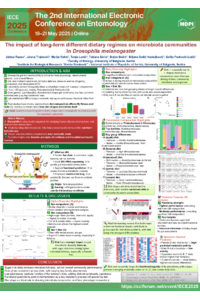
Introduction: Microbiota communities have been found as entities whose diversity significantly contributed to various dimensions of animal health, including that of humans. Since the fruit fly, Drosophila melanogaster, shares significant proportions of its genes that cause human diseases, it is currently widely used as an important model organism when testing the microbiota composition and its relation to development, physiology, and behavior. Methods: In this work, we focused on adult fly microbiota communities in D. melanogaster strains which had been maintained for over twenty years in different nutritional regimes. Flies were reared under optimal laboratory conditions, on five different diets: standard cornmeal–sugar–agar–yeast medium, as well as substrates prepared with their natural food sources, i.e., apple, banana, tomato, and carrot. Adult fly microbiota communities were characterized by employing 16S rRNA sequencing and additionally corroborated through machine learning-based analysis. Results: The results confirmed the dominance of the phyla Proteobacteria and Firmicutes irrespective of the diet type, while the most abundant families, such as Acetobacteraceae, Lactobacillaceae, Moraxellaceae, Bradyrhizobiaceae, and Leucostonocaceae, varied in community proportions among strains. A high level of distinctiveness among strains was also recorded regarding some other bacterial families of lower abundance. Further, adult fly microbiota communities differed between males and females, which may be related to specific sex-linked host metabolic needs. Conclusion: The aforementioned results indicate connectedness between the diet types, adult fly microbiota, and host phenotype in D. melanogaster, which further opens new opportunities for linking microbiota composition with various aspects of fruit fly biology.
Keywords
Drosophila melanogaster
adult fly microbiota
long-term different dietary regimes
Poster
sciforum-113181_Repac.pdf
Breeding Habitat Preferences and Environmental Dynamics of Aedes Mosquitoes in Urban and Semi-Urban Areas of Ibadan, Nigeria
COMPARATIVE ANALYSIS OF SHORT-HORNED GRASSHOPPER DIVERSITY IN AGROECOSYSTEMS AND FORESTS: IMPLICATIONS FOR CONSERVATION