Event submissions
Published
This submission belongs to the session S4. Biodiversity, Climate Change, Conservation, Ecology, and Evolution of the event The 2nd International Electronic Conference on Entomology
Published date
17 May, 2025
Academic Editor
'%3e%3cpath%20d='M12.6657%2010.9104C12.4185%2010.325%2012.0599%209.79327%2011.6097%209.34482C11.1609%208.89508%2010.6293%208.5365%2010.0442%208.28888C10.0389%208.28626%2010.0337%208.28495%2010.0285%208.28233C10.8446%207.69279%2011.3752%206.73249%2011.3752%205.64904C11.3752%203.8542%209.92103%202.39999%208.1262%202.39999C6.33136%202.39999%204.87715%203.8542%204.87715%205.64904C4.87715%206.73249%205.40774%207.69279%206.22393%208.28364C6.21869%208.28626%206.21345%208.28757%206.20821%208.29019C5.62129%208.5378%205.09463%208.89284%204.64265%209.34613C4.1929%209.79493%203.83432%2010.3266%203.58671%2010.9117C3.34345%2011.4845%203.21226%2012.0987%203.20023%2012.7209C3.19988%2012.7349%203.20233%2012.7488%203.20744%2012.7619C3.21255%2012.7749%203.22022%2012.7867%203.22998%2012.7968C3.23975%2012.8068%203.25142%2012.8147%203.26431%2012.8202C3.2772%2012.8256%203.29105%2012.8284%203.30504%2012.8284H4.09109C4.14874%2012.8284%204.19459%2012.7825%204.1959%2012.7262C4.2221%2011.7148%204.62823%2010.7676%205.34617%2010.0497C6.08899%209.30683%207.0755%208.89808%208.1262%208.89808C9.17689%208.89808%2010.1634%209.30683%2010.9062%2010.0497C11.6242%2010.7676%2012.0303%2011.7148%2012.0565%2012.7262C12.0578%2012.7838%2012.1037%2012.8284%2012.1613%2012.8284H12.9474C12.9613%2012.8284%2012.9752%2012.8256%2012.9881%2012.8202C13.001%2012.8147%2013.0126%2012.8068%2013.0224%2012.7968C13.0322%2012.7867%2013.0398%2012.7749%2013.0449%2012.7619C13.0501%2012.7488%2013.0525%2012.7349%2013.0522%2012.7209C13.0391%2012.0947%2012.9094%2011.4855%2012.6657%2010.9104ZM8.1262%207.9024C7.52486%207.9024%206.9589%207.6679%206.53312%207.24211C6.10733%206.81633%205.87283%206.25037%205.87283%205.64904C5.87283%205.0477%206.10733%204.48174%206.53312%204.05596C6.9589%203.63018%207.52486%203.39567%208.1262%203.39567C8.72753%203.39567%209.29349%203.63018%209.71927%204.05596C10.1451%204.48174%2010.3796%205.0477%2010.3796%205.64904C10.3796%206.25037%2010.1451%206.81633%209.71927%207.24211C9.29349%207.6679%208.72753%207.9024%208.1262%207.9024Z'%20fill='%235D1EE1'/%3e%3c/g%3e%3c/svg%3e) António Soares
António SoaresCitation
Sanja VESELIĆ, Sofija Dmitrović, Dušanka Vujanović, Aleksandra Djordjević, Maja Arok, Andrijana Andrić, Marina Janković, Tea Skendžić, Ante Vujić, Snežana Radenković, Exploring the impact of temperature on butterfly abundance and diversity (Lepidoptera: Rhopalocera) across selected localities in Serbia, in Proceedings of The 2nd International Electronic Conference on Entomology, 19 May–21 May 2025, MDPI: Basel, Switzerland
Share
Email
Facebook
Twitter
LinkedIn
Exploring the impact of temperature on butterfly abundance and diversity (Lepidoptera: Rhopalocera) across selected localities in Serbia
'%3e%3cpath%20d='M12.6647%2010.9104C12.4176%2010.325%2012.0589%209.7933%2011.6088%209.34485C11.16%208.89511%2010.6283%208.53653%2010.0432%208.28891C10.038%208.28629%2010.0327%208.28498%2010.0275%208.28236C10.8437%207.69282%2011.3743%206.73252%2011.3743%205.64907C11.3743%203.85423%209.92005%202.40002%208.12522%202.40002C6.33038%202.40002%204.87618%203.85423%204.87618%205.64907C4.87618%206.73252%205.40677%207.69282%206.22296%208.28367C6.21772%208.28629%206.21248%208.2876%206.20724%208.29022C5.62031%208.53783%205.09365%208.89287%204.64167%209.34616C4.19192%209.79496%203.83334%2010.3266%203.58573%2010.9117C3.34247%2011.4846%203.21128%2012.0987%203.19925%2012.721C3.1989%2012.735%203.20135%2012.7489%203.20646%2012.7619C3.21157%2012.7749%203.21924%2012.7868%203.22901%2012.7968C3.23877%2012.8068%203.25045%2012.8148%203.26334%2012.8202C3.27623%2012.8256%203.29007%2012.8284%203.30406%2012.8284H4.09012C4.14776%2012.8284%204.19362%2012.7825%204.19493%2012.7262C4.22113%2011.7148%204.62726%2010.7676%205.34519%2010.0497C6.08802%209.30686%207.07452%208.89811%208.12522%208.89811C9.17592%208.89811%2010.1624%209.30686%2010.9052%2010.0497C11.6232%2010.7676%2012.0293%2011.7148%2012.0555%2012.7262C12.0568%2012.7839%2012.1027%2012.8284%2012.1603%2012.8284H12.9464C12.9604%2012.8284%2012.9742%2012.8256%2012.9871%2012.8202C13%2012.8148%2013.0117%2012.8068%2013.0214%2012.7968C13.0312%2012.7868%2013.0389%2012.7749%2013.044%2012.7619C13.0491%2012.7489%2013.0515%2012.735%2013.0512%2012.721C13.0381%2012.0947%2012.9084%2011.4856%2012.6647%2010.9104ZM8.12522%207.90243C7.52388%207.90243%206.95792%207.66793%206.53214%207.24215C6.10636%206.81636%205.87185%206.2504%205.87185%205.64907C5.87185%205.04773%206.10636%204.48177%206.53214%204.05599C6.95792%203.63021%207.52388%203.3957%208.12522%203.3957C8.72655%203.3957%209.29252%203.63021%209.7183%204.05599C10.1441%204.48177%2010.3786%205.04773%2010.3786%205.64907C10.3786%206.2504%2010.1441%206.81636%209.7183%207.24215C9.29252%207.66793%208.72655%207.90243%208.12522%207.90243Z'%20fill='%235D1EE1'/%3e%3c/g%3e%3c/svg%3e)
Sanja VESELIĆ 1
Sofija Dmitrović 1
Dušanka Vujanović 2
Aleksandra Djordjević 1
Maja Arok 2
Andrijana Andrić 2
Marina Janković 1
Tea Skendžić 1
Ante Vujić 1
Snežana Radenković 1
1. Department of Biology and Ecology, University of Novi Sad, Faculty of Sciences, Novi Sad, 21000, Serbia
2. BioSense Institute, University of Novi Sad, Novi Sad, 21000, Serbia
Abstract
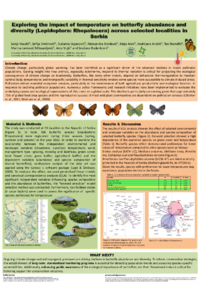
Global warming and climate change have been recognized as key factors contributing to the decline in insect pollinator populations. Understanding how animals can quickly respond to temperature changes is essential for predicting the impacts of climate change on biodiversity. An adequate microclimate is crucial for determining habitat quality for butterflies, particularly for the less mobile immature stages. Butterflies, like other insects, rely on behavioral thermoregulation, with some species being more vulnerable to the effects of climate change. In this study, conducted at 33 selected localities in the Republic of Serbia, an assessment was carried out to determine the impact of key environmental variables on the abundance and species composition of butterflies. In total, 105 butterfly species (Lepidoptera: Rhopalocera) were registered and analyzed during three seasons (spring, summer, and autumn) in 2022. To evaluate the effect of selected environmental and landscape variables on the abundance and species composition of butterflies, we used generalized linear models and canonical correspondence analyses (CCAs). To identify the most significant environmental variables influencing species composition and the abundance of butterflies, a “forward selection” analysis was conducted which showed a high dependence of the examined species on green cover and temperature. Furthermore, Van Dobben circles (t value biplots) were used to assess the significance of specific species' preference for temperature. The results showed that butterfly species which demonstrated preferences for lower values of temperature compared to other species were as follows: Erebia medusa, Melitaea arduinna, Melitaea trivia, Brenthis ino, Callophrys rubi, and Pseudophilotes vicrama. Two of these species are listed as strictly protected in the Republic of Serbia, and one is in the IUCN Nearly Threatened category in Europe. Given the results, species with preferences for lower temperatures may experience population decline in the future.
Keywords
butterflies
temperature
climate change
CCA
t value
Poster
Veselić et al_poster.pdf
Arthropod Communities in the Mountain–Arctic Ecosystems of the Kola Peninsula
Effects of diet on the fecundity of continuously mated females of the Melon Fruit Fly Zeugodacus cucurbitae (Diptera: Tephritidae).