Event submissions
Published

This submission belongs to the session f. Ionic Liquids of the event The 17th International Electronic Conference on Synthetic Organic Chemistry
Published date
31 Oct, 2013
Citation
Pedro Verdía, Marta Hernaíz, Emilio J. González, Eugénia A. Macedo, Josefa Salgado, Emilia Tojo, Effect of the number, position and length of alkyl chains on the physical and thermal properties of poly-substituted pyridinium ionic liquids, in Proceedings of The 17th International Electronic Conference on Synthetic Organic Chemistry, 1 November–30 November 2013, MDPI: Basel, Switzerland, doi: 10.3390/ecsoc-17-f007
Share
Email
Facebook
Twitter
LinkedIn
Effect of the number, position and length of alkyl chains on the physical and thermal properties of poly-substituted pyridinium ionic liquids
'%3e%3cpath%20d='M12.6647%2010.9104C12.4176%2010.325%2012.0589%209.7933%2011.6088%209.34485C11.16%208.89511%2010.6283%208.53653%2010.0432%208.28891C10.038%208.28629%2010.0327%208.28498%2010.0275%208.28236C10.8437%207.69282%2011.3743%206.73252%2011.3743%205.64907C11.3743%203.85423%209.92005%202.40002%208.12522%202.40002C6.33038%202.40002%204.87618%203.85423%204.87618%205.64907C4.87618%206.73252%205.40677%207.69282%206.22296%208.28367C6.21772%208.28629%206.21248%208.2876%206.20724%208.29022C5.62031%208.53783%205.09365%208.89287%204.64167%209.34616C4.19192%209.79496%203.83334%2010.3266%203.58573%2010.9117C3.34247%2011.4846%203.21128%2012.0987%203.19925%2012.721C3.1989%2012.735%203.20135%2012.7489%203.20646%2012.7619C3.21157%2012.7749%203.21924%2012.7868%203.22901%2012.7968C3.23877%2012.8068%203.25045%2012.8148%203.26334%2012.8202C3.27623%2012.8256%203.29007%2012.8284%203.30406%2012.8284H4.09012C4.14776%2012.8284%204.19362%2012.7825%204.19493%2012.7262C4.22113%2011.7148%204.62726%2010.7676%205.34519%2010.0497C6.08802%209.30686%207.07452%208.89811%208.12522%208.89811C9.17592%208.89811%2010.1624%209.30686%2010.9052%2010.0497C11.6232%2010.7676%2012.0293%2011.7148%2012.0555%2012.7262C12.0568%2012.7839%2012.1027%2012.8284%2012.1603%2012.8284H12.9464C12.9604%2012.8284%2012.9742%2012.8256%2012.9871%2012.8202C13%2012.8148%2013.0117%2012.8068%2013.0214%2012.7968C13.0312%2012.7868%2013.0389%2012.7749%2013.044%2012.7619C13.0491%2012.7489%2013.0515%2012.735%2013.0512%2012.721C13.0381%2012.0947%2012.9084%2011.4856%2012.6647%2010.9104ZM8.12522%207.90243C7.52388%207.90243%206.95792%207.66793%206.53214%207.24215C6.10636%206.81636%205.87185%206.2504%205.87185%205.64907C5.87185%205.04773%206.10636%204.48177%206.53214%204.05599C6.95792%203.63021%207.52388%203.3957%208.12522%203.3957C8.72655%203.3957%209.29252%203.63021%209.7183%204.05599C10.1441%204.48177%2010.3786%205.04773%2010.3786%205.64907C10.3786%206.2504%2010.1441%206.81636%209.7183%207.24215C9.29252%207.66793%208.72655%207.90243%208.12522%207.90243Z'%20fill='%235D1EE1'/%3e%3c/g%3e%3c/svg%3e)
Pedro Verdía 1
Marta Hernaíz 2
Emilio J. González 3

Eugénia A. Macedo 4
Josefa Salgado 5
Emilia Tojo 1
1. Department of Organic Chemistry, University of Vigo, Vigo, Spain
2. Tekniker, Eibar, Spain
3. Department of Chemical Engineering, University of Porto, Portugal
4. LSRE-Laboratory of Separation and Reaction Engineering, University of Porto, Porto 4200-465, Portugal;
5. Applied Physic Department, University of Santiago de Compostela, Santiago de Compostela, Spain
Abstract
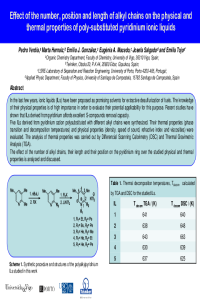
Five ionic liquids derived from pyridinium cation polysubstituted with different alkyl chains were synthesized. Their thermal properties (phase transition and decomposition temperatures) and physical properties (density, speed of sound, refractive index and viscosities) were evaluated. The effect of the number of alkyl chains, their length and their position on the pyridinium ring over the studied physical and thermal properties is also analyzed and discussed.
Keywords
pyridinium
ionic liquids
physical properties
thermal properties
Manuscript
E.Tojomanuscript.pdf
Poster
E TojoPresentation.pdf
Synthesis and Biological Evaluations of a Series of Novel Azolyl, Azinyl, Pyranyl, Chromonyl and Azepinyl Phosphonates
Tris-Imidazolium Derivatives of Isocyanuric Acid. A Lead for Tripodal Ionic Liquids and Anion Receptors