Event submissions
Published
This submission belongs to the session S7. Social Insects of the event The 2nd International Electronic Conference on Entomology
Published date
17 May, 2025
Academic Editor
'%3e%3cpath%20d='M12.6657%2010.9104C12.4185%2010.325%2012.0599%209.79327%2011.6097%209.34482C11.1609%208.89508%2010.6293%208.5365%2010.0442%208.28888C10.0389%208.28626%2010.0337%208.28495%2010.0285%208.28233C10.8446%207.69279%2011.3752%206.73249%2011.3752%205.64904C11.3752%203.8542%209.92103%202.39999%208.1262%202.39999C6.33136%202.39999%204.87715%203.8542%204.87715%205.64904C4.87715%206.73249%205.40774%207.69279%206.22393%208.28364C6.21869%208.28626%206.21345%208.28757%206.20821%208.29019C5.62129%208.5378%205.09463%208.89284%204.64265%209.34613C4.1929%209.79493%203.83432%2010.3266%203.58671%2010.9117C3.34345%2011.4845%203.21226%2012.0987%203.20023%2012.7209C3.19988%2012.7349%203.20233%2012.7488%203.20744%2012.7619C3.21255%2012.7749%203.22022%2012.7867%203.22998%2012.7968C3.23975%2012.8068%203.25142%2012.8147%203.26431%2012.8202C3.2772%2012.8256%203.29105%2012.8284%203.30504%2012.8284H4.09109C4.14874%2012.8284%204.19459%2012.7825%204.1959%2012.7262C4.2221%2011.7148%204.62823%2010.7676%205.34617%2010.0497C6.08899%209.30683%207.0755%208.89808%208.1262%208.89808C9.17689%208.89808%2010.1634%209.30683%2010.9062%2010.0497C11.6242%2010.7676%2012.0303%2011.7148%2012.0565%2012.7262C12.0578%2012.7838%2012.1037%2012.8284%2012.1613%2012.8284H12.9474C12.9613%2012.8284%2012.9752%2012.8256%2012.9881%2012.8202C13.001%2012.8147%2013.0126%2012.8068%2013.0224%2012.7968C13.0322%2012.7867%2013.0398%2012.7749%2013.0449%2012.7619C13.0501%2012.7488%2013.0525%2012.7349%2013.0522%2012.7209C13.0391%2012.0947%2012.9094%2011.4855%2012.6657%2010.9104ZM8.1262%207.9024C7.52486%207.9024%206.9589%207.6679%206.53312%207.24211C6.10733%206.81633%205.87283%206.25037%205.87283%205.64904C5.87283%205.0477%206.10733%204.48174%206.53312%204.05596C6.9589%203.63018%207.52486%203.39567%208.1262%203.39567C8.72753%203.39567%209.29349%203.63018%209.71927%204.05596C10.1451%204.48174%2010.3796%205.0477%2010.3796%205.64904C10.3796%206.25037%2010.1451%206.81633%209.71927%207.24211C9.29349%207.6679%208.72753%207.9024%208.1262%207.9024Z'%20fill='%235D1EE1'/%3e%3c/g%3e%3c/svg%3e) Ljubiša Stanisavljević
Ljubiša StanisavljevićCitation
Vera Antonova, Maria Naumova, Ivaylo Georgiev, Boyan Vagalinski, Simeon Indzhov, Vassil Vassilev, Teodor Trifonov, Teodora Teofilova, Tsvetelina Gerasimova, Sirma Zidarova, Albena Vlasseva, Myrmecofauna of Mesta river valley (Bulgaria): a report of fifteen new species in the region, in Proceedings of The 2nd International Electronic Conference on Entomology, 19 May–21 May 2025, MDPI: Basel, Switzerland
Share
Email
Facebook
Twitter
LinkedIn
Myrmecofauna of Mesta river valley (Bulgaria): a report of fifteen new species in the region
'%3e%3cpath%20d='M12.6647%2010.9104C12.4176%2010.325%2012.0589%209.7933%2011.6088%209.34485C11.16%208.89511%2010.6283%208.53653%2010.0432%208.28891C10.038%208.28629%2010.0327%208.28498%2010.0275%208.28236C10.8437%207.69282%2011.3743%206.73252%2011.3743%205.64907C11.3743%203.85423%209.92005%202.40002%208.12522%202.40002C6.33038%202.40002%204.87618%203.85423%204.87618%205.64907C4.87618%206.73252%205.40677%207.69282%206.22296%208.28367C6.21772%208.28629%206.21248%208.2876%206.20724%208.29022C5.62031%208.53783%205.09365%208.89287%204.64167%209.34616C4.19192%209.79496%203.83334%2010.3266%203.58573%2010.9117C3.34247%2011.4846%203.21128%2012.0987%203.19925%2012.721C3.1989%2012.735%203.20135%2012.7489%203.20646%2012.7619C3.21157%2012.7749%203.21924%2012.7868%203.22901%2012.7968C3.23877%2012.8068%203.25045%2012.8148%203.26334%2012.8202C3.27623%2012.8256%203.29007%2012.8284%203.30406%2012.8284H4.09012C4.14776%2012.8284%204.19362%2012.7825%204.19493%2012.7262C4.22113%2011.7148%204.62726%2010.7676%205.34519%2010.0497C6.08802%209.30686%207.07452%208.89811%208.12522%208.89811C9.17592%208.89811%2010.1624%209.30686%2010.9052%2010.0497C11.6232%2010.7676%2012.0293%2011.7148%2012.0555%2012.7262C12.0568%2012.7839%2012.1027%2012.8284%2012.1603%2012.8284H12.9464C12.9604%2012.8284%2012.9742%2012.8256%2012.9871%2012.8202C13%2012.8148%2013.0117%2012.8068%2013.0214%2012.7968C13.0312%2012.7868%2013.0389%2012.7749%2013.044%2012.7619C13.0491%2012.7489%2013.0515%2012.735%2013.0512%2012.721C13.0381%2012.0947%2012.9084%2011.4856%2012.6647%2010.9104ZM8.12522%207.90243C7.52388%207.90243%206.95792%207.66793%206.53214%207.24215C6.10636%206.81636%205.87185%206.2504%205.87185%205.64907C5.87185%205.04773%206.10636%204.48177%206.53214%204.05599C6.95792%203.63021%207.52388%203.3957%208.12522%203.3957C8.72655%203.3957%209.29252%203.63021%209.7183%204.05599C10.1441%204.48177%2010.3786%205.04773%2010.3786%205.64907C10.3786%206.2504%2010.1441%206.81636%209.7183%207.24215C9.29252%207.66793%208.72655%207.90243%208.12522%207.90243Z'%20fill='%235D1EE1'/%3e%3c/g%3e%3c/svg%3e)
Vera Antonova 1
Maria Naumova 2

Ivaylo Georgiev 3
Boyan Vagalinski 1
Simeon Indzhov 4
Vassil Vassilev 5,6
Teodor Trifonov 2

Teodora Teofilova 2
Tsvetelina Gerasimova 2
Sirma Zidarova 2
Albena Vlasseva 2
1. Institute of Biodiversity and Ecosystem Research, Bulgarian Academy of Sciences, 2 Yuriy Gagarin Str, 1113 Sofia, Bulgaria
2. Institute of Biodiversity and Ecosystem Research, Bulgarian Academy of Sciences, 1 Tsar Osvoboditel Blvd, 1000 Sofia, Bulgaria
3. Technical University, 11 Professor Georgi Bradistilov Str., 1756 Sofia, Bulgaria
4. Faculty of Biology, Sofia University, 8 Dragan Tsankov, 1164 Sofia, Bulgaria
5. Space Research and Technology Institute (SRTI), Bulgarian Academy of Sciences (BAS), Sofia 1113, str. "Acad. Georgy Bonchev" bl. 1, Bulgaria
6. GeoPolymorphic Cloud Association, 58 Sitnyakovo Blvd., 1111 Sofia, Bulgaria
Abstract
The myrmecofauna of Bulgaria is diverse, including Central and Northern European species as well as thermophilic and xerophilic Mediterranean species. Potential corridors for thermophilic fauna penetration include the valleys of the Struma, Mesta, and Maritsa rivers. Here, we consider the species diversity and the availability of thermophilic species in the Mesta river valley. Three sampling plots were situated in the Mesta river biocorridor, from the southernmost point in the Bulgarian territory up north to where Mediterranean influence is still significant. A total of 30 pitfall traps and 2 mesovoid shallow substratum (MSS) traps were set. The myrmecofauna was additionally sampled by hand collection, leaf litter sifting, and sweep netting. Only five species were reported in the literature for the region of Mesta Valley prior to our study. Twenty species were recorded in total during the survey in Mesta Valley. Fifteen species are new to the area, and fourteen are thermophilic species. The collected specimens were preserved in 70-80% ethanol and deposited in the Institute of Biodiversity and Ecosystem Research collection at the Bulgarian Academy of Sciences (IBER). Additional studies will clarify the rates of penetration of thermophilic species after qualitative and quantitative comparison of the composition of the myrmecofauna, along the south–north gradients. This study is a part of the Project “Monitoring the effects of global climate changes through qualitative and quantitative analysis of model animal groups in selected corridors of thermophilic fauna penetration in Bulgaria” (funded by the National Science Fund of Bulgaria under grant contract number KP-06-N61/6 – 14.12.2022).
Keywords
ants
Formicidae
Mediterranean
thermophilic
xerophilic
Poster
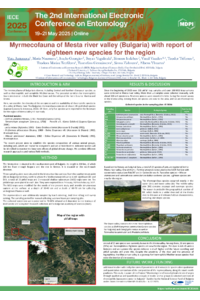
Mesta ants_20250516_18h.pdf
Ecological preferences and new data on distribution of perlid stonefly Dinocras megacephala (Klapálek, 1907) in Serbia
Merolimnic vs. hololimnic insects: spatio-temporal inconsistency in linking species populations to sampling locations