Event submissions
Published
This submission belongs to the session S5. Pest Management, Pesticide Resistance, and Toxicology of the event The 2nd International Electronic Conference on Entomology
Published date
17 May, 2025
Academic Editor
'%3e%3cpath%20d='M12.6657%2010.9104C12.4185%2010.325%2012.0599%209.79327%2011.6097%209.34482C11.1609%208.89508%2010.6293%208.5365%2010.0442%208.28888C10.0389%208.28626%2010.0337%208.28495%2010.0285%208.28233C10.8446%207.69279%2011.3752%206.73249%2011.3752%205.64904C11.3752%203.8542%209.92103%202.39999%208.1262%202.39999C6.33136%202.39999%204.87715%203.8542%204.87715%205.64904C4.87715%206.73249%205.40774%207.69279%206.22393%208.28364C6.21869%208.28626%206.21345%208.28757%206.20821%208.29019C5.62129%208.5378%205.09463%208.89284%204.64265%209.34613C4.1929%209.79493%203.83432%2010.3266%203.58671%2010.9117C3.34345%2011.4845%203.21226%2012.0987%203.20023%2012.7209C3.19988%2012.7349%203.20233%2012.7488%203.20744%2012.7619C3.21255%2012.7749%203.22022%2012.7867%203.22998%2012.7968C3.23975%2012.8068%203.25142%2012.8147%203.26431%2012.8202C3.2772%2012.8256%203.29105%2012.8284%203.30504%2012.8284H4.09109C4.14874%2012.8284%204.19459%2012.7825%204.1959%2012.7262C4.2221%2011.7148%204.62823%2010.7676%205.34617%2010.0497C6.08899%209.30683%207.0755%208.89808%208.1262%208.89808C9.17689%208.89808%2010.1634%209.30683%2010.9062%2010.0497C11.6242%2010.7676%2012.0303%2011.7148%2012.0565%2012.7262C12.0578%2012.7838%2012.1037%2012.8284%2012.1613%2012.8284H12.9474C12.9613%2012.8284%2012.9752%2012.8256%2012.9881%2012.8202C13.001%2012.8147%2013.0126%2012.8068%2013.0224%2012.7968C13.0322%2012.7867%2013.0398%2012.7749%2013.0449%2012.7619C13.0501%2012.7488%2013.0525%2012.7349%2013.0522%2012.7209C13.0391%2012.0947%2012.9094%2011.4855%2012.6657%2010.9104ZM8.1262%207.9024C7.52486%207.9024%206.9589%207.6679%206.53312%207.24211C6.10733%206.81633%205.87283%206.25037%205.87283%205.64904C5.87283%205.0477%206.10733%204.48174%206.53312%204.05596C6.9589%203.63018%207.52486%203.39567%208.1262%203.39567C8.72753%203.39567%209.29349%203.63018%209.71927%204.05596C10.1451%204.48174%2010.3796%205.0477%2010.3796%205.64904C10.3796%206.25037%2010.1451%206.81633%209.71927%207.24211C9.29349%207.6679%208.72753%207.9024%208.1262%207.9024Z'%20fill='%235D1EE1'/%3e%3c/g%3e%3c/svg%3e) Louis Hesler
Louis HeslerCitation
W.D.T.A. Sandeepanie, W.H.K.E. Senevirathne, J.M.M.B.T. Premarathana, R.S. Diyabalanage, A.G.W.U. Perera, Chemical characterization and biopotency of black pepper (Piper nigrum) corn essential oil-loaded nanoemulsions: Effects on enzymatic activities in Tribolium castaneum, in Proceedings of The 2nd International Electronic Conference on Entomology, 19 May–21 May 2025, MDPI: Basel, Switzerland
Share
Email
Facebook
Twitter
LinkedIn
Chemical characterization and biopotency of black pepper (Piper nigrum) corn essential oil-loaded nanoemulsions: Effects on enzymatic activities in Tribolium castaneum
'%3e%3cpath%20d='M12.6647%2010.9104C12.4176%2010.325%2012.0589%209.7933%2011.6088%209.34485C11.16%208.89511%2010.6283%208.53653%2010.0432%208.28891C10.038%208.28629%2010.0327%208.28498%2010.0275%208.28236C10.8437%207.69282%2011.3743%206.73252%2011.3743%205.64907C11.3743%203.85423%209.92005%202.40002%208.12522%202.40002C6.33038%202.40002%204.87618%203.85423%204.87618%205.64907C4.87618%206.73252%205.40677%207.69282%206.22296%208.28367C6.21772%208.28629%206.21248%208.2876%206.20724%208.29022C5.62031%208.53783%205.09365%208.89287%204.64167%209.34616C4.19192%209.79496%203.83334%2010.3266%203.58573%2010.9117C3.34247%2011.4846%203.21128%2012.0987%203.19925%2012.721C3.1989%2012.735%203.20135%2012.7489%203.20646%2012.7619C3.21157%2012.7749%203.21924%2012.7868%203.22901%2012.7968C3.23877%2012.8068%203.25045%2012.8148%203.26334%2012.8202C3.27623%2012.8256%203.29007%2012.8284%203.30406%2012.8284H4.09012C4.14776%2012.8284%204.19362%2012.7825%204.19493%2012.7262C4.22113%2011.7148%204.62726%2010.7676%205.34519%2010.0497C6.08802%209.30686%207.07452%208.89811%208.12522%208.89811C9.17592%208.89811%2010.1624%209.30686%2010.9052%2010.0497C11.6232%2010.7676%2012.0293%2011.7148%2012.0555%2012.7262C12.0568%2012.7839%2012.1027%2012.8284%2012.1603%2012.8284H12.9464C12.9604%2012.8284%2012.9742%2012.8256%2012.9871%2012.8202C13%2012.8148%2013.0117%2012.8068%2013.0214%2012.7968C13.0312%2012.7868%2013.0389%2012.7749%2013.044%2012.7619C13.0491%2012.7489%2013.0515%2012.735%2013.0512%2012.721C13.0381%2012.0947%2012.9084%2011.4856%2012.6647%2010.9104ZM8.12522%207.90243C7.52388%207.90243%206.95792%207.66793%206.53214%207.24215C6.10636%206.81636%205.87185%206.2504%205.87185%205.64907C5.87185%205.04773%206.10636%204.48177%206.53214%204.05599C6.95792%203.63021%207.52388%203.3957%208.12522%203.3957C8.72655%203.3957%209.29252%203.63021%209.7183%204.05599C10.1441%204.48177%2010.3786%205.04773%2010.3786%205.64907C10.3786%206.2504%2010.1441%206.81636%209.7183%207.24215C9.29252%207.66793%208.72655%207.90243%208.12522%207.90243Z'%20fill='%235D1EE1'/%3e%3c/g%3e%3c/svg%3e)
W.D.T.A. Sandeepanie 1
W.H.K.E. Senevirathne 1
J.M.M.B.T. Premarathana 1

R.S. Diyabalanage 2,3
A.G.W.U. Perera 1
1. Department of Zoology, Faculty of Applied Sciences, University of Sri Jayewardenepura, Sri Lanka
2. Instrument Centre, Faculty of Applied Sciences, University of Sri Jayewardenepura, Sri Lanka
3. Ecosphere Resilience Research Center, Faculty of Applied Sciences, University of Sri Jayewardenepura, Sri Lanka
Abstract
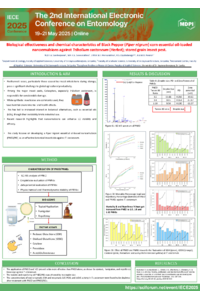
Declines in post-harvest loss during storage due to insect pests require the development of eco-friendly bio-insecticide formulations such as plant-derived essential oils (EOs). Despite their advantages, the transient nature and high volatility of EOs are addressed through nanoemulsion (NE) formulations, enabling sustained release, enhanced stability, and prolonged bioefficacy. Considering the above, the contact insecticidal and repellent activity of 6% (v/v) of Piper nigrum corn EO (PNEO)-based NEs (PNNEs) were evaluated on Tribolium castaneum. The NEs were prepared using the high-shear emulsification method, witha single surfactant of Tween80 at three EO:Tween80 combinations, PNNE1 (1:5), PNNE2 (1:8), and PNNE3 (1:10). The chemical profile of PNEO was analyzed via GC-MS. The effect of cutaneous exposure of the treatments on antioxidant systems and acetylcholinesterase (AChE) in T. castaneumwas was further assessed. The chemical constitution of PNEO was dominated by (+/-)-alpha-thujene. With increasing Tween80 levels, PNNE particle sizes decreased from 11.66 nm through 10.5 nm to 9.581 nm. Correspondingly, the PDI values were0.210, 0.153, and 0.130, resulting in zeta potential values of -10.65mV, -17.87 mV, and -11.27 mV for PNNE1, PNNE2, and PNNE3, respectively. In comparison to PNEO treatments, the insecticidal activity of PNNE increased by ~2-fold, ~3-fold, and ~7-fold for PNNE1, PNNE2, and PNNE3, respectively, after 12 h of post-treatment, while all PNNEs showed ~2 times more repellency than PNEO. The results revealed that PNNEs significantly depleted the levels of glutathione (GSH), catalase (CAT), and peroxidase (POD), along with an augmenting effect on oxidized glutathione (GSSG) levels and Acetylcholinesterase (AChE) inhibition rates after cutaneous application compared to that of PNEO. Consequently, the encapsulation of PNEO in NEs improved the stability and bio-effectiveness of PNEO, thereby making it a potentially applicable bio-insecticide against T. castaneum.
Keywords
Piper nigrum essential oil
Nanoemulsion
Tribolium castaneum
Contact toxicity
Repellency
Enzyme activities
Poster
sciforum-113435.pdf
Merolimnic vs. hololimnic insects: spatio-temporal inconsistency in linking species populations to sampling locations
Polyphenol-Based Biostimulants Shape Soybean–Pest Interactions