Event submissions
Published
This submission belongs to the session S5. Pest Management, Pesticide Resistance, and Toxicology of the event The 2nd International Electronic Conference on Entomology
Published date
17 May, 2025
Academic Editor
'%3e%3cpath%20d='M12.6657%2010.9104C12.4185%2010.325%2012.0599%209.79327%2011.6097%209.34482C11.1609%208.89508%2010.6293%208.5365%2010.0442%208.28888C10.0389%208.28626%2010.0337%208.28495%2010.0285%208.28233C10.8446%207.69279%2011.3752%206.73249%2011.3752%205.64904C11.3752%203.8542%209.92103%202.39999%208.1262%202.39999C6.33136%202.39999%204.87715%203.8542%204.87715%205.64904C4.87715%206.73249%205.40774%207.69279%206.22393%208.28364C6.21869%208.28626%206.21345%208.28757%206.20821%208.29019C5.62129%208.5378%205.09463%208.89284%204.64265%209.34613C4.1929%209.79493%203.83432%2010.3266%203.58671%2010.9117C3.34345%2011.4845%203.21226%2012.0987%203.20023%2012.7209C3.19988%2012.7349%203.20233%2012.7488%203.20744%2012.7619C3.21255%2012.7749%203.22022%2012.7867%203.22998%2012.7968C3.23975%2012.8068%203.25142%2012.8147%203.26431%2012.8202C3.2772%2012.8256%203.29105%2012.8284%203.30504%2012.8284H4.09109C4.14874%2012.8284%204.19459%2012.7825%204.1959%2012.7262C4.2221%2011.7148%204.62823%2010.7676%205.34617%2010.0497C6.08899%209.30683%207.0755%208.89808%208.1262%208.89808C9.17689%208.89808%2010.1634%209.30683%2010.9062%2010.0497C11.6242%2010.7676%2012.0303%2011.7148%2012.0565%2012.7262C12.0578%2012.7838%2012.1037%2012.8284%2012.1613%2012.8284H12.9474C12.9613%2012.8284%2012.9752%2012.8256%2012.9881%2012.8202C13.001%2012.8147%2013.0126%2012.8068%2013.0224%2012.7968C13.0322%2012.7867%2013.0398%2012.7749%2013.0449%2012.7619C13.0501%2012.7488%2013.0525%2012.7349%2013.0522%2012.7209C13.0391%2012.0947%2012.9094%2011.4855%2012.6657%2010.9104ZM8.1262%207.9024C7.52486%207.9024%206.9589%207.6679%206.53312%207.24211C6.10733%206.81633%205.87283%206.25037%205.87283%205.64904C5.87283%205.0477%206.10733%204.48174%206.53312%204.05596C6.9589%203.63018%207.52486%203.39567%208.1262%203.39567C8.72753%203.39567%209.29349%203.63018%209.71927%204.05596C10.1451%204.48174%2010.3796%205.0477%2010.3796%205.64904C10.3796%206.25037%2010.1451%206.81633%209.71927%207.24211C9.29349%207.6679%208.72753%207.9024%208.1262%207.9024Z'%20fill='%235D1EE1'/%3e%3c/g%3e%3c/svg%3e) Louis Hesler
Louis HeslerCitation
Vanesa Gisela Jacobi, Lorenzo Galmarini, Bruno Rosso, María Daniela Tejedor, Camila Menendez, Gerardo Irigoyen, Mariana Manetti, Jorge Alberto Zavala, Polyphenol-Based Biostimulants Shape Soybean–Pest Interactions , in Proceedings of The 2nd International Electronic Conference on Entomology, 19 May–21 May 2025, MDPI: Basel, Switzerland
Share
Email
Facebook
Twitter
LinkedIn
Polyphenol-Based Biostimulants Shape Soybean–Pest Interactions
'%3e%3cpath%20d='M12.6647%2010.9104C12.4176%2010.325%2012.0589%209.7933%2011.6088%209.34485C11.16%208.89511%2010.6283%208.53653%2010.0432%208.28891C10.038%208.28629%2010.0327%208.28498%2010.0275%208.28236C10.8437%207.69282%2011.3743%206.73252%2011.3743%205.64907C11.3743%203.85423%209.92005%202.40002%208.12522%202.40002C6.33038%202.40002%204.87618%203.85423%204.87618%205.64907C4.87618%206.73252%205.40677%207.69282%206.22296%208.28367C6.21772%208.28629%206.21248%208.2876%206.20724%208.29022C5.62031%208.53783%205.09365%208.89287%204.64167%209.34616C4.19192%209.79496%203.83334%2010.3266%203.58573%2010.9117C3.34247%2011.4846%203.21128%2012.0987%203.19925%2012.721C3.1989%2012.735%203.20135%2012.7489%203.20646%2012.7619C3.21157%2012.7749%203.21924%2012.7868%203.22901%2012.7968C3.23877%2012.8068%203.25045%2012.8148%203.26334%2012.8202C3.27623%2012.8256%203.29007%2012.8284%203.30406%2012.8284H4.09012C4.14776%2012.8284%204.19362%2012.7825%204.19493%2012.7262C4.22113%2011.7148%204.62726%2010.7676%205.34519%2010.0497C6.08802%209.30686%207.07452%208.89811%208.12522%208.89811C9.17592%208.89811%2010.1624%209.30686%2010.9052%2010.0497C11.6232%2010.7676%2012.0293%2011.7148%2012.0555%2012.7262C12.0568%2012.7839%2012.1027%2012.8284%2012.1603%2012.8284H12.9464C12.9604%2012.8284%2012.9742%2012.8256%2012.9871%2012.8202C13%2012.8148%2013.0117%2012.8068%2013.0214%2012.7968C13.0312%2012.7868%2013.0389%2012.7749%2013.044%2012.7619C13.0491%2012.7489%2013.0515%2012.735%2013.0512%2012.721C13.0381%2012.0947%2012.9084%2011.4856%2012.6647%2010.9104ZM8.12522%207.90243C7.52388%207.90243%206.95792%207.66793%206.53214%207.24215C6.10636%206.81636%205.87185%206.2504%205.87185%205.64907C5.87185%205.04773%206.10636%204.48177%206.53214%204.05599C6.95792%203.63021%207.52388%203.3957%208.12522%203.3957C8.72655%203.3957%209.29252%203.63021%209.7183%204.05599C10.1441%204.48177%2010.3786%205.04773%2010.3786%205.64907C10.3786%206.2504%2010.1441%206.81636%209.7183%207.24215C9.29252%207.66793%208.72655%207.90243%208.12522%207.90243Z'%20fill='%235D1EE1'/%3e%3c/g%3e%3c/svg%3e)
Vanesa Gisela Jacobi 1,2,3
Lorenzo Galmarini 4
Bruno Rosso 2,5
María Daniela Tejedor 2,6
Camila Menendez 2,6
Gerardo Irigoyen 2,6
Mariana Manetti 2,6

Jorge Alberto Zavala 2,3,6
1. Cátedra de Genética, Facultad de Agronomía de la Universidad de Buenos Aires (FAUBA), Av. San Martín 4453 - C1417DSE, Buenos Aires, Argentina
2. Instituto de Investigaciones en Biociencias Agrícolas y Ambientales (INBA-CONICET), Buenos Aires, Argentina
3. Cátedra de Zoología Agrícola, Facultad de Agronomía de la Universidad de Buenos Aires (FAUBA), Av. San Martín 4453 - C1417DSE, Buenos Aires, Argentina
4. Facultad de Agronomía, Universidad de Buenos Aires, Av. San Martín 4453 - C1417DSE, Argentina
5. Cátedra de Microbiología, Facultad de Agronomía de la Universidad de Buenos Aires (FAUBA), Universidad de Buenos Aires, Av. San Martín 4453 - C1417DSE, Buenos Aires, Argentina
6. Cátedra de Bioquímica, Facultad de Agronomía de la Universidad de Buenos Aires (FAUBA), Av. San Martín 4453 - C1417DSE, Buenos Aires, Argentina
Abstract
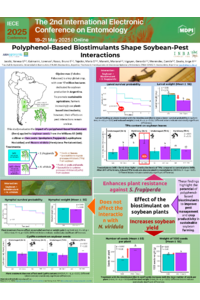
Glycine max (Fabales: Fabaceae) is a key global crop, with over 17 million hectares dedicated to soybean production in Argentina, making it a cornerstone of agricultural systems. To promote sustainable agriculture practices, farmers increasingly use plant-based biostimulants, yet their effects on pest interactions remain unclear. This study evaluates the impact of a polyphenol-based biostimulant applied to soybean seeds on two pests: Spodoptera frugiperda (Lepidoptera: Noctuidae) and Nezara viridula (Hemiptera: Pentatomidae). Yield traits were assessed, while insect bioassays measured the survival and weight gain of larval S. frugiperda and nymphal N. viridula. Additionally, protease inhibitor (PI) levels in leaves and seeds were measured after 24 and 72 hours of herbivory. Biostimulant-treated plants exhibited improved yield parameters, including seed count and plant height. Serine PIs (defensive against lepidopterans) increased in the treated plants’ leaves, but cysteine PIs (defensive against stink bugs) showed no significant differences, even after feeding. The survival and weight gain of S. frugiperda were significantly affected by the treatment, whereas no effect was observed for N. viridula. The results suggest that biostimulant-treated soybeans enhance lepidopteran resistance while having limited effects on stink bugs. These findings highlight the potential of polyphenol-based biostimulants to improve integrated pest management and boost crop productivity in sustainable soybean farming systems.
Keywords
Soybean
stink bug
lepidopterans
biostimulants
Poster
sciforum-113377-Vanesa.pdf
Chemical characterization and biopotency of black pepper (Piper nigrum) corn essential oil-loaded nanoemulsions: Effects on enzymatic activities in Tribolium castaneum
Symphony across latitudes: exploring the acoustic diversity of katydids across the latitudinal gradient in India