Event submissions
Published
This submission belongs to the session S4. Biodiversity, Climate Change, Conservation, Ecology, and Evolution of the event The 2nd International Electronic Conference on Entomology
Published date
17 May, 2025
Academic Editor
'%3e%3cpath%20d='M12.6657%2010.9104C12.4185%2010.325%2012.0599%209.79327%2011.6097%209.34482C11.1609%208.89508%2010.6293%208.5365%2010.0442%208.28888C10.0389%208.28626%2010.0337%208.28495%2010.0285%208.28233C10.8446%207.69279%2011.3752%206.73249%2011.3752%205.64904C11.3752%203.8542%209.92103%202.39999%208.1262%202.39999C6.33136%202.39999%204.87715%203.8542%204.87715%205.64904C4.87715%206.73249%205.40774%207.69279%206.22393%208.28364C6.21869%208.28626%206.21345%208.28757%206.20821%208.29019C5.62129%208.5378%205.09463%208.89284%204.64265%209.34613C4.1929%209.79493%203.83432%2010.3266%203.58671%2010.9117C3.34345%2011.4845%203.21226%2012.0987%203.20023%2012.7209C3.19988%2012.7349%203.20233%2012.7488%203.20744%2012.7619C3.21255%2012.7749%203.22022%2012.7867%203.22998%2012.7968C3.23975%2012.8068%203.25142%2012.8147%203.26431%2012.8202C3.2772%2012.8256%203.29105%2012.8284%203.30504%2012.8284H4.09109C4.14874%2012.8284%204.19459%2012.7825%204.1959%2012.7262C4.2221%2011.7148%204.62823%2010.7676%205.34617%2010.0497C6.08899%209.30683%207.0755%208.89808%208.1262%208.89808C9.17689%208.89808%2010.1634%209.30683%2010.9062%2010.0497C11.6242%2010.7676%2012.0303%2011.7148%2012.0565%2012.7262C12.0578%2012.7838%2012.1037%2012.8284%2012.1613%2012.8284H12.9474C12.9613%2012.8284%2012.9752%2012.8256%2012.9881%2012.8202C13.001%2012.8147%2013.0126%2012.8068%2013.0224%2012.7968C13.0322%2012.7867%2013.0398%2012.7749%2013.0449%2012.7619C13.0501%2012.7488%2013.0525%2012.7349%2013.0522%2012.7209C13.0391%2012.0947%2012.9094%2011.4855%2012.6657%2010.9104ZM8.1262%207.9024C7.52486%207.9024%206.9589%207.6679%206.53312%207.24211C6.10733%206.81633%205.87283%206.25037%205.87283%205.64904C5.87283%205.0477%206.10733%204.48174%206.53312%204.05596C6.9589%203.63018%207.52486%203.39567%208.1262%203.39567C8.72753%203.39567%209.29349%203.63018%209.71927%204.05596C10.1451%204.48174%2010.3796%205.0477%2010.3796%205.64904C10.3796%206.25037%2010.1451%206.81633%209.71927%207.24211C9.29349%207.6679%208.72753%207.9024%208.1262%207.9024Z'%20fill='%235D1EE1'/%3e%3c/g%3e%3c/svg%3e) António Soares
António SoaresCitation
Jowita Drohojowska, Anita Gorzelańczyk, Jacek Szwedo, Whiteflies (Hemiptera: Aleyrodidae) of the Eocene succinite, in Proceedings of The 2nd International Electronic Conference on Entomology, 19 May–21 May 2025, MDPI: Basel, Switzerland
Share
Email
Facebook
Twitter
LinkedIn
Whiteflies (Hemiptera: Aleyrodidae) of the Eocene succinite
'%3e%3cpath%20d='M12.6647%2010.9104C12.4176%2010.325%2012.0589%209.7933%2011.6088%209.34485C11.16%208.89511%2010.6283%208.53653%2010.0432%208.28891C10.038%208.28629%2010.0327%208.28498%2010.0275%208.28236C10.8437%207.69282%2011.3743%206.73252%2011.3743%205.64907C11.3743%203.85423%209.92005%202.40002%208.12522%202.40002C6.33038%202.40002%204.87618%203.85423%204.87618%205.64907C4.87618%206.73252%205.40677%207.69282%206.22296%208.28367C6.21772%208.28629%206.21248%208.2876%206.20724%208.29022C5.62031%208.53783%205.09365%208.89287%204.64167%209.34616C4.19192%209.79496%203.83334%2010.3266%203.58573%2010.9117C3.34247%2011.4846%203.21128%2012.0987%203.19925%2012.721C3.1989%2012.735%203.20135%2012.7489%203.20646%2012.7619C3.21157%2012.7749%203.21924%2012.7868%203.22901%2012.7968C3.23877%2012.8068%203.25045%2012.8148%203.26334%2012.8202C3.27623%2012.8256%203.29007%2012.8284%203.30406%2012.8284H4.09012C4.14776%2012.8284%204.19362%2012.7825%204.19493%2012.7262C4.22113%2011.7148%204.62726%2010.7676%205.34519%2010.0497C6.08802%209.30686%207.07452%208.89811%208.12522%208.89811C9.17592%208.89811%2010.1624%209.30686%2010.9052%2010.0497C11.6232%2010.7676%2012.0293%2011.7148%2012.0555%2012.7262C12.0568%2012.7839%2012.1027%2012.8284%2012.1603%2012.8284H12.9464C12.9604%2012.8284%2012.9742%2012.8256%2012.9871%2012.8202C13%2012.8148%2013.0117%2012.8068%2013.0214%2012.7968C13.0312%2012.7868%2013.0389%2012.7749%2013.044%2012.7619C13.0491%2012.7489%2013.0515%2012.735%2013.0512%2012.721C13.0381%2012.0947%2012.9084%2011.4856%2012.6647%2010.9104ZM8.12522%207.90243C7.52388%207.90243%206.95792%207.66793%206.53214%207.24215C6.10636%206.81636%205.87185%206.2504%205.87185%205.64907C5.87185%205.04773%206.10636%204.48177%206.53214%204.05599C6.95792%203.63021%207.52388%203.3957%208.12522%203.3957C8.72655%203.3957%209.29252%203.63021%209.7183%204.05599C10.1441%204.48177%2010.3786%205.04773%2010.3786%205.64907C10.3786%206.2504%2010.1441%206.81636%209.7183%207.24215C9.29252%207.66793%208.72655%207.90243%208.12522%207.90243Z'%20fill='%235D1EE1'/%3e%3c/g%3e%3c/svg%3e)
Jowita Drohojowska 1
Anita Gorzelańczyk 1
Jacek Szwedo 2
1. Institute of Biology, Biotechnology and Environmental Protection, University of Silesia, Katowice 40-007, Poland
2. Laboratory of Evolutionary Entomology and Museum of Amber Inclusions, University of Gdańsk, Gdańsk 80-308, Poland
Abstract
Whiteflies (Hemiptera: Sternorrhyncha: Aleyrodidae) are minute insects with a body length of 1 mm to 2 mm and a wingspan of less than 3 mm. The nomenclature of this insect is derived from the presence of a powdery secretion that is preened over the bodies and wings of the adults of almost all species. These insects typically feed on the undersides of plant leaves during their larval, pupal, and adult stages. The fossil record of whiteflies extends back to the Late Jurassic, with the majority of known fossils being reported from resins, including the first specimen, which was described by Menge in 1856 under the name of 'Aleyrodes' aculeatus from the Eocene Baltic amber. The Eocene fossil resins of Europe, which contain inclusions of whiteflies, comprise the Lowermost Eocene amber from Oise (Paris Basin, France) and younger resins collectively named ‘Baltic amber’, of various ages (Lutetian to Priabonian). These resins have yielded five taxa of Aleurodicinae from Ypresian Oise amber. More taxa representing both Aleyrodinae and Aleurodicinae originate from the succinite of various ages and geographic origins. Succinite from the Gulf of Gdańsk area has yielded five identified species to date (three taxa of Aleurodicinae and two of Aleyrodinae), while a single Aleyrodicinae species is known from amber found in Rovno. Recently, seven species of Aleurodicinae were described from the succinite of Denmark. A further Aleyrodinae species was identified from the succinite found in the Miocene Lower Lusatia deposits, although the resin appears to be older. These fossils exhibit significant morphological diversity, and their distribution provides valuable insights into the palaeobiogeographic and palaeoenvironmental differentiation of Europe during the Eocene. Whiteflies can serve as valuable indicators of local faunas, while also facilitating our understanding of the taphonomy, transportation, and deposition of amber. This research was funded by the National Science Centre, Poland grant no. 2022/47/B/NZ8/02113.
Keywords
fossil resins
Aleyrodidae
Aleurodinae
Aleyrodicinae
morphology
Poster
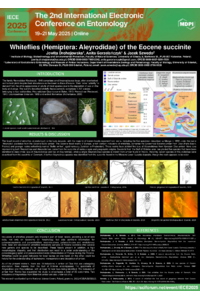
Drohojowska et al. Whiteflies (Hemiptera Aleyrodidae) of the Eocene succinite.pdf
Landscape Alterations and Butterfly Diversity in the Moist Shiwalik Sal Forest of the Lower Garhwal Himalayas: A Comparative Study between Natural Forests and Urban Areas
Bioefficacy and biochemical responses to Acorus calamus essential oil-loaded nanoemulsions in Sitophilus oryzae