Event submissions
Published
This submission belongs to the session S5. Pest Management, Pesticide Resistance, and Toxicology of the event The 2nd International Electronic Conference on Entomology
Published date
17 May, 2025
Academic Editor
'%3e%3cpath%20d='M12.6657%2010.9104C12.4185%2010.325%2012.0599%209.79327%2011.6097%209.34482C11.1609%208.89508%2010.6293%208.5365%2010.0442%208.28888C10.0389%208.28626%2010.0337%208.28495%2010.0285%208.28233C10.8446%207.69279%2011.3752%206.73249%2011.3752%205.64904C11.3752%203.8542%209.92103%202.39999%208.1262%202.39999C6.33136%202.39999%204.87715%203.8542%204.87715%205.64904C4.87715%206.73249%205.40774%207.69279%206.22393%208.28364C6.21869%208.28626%206.21345%208.28757%206.20821%208.29019C5.62129%208.5378%205.09463%208.89284%204.64265%209.34613C4.1929%209.79493%203.83432%2010.3266%203.58671%2010.9117C3.34345%2011.4845%203.21226%2012.0987%203.20023%2012.7209C3.19988%2012.7349%203.20233%2012.7488%203.20744%2012.7619C3.21255%2012.7749%203.22022%2012.7867%203.22998%2012.7968C3.23975%2012.8068%203.25142%2012.8147%203.26431%2012.8202C3.2772%2012.8256%203.29105%2012.8284%203.30504%2012.8284H4.09109C4.14874%2012.8284%204.19459%2012.7825%204.1959%2012.7262C4.2221%2011.7148%204.62823%2010.7676%205.34617%2010.0497C6.08899%209.30683%207.0755%208.89808%208.1262%208.89808C9.17689%208.89808%2010.1634%209.30683%2010.9062%2010.0497C11.6242%2010.7676%2012.0303%2011.7148%2012.0565%2012.7262C12.0578%2012.7838%2012.1037%2012.8284%2012.1613%2012.8284H12.9474C12.9613%2012.8284%2012.9752%2012.8256%2012.9881%2012.8202C13.001%2012.8147%2013.0126%2012.8068%2013.0224%2012.7968C13.0322%2012.7867%2013.0398%2012.7749%2013.0449%2012.7619C13.0501%2012.7488%2013.0525%2012.7349%2013.0522%2012.7209C13.0391%2012.0947%2012.9094%2011.4855%2012.6657%2010.9104ZM8.1262%207.9024C7.52486%207.9024%206.9589%207.6679%206.53312%207.24211C6.10733%206.81633%205.87283%206.25037%205.87283%205.64904C5.87283%205.0477%206.10733%204.48174%206.53312%204.05596C6.9589%203.63018%207.52486%203.39567%208.1262%203.39567C8.72753%203.39567%209.29349%203.63018%209.71927%204.05596C10.1451%204.48174%2010.3796%205.0477%2010.3796%205.64904C10.3796%206.25037%2010.1451%206.81633%209.71927%207.24211C9.29349%207.6679%208.72753%207.9024%208.1262%207.9024Z'%20fill='%235D1EE1'/%3e%3c/g%3e%3c/svg%3e) Louis Hesler
Louis HeslerCitation
J.M.M.B.T. Premarathana, R.S. Diyabalanage, T.M.S.U. Gunathilake, A.G.W.U. Perera, Bioefficacy and biochemical responses to Acorus calamus essential oil-loaded nanoemulsions in Sitophilus oryzae, in Proceedings of The 2nd International Electronic Conference on Entomology, 19 May–21 May 2025, MDPI: Basel, Switzerland
Share
Email
Facebook
Twitter
LinkedIn
Bioefficacy and biochemical responses to Acorus calamus essential oil-loaded nanoemulsions in Sitophilus oryzae
'%3e%3cpath%20d='M12.6647%2010.9104C12.4176%2010.325%2012.0589%209.7933%2011.6088%209.34485C11.16%208.89511%2010.6283%208.53653%2010.0432%208.28891C10.038%208.28629%2010.0327%208.28498%2010.0275%208.28236C10.8437%207.69282%2011.3743%206.73252%2011.3743%205.64907C11.3743%203.85423%209.92005%202.40002%208.12522%202.40002C6.33038%202.40002%204.87618%203.85423%204.87618%205.64907C4.87618%206.73252%205.40677%207.69282%206.22296%208.28367C6.21772%208.28629%206.21248%208.2876%206.20724%208.29022C5.62031%208.53783%205.09365%208.89287%204.64167%209.34616C4.19192%209.79496%203.83334%2010.3266%203.58573%2010.9117C3.34247%2011.4846%203.21128%2012.0987%203.19925%2012.721C3.1989%2012.735%203.20135%2012.7489%203.20646%2012.7619C3.21157%2012.7749%203.21924%2012.7868%203.22901%2012.7968C3.23877%2012.8068%203.25045%2012.8148%203.26334%2012.8202C3.27623%2012.8256%203.29007%2012.8284%203.30406%2012.8284H4.09012C4.14776%2012.8284%204.19362%2012.7825%204.19493%2012.7262C4.22113%2011.7148%204.62726%2010.7676%205.34519%2010.0497C6.08802%209.30686%207.07452%208.89811%208.12522%208.89811C9.17592%208.89811%2010.1624%209.30686%2010.9052%2010.0497C11.6232%2010.7676%2012.0293%2011.7148%2012.0555%2012.7262C12.0568%2012.7839%2012.1027%2012.8284%2012.1603%2012.8284H12.9464C12.9604%2012.8284%2012.9742%2012.8256%2012.9871%2012.8202C13%2012.8148%2013.0117%2012.8068%2013.0214%2012.7968C13.0312%2012.7868%2013.0389%2012.7749%2013.044%2012.7619C13.0491%2012.7489%2013.0515%2012.735%2013.0512%2012.721C13.0381%2012.0947%2012.9084%2011.4856%2012.6647%2010.9104ZM8.12522%207.90243C7.52388%207.90243%206.95792%207.66793%206.53214%207.24215C6.10636%206.81636%205.87185%206.2504%205.87185%205.64907C5.87185%205.04773%206.10636%204.48177%206.53214%204.05599C6.95792%203.63021%207.52388%203.3957%208.12522%203.3957C8.72655%203.3957%209.29252%203.63021%209.7183%204.05599C10.1441%204.48177%2010.3786%205.04773%2010.3786%205.64907C10.3786%206.2504%2010.1441%206.81636%209.7183%207.24215C9.29252%207.66793%208.72655%207.90243%208.12522%207.90243Z'%20fill='%235D1EE1'/%3e%3c/g%3e%3c/svg%3e)
J.M.M.B.T. Premarathana 1

R.S. Diyabalanage 2,3
T.M.S.U. Gunathilake 4
A.G.W.U. Perera 1
1. Department of Zoology, Faculty of Applied Sciences, University of Sri Jayewardenepura, Sri Lanka
2. Instrument Centre, Faculty of Applied Sciences, University of Sri Jayewardenepura, Sri Lanka
3. Ecosphere Resilience Research Center, Faculty of Applied Sciences, University of Sri Jayewardenepura, Sri Lanka
4. Department of Polymer Science, Faculty of Applied Sciences, University of Sri Jayewardenepura, Sri Lanka
Abstract
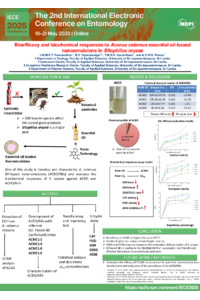
Post-harvest stored grain losses caused by insect pests are a growing concern, emphasizing the need for eco-friendly alternatives like plant-derived essential oils (EOs). However, due to their low solubility and persistence, EOs are formulated into nanoemulsions (NEs), which enhance their stability and effectiveness. Therefore, NEs based on 6% (v/v) Acorus calamus rhizome essential oil (ACEO) were evaluated for their contact insecticidal, fumigant, and repellent activity, alongside their impact on antioxidant systems and acetylcholinesterase activity against S. oryzae. GC/MS analysis revealed that the chemical profile of ACEO was predominantly composed of α-asarone (80.46%). ACEO was encapsulated into four NEs at varying EO:Tween80 ratios: ACNE1 (1:1), ACNE2 (1:3), ACNE3 (1:4), and ACNE4 (1:6). The particle sizes decreased with increasing Tween80 concentration, ranging from 329.62 nm (ACNE1) to 270.20 nm (ACNE2), 162.5 nm (ACNE3), and 30.49 nm (ACNE4). The Polydispersity Index (PDI) values were observed as 0.231, 0.124, 0.515, and 0.339 for ACNE1, ACNE2, ACNE3, and ACNE4. The zeta potential, which is the electrical potential difference between a particle's surface and the surrounding liquid that reflects the stability of colloidal dispersions, resulted in -12.60 mV, -11.58 mV, -7.07 mV, and -1.18 mV for ACNE1, ACNE2, ACNE3, and ACNE4, respectively. The ACNE4 demonstrated significantly enhanced insecticidal properties, including a six-fold increase in contact and fumigant toxicity as well as a five-fold repellency compared to ACEO after 24 hours. ACNEs also altered enzyme activities in S. oryzae, increasing oxidized glutathione levels while reducing glutathione, catalase, peroxidase, and acetylcholinesterase activities. The current study provides a first-time account of introducing ACNEs leading to the efficient, cost-effective use of ACEO in stored-grain insect pest management.
Keywords
Acorus calamus rhizome
essential oil
Sitophilus oryzae
nanoemulsions
antioxidant systems
Poster
sciforum-113430.pdf
Whiteflies (Hemiptera: Aleyrodidae) of the Eocene succinite
Comparing the effectiveness of different monitoring methods on butterfly richness and abundance (Lepidoptera: Rhopalocera) in Serbia