Event submissions
Published
This submission belongs to the session S1. Morphology and Systematics of the event The 2nd International Electronic Conference on Entomology
Published date
17 May, 2025
Academic Editor
'%3e%3cpath%20d='M12.6657%2010.9104C12.4185%2010.325%2012.0599%209.79327%2011.6097%209.34482C11.1609%208.89508%2010.6293%208.5365%2010.0442%208.28888C10.0389%208.28626%2010.0337%208.28495%2010.0285%208.28233C10.8446%207.69279%2011.3752%206.73249%2011.3752%205.64904C11.3752%203.8542%209.92103%202.39999%208.1262%202.39999C6.33136%202.39999%204.87715%203.8542%204.87715%205.64904C4.87715%206.73249%205.40774%207.69279%206.22393%208.28364C6.21869%208.28626%206.21345%208.28757%206.20821%208.29019C5.62129%208.5378%205.09463%208.89284%204.64265%209.34613C4.1929%209.79493%203.83432%2010.3266%203.58671%2010.9117C3.34345%2011.4845%203.21226%2012.0987%203.20023%2012.7209C3.19988%2012.7349%203.20233%2012.7488%203.20744%2012.7619C3.21255%2012.7749%203.22022%2012.7867%203.22998%2012.7968C3.23975%2012.8068%203.25142%2012.8147%203.26431%2012.8202C3.2772%2012.8256%203.29105%2012.8284%203.30504%2012.8284H4.09109C4.14874%2012.8284%204.19459%2012.7825%204.1959%2012.7262C4.2221%2011.7148%204.62823%2010.7676%205.34617%2010.0497C6.08899%209.30683%207.0755%208.89808%208.1262%208.89808C9.17689%208.89808%2010.1634%209.30683%2010.9062%2010.0497C11.6242%2010.7676%2012.0303%2011.7148%2012.0565%2012.7262C12.0578%2012.7838%2012.1037%2012.8284%2012.1613%2012.8284H12.9474C12.9613%2012.8284%2012.9752%2012.8256%2012.9881%2012.8202C13.001%2012.8147%2013.0126%2012.8068%2013.0224%2012.7968C13.0322%2012.7867%2013.0398%2012.7749%2013.0449%2012.7619C13.0501%2012.7488%2013.0525%2012.7349%2013.0522%2012.7209C13.0391%2012.0947%2012.9094%2011.4855%2012.6657%2010.9104ZM8.1262%207.9024C7.52486%207.9024%206.9589%207.6679%206.53312%207.24211C6.10733%206.81633%205.87283%206.25037%205.87283%205.64904C5.87283%205.0477%206.10733%204.48174%206.53312%204.05596C6.9589%203.63018%207.52486%203.39567%208.1262%203.39567C8.72753%203.39567%209.29349%203.63018%209.71927%204.05596C10.1451%204.48174%2010.3796%205.0477%2010.3796%205.64904C10.3796%206.25037%2010.1451%206.81633%209.71927%207.24211C9.29349%207.6679%208.72753%207.9024%208.1262%207.9024Z'%20fill='%235D1EE1'/%3e%3c/g%3e%3c/svg%3e) Nickolas Kavallieratos
Nickolas KavallieratosCitation
Bojan Ilić, Vukica Vujić, Jelena Milovanović, Zvezdana Jovanović, Mirko Šević, Boris Dudić, Vladimir Tomić, Luka Lučić, Slobodan Makarov, Male-specific leg modifications in five species of European millipedes (Diplopoda, Julida), in Proceedings of The 2nd International Electronic Conference on Entomology, 19 May–21 May 2025, MDPI: Basel, Switzerland
Share
Email
Facebook
Twitter
LinkedIn
Male-specific leg modifications in five species of European millipedes (Diplopoda, Julida)
'%3e%3cpath%20d='M12.6647%2010.9104C12.4176%2010.325%2012.0589%209.7933%2011.6088%209.34485C11.16%208.89511%2010.6283%208.53653%2010.0432%208.28891C10.038%208.28629%2010.0327%208.28498%2010.0275%208.28236C10.8437%207.69282%2011.3743%206.73252%2011.3743%205.64907C11.3743%203.85423%209.92005%202.40002%208.12522%202.40002C6.33038%202.40002%204.87618%203.85423%204.87618%205.64907C4.87618%206.73252%205.40677%207.69282%206.22296%208.28367C6.21772%208.28629%206.21248%208.2876%206.20724%208.29022C5.62031%208.53783%205.09365%208.89287%204.64167%209.34616C4.19192%209.79496%203.83334%2010.3266%203.58573%2010.9117C3.34247%2011.4846%203.21128%2012.0987%203.19925%2012.721C3.1989%2012.735%203.20135%2012.7489%203.20646%2012.7619C3.21157%2012.7749%203.21924%2012.7868%203.22901%2012.7968C3.23877%2012.8068%203.25045%2012.8148%203.26334%2012.8202C3.27623%2012.8256%203.29007%2012.8284%203.30406%2012.8284H4.09012C4.14776%2012.8284%204.19362%2012.7825%204.19493%2012.7262C4.22113%2011.7148%204.62726%2010.7676%205.34519%2010.0497C6.08802%209.30686%207.07452%208.89811%208.12522%208.89811C9.17592%208.89811%2010.1624%209.30686%2010.9052%2010.0497C11.6232%2010.7676%2012.0293%2011.7148%2012.0555%2012.7262C12.0568%2012.7839%2012.1027%2012.8284%2012.1603%2012.8284H12.9464C12.9604%2012.8284%2012.9742%2012.8256%2012.9871%2012.8202C13%2012.8148%2013.0117%2012.8068%2013.0214%2012.7968C13.0312%2012.7868%2013.0389%2012.7749%2013.044%2012.7619C13.0491%2012.7489%2013.0515%2012.735%2013.0512%2012.721C13.0381%2012.0947%2012.9084%2011.4856%2012.6647%2010.9104ZM8.12522%207.90243C7.52388%207.90243%206.95792%207.66793%206.53214%207.24215C6.10636%206.81636%205.87185%206.2504%205.87185%205.64907C5.87185%205.04773%206.10636%204.48177%206.53214%204.05599C6.95792%203.63021%207.52388%203.3957%208.12522%203.3957C8.72655%203.3957%209.29252%203.63021%209.7183%204.05599C10.1441%204.48177%2010.3786%205.04773%2010.3786%205.64907C10.3786%206.2504%2010.1441%206.81636%209.7183%207.24215C9.29252%207.66793%208.72655%207.90243%208.12522%207.90243Z'%20fill='%235D1EE1'/%3e%3c/g%3e%3c/svg%3e)
Bojan Ilić 1
Vukica Vujić 1
Jelena Milovanović 1
Zvezdana Jovanović 1
Mirko Šević 1
Boris Dudić 1
Vladimir Tomić 1
Luka Lučić 1
Slobodan Makarov 1
1. University of Belgrade – Faculty of Biology, Studentski Trg 16, 11000 Belgrade, Serbia
Abstract
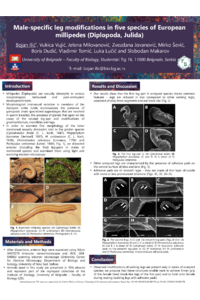
Millipedes (Diplopoda) are sexually dimorphic in various morphological, behavioral and post-embryonic development traits. Morphological intersexual variation in members of the diplopod order Julida encompasses the presence of gonopods (male specialized appendages that are involved in sperm transfer), the presence of glands that open on the coxae of the second leg-pair and modifications of gnathochilarium, mandibles and legs. In order to examine fine morphology of the latter sexually dimorphic trait in five julidan species [Cylindroiulus boleti (C. L. Koch, 1847), Megaphyllum bosniense (Verhoeff, 1897), M. unilineatum (C. L. Koch, 1838), Ommatoiulus sabulosus (Linnaeus, 1758) and Pachyiulus cattarensis (Latzel, 1884)], we dissected anterior (including the first) leg-pairs in males of the mentioned species and examined them using light and scanning electron microscopy. Our results show that the first leg-pair in all analyzed species shares common features: the legs are reduced in size (compared to other walking legs), consist of only three segments, and are hook-like. The other legs are characterized by the presence of adhesive pads on the ventral surface of the tibia and tarsi. The adhesive pads are of a ‘smooth’ type: they are made of a thin layer of cuticle with only a few striations. Since these modifications of the walking legs are present only in males of the analyzed species, we propose that these structures enable males to achieve a firmer grip of the female head (hook-like legs of the first pair) and to hold onto the female during mating (walking legs with adhesive pads).
Keywords
Sexual dimorphism
morphology
diplopods
legs
scanning electron microscopy
Poster
Ilic et al - IECE2025.pdf
Bacterial communities in defecated contents and the gut of post-defecated females of the vector of bluetongue virus, Culicoides oxystoma Kieffer (Diptera: Ceratopogonidae)
Public health concerns: Assessment of synanthropic status and sanitary risks of muscid flies (Insecta: Diptera) from wet market areas of Kolkata Metropolitan Area, West Bengal, India