Event submissions
Published
This submission belongs to the session S8. Medical and Veterinary Entomology of the event The 2nd International Electronic Conference on Entomology
Published date
17 May, 2025
Academic Editor
'%3e%3cpath%20d='M12.6657%2010.9104C12.4185%2010.325%2012.0599%209.79327%2011.6097%209.34482C11.1609%208.89508%2010.6293%208.5365%2010.0442%208.28888C10.0389%208.28626%2010.0337%208.28495%2010.0285%208.28233C10.8446%207.69279%2011.3752%206.73249%2011.3752%205.64904C11.3752%203.8542%209.92103%202.39999%208.1262%202.39999C6.33136%202.39999%204.87715%203.8542%204.87715%205.64904C4.87715%206.73249%205.40774%207.69279%206.22393%208.28364C6.21869%208.28626%206.21345%208.28757%206.20821%208.29019C5.62129%208.5378%205.09463%208.89284%204.64265%209.34613C4.1929%209.79493%203.83432%2010.3266%203.58671%2010.9117C3.34345%2011.4845%203.21226%2012.0987%203.20023%2012.7209C3.19988%2012.7349%203.20233%2012.7488%203.20744%2012.7619C3.21255%2012.7749%203.22022%2012.7867%203.22998%2012.7968C3.23975%2012.8068%203.25142%2012.8147%203.26431%2012.8202C3.2772%2012.8256%203.29105%2012.8284%203.30504%2012.8284H4.09109C4.14874%2012.8284%204.19459%2012.7825%204.1959%2012.7262C4.2221%2011.7148%204.62823%2010.7676%205.34617%2010.0497C6.08899%209.30683%207.0755%208.89808%208.1262%208.89808C9.17689%208.89808%2010.1634%209.30683%2010.9062%2010.0497C11.6242%2010.7676%2012.0303%2011.7148%2012.0565%2012.7262C12.0578%2012.7838%2012.1037%2012.8284%2012.1613%2012.8284H12.9474C12.9613%2012.8284%2012.9752%2012.8256%2012.9881%2012.8202C13.001%2012.8147%2013.0126%2012.8068%2013.0224%2012.7968C13.0322%2012.7867%2013.0398%2012.7749%2013.0449%2012.7619C13.0501%2012.7488%2013.0525%2012.7349%2013.0522%2012.7209C13.0391%2012.0947%2012.9094%2011.4855%2012.6657%2010.9104ZM8.1262%207.9024C7.52486%207.9024%206.9589%207.6679%206.53312%207.24211C6.10733%206.81633%205.87283%206.25037%205.87283%205.64904C5.87283%205.0477%206.10733%204.48174%206.53312%204.05596C6.9589%203.63018%207.52486%203.39567%208.1262%203.39567C8.72753%203.39567%209.29349%203.63018%209.71927%204.05596C10.1451%204.48174%2010.3796%205.0477%2010.3796%205.64904C10.3796%206.25037%2010.1451%206.81633%209.71927%207.24211C9.29349%207.6679%208.72753%207.9024%208.1262%207.9024Z'%20fill='%235D1EE1'/%3e%3c/g%3e%3c/svg%3e) Rui-De Xue
Rui-De XueCitation
Oishik Kar, Koustav Mukherjee, Dola Roy, Arka Mukherjee, Debdeep Pramanik, Atanu Naskar, Dhriti Banerjee, Public health concerns: Assessment of synanthropic status and sanitary risks of muscid flies (Insecta: Diptera) from wet market areas of Kolkata Metropolitan Area, West Bengal, India, in Proceedings of The 2nd International Electronic Conference on Entomology, 19 May–21 May 2025, MDPI: Basel, Switzerland
Share
Email
Facebook
Twitter
LinkedIn
Public health concerns: Assessment of synanthropic status and sanitary risks of muscid flies (Insecta: Diptera) from wet market areas of Kolkata Metropolitan Area, West Bengal, India
'%3e%3cpath%20d='M12.6647%2010.9104C12.4176%2010.325%2012.0589%209.7933%2011.6088%209.34485C11.16%208.89511%2010.6283%208.53653%2010.0432%208.28891C10.038%208.28629%2010.0327%208.28498%2010.0275%208.28236C10.8437%207.69282%2011.3743%206.73252%2011.3743%205.64907C11.3743%203.85423%209.92005%202.40002%208.12522%202.40002C6.33038%202.40002%204.87618%203.85423%204.87618%205.64907C4.87618%206.73252%205.40677%207.69282%206.22296%208.28367C6.21772%208.28629%206.21248%208.2876%206.20724%208.29022C5.62031%208.53783%205.09365%208.89287%204.64167%209.34616C4.19192%209.79496%203.83334%2010.3266%203.58573%2010.9117C3.34247%2011.4846%203.21128%2012.0987%203.19925%2012.721C3.1989%2012.735%203.20135%2012.7489%203.20646%2012.7619C3.21157%2012.7749%203.21924%2012.7868%203.22901%2012.7968C3.23877%2012.8068%203.25045%2012.8148%203.26334%2012.8202C3.27623%2012.8256%203.29007%2012.8284%203.30406%2012.8284H4.09012C4.14776%2012.8284%204.19362%2012.7825%204.19493%2012.7262C4.22113%2011.7148%204.62726%2010.7676%205.34519%2010.0497C6.08802%209.30686%207.07452%208.89811%208.12522%208.89811C9.17592%208.89811%2010.1624%209.30686%2010.9052%2010.0497C11.6232%2010.7676%2012.0293%2011.7148%2012.0555%2012.7262C12.0568%2012.7839%2012.1027%2012.8284%2012.1603%2012.8284H12.9464C12.9604%2012.8284%2012.9742%2012.8256%2012.9871%2012.8202C13%2012.8148%2013.0117%2012.8068%2013.0214%2012.7968C13.0312%2012.7868%2013.0389%2012.7749%2013.044%2012.7619C13.0491%2012.7489%2013.0515%2012.735%2013.0512%2012.721C13.0381%2012.0947%2012.9084%2011.4856%2012.6647%2010.9104ZM8.12522%207.90243C7.52388%207.90243%206.95792%207.66793%206.53214%207.24215C6.10636%206.81636%205.87185%206.2504%205.87185%205.64907C5.87185%205.04773%206.10636%204.48177%206.53214%204.05599C6.95792%203.63021%207.52388%203.3957%208.12522%203.3957C8.72655%203.3957%209.29252%203.63021%209.7183%204.05599C10.1441%204.48177%2010.3786%205.04773%2010.3786%205.64907C10.3786%206.2504%2010.1441%206.81636%209.7183%207.24215C9.29252%207.66793%208.72655%207.90243%208.12522%207.90243Z'%20fill='%235D1EE1'/%3e%3c/g%3e%3c/svg%3e)
Oishik Kar 1
Koustav Mukherjee 1
Dola Roy 2
Arka Mukherjee 1
Debdeep Pramanik 1
Atanu Naskar 1
Dhriti Banerjee 1
1. Diptera Section, Zoological Survey of India (HQ), Kolkata, M-Block, New Alipore, Kolkata-700053
2. Paleozoology Division, Zoological Survey of India (HQ), Kolkata, M-Block, New Alipore, Kolkata-700053
Abstract
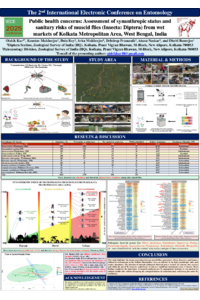
Introduction: Determination of the synanthropic index is essential for assessing the degree of association between species, in this case, necrophagous dipterans, and humans; thus, knowledge of synanthropic relationships is crucial not only from the perspective of animal ecology and behavior but also from the standpoint of human health and hygiene.
Methods: This study aimed to detect muscid flies with the highest synanthropy and relative abundance in and around the open wet markets of the Kolkata Metropolitan Area (KMA), along with their potential risk to human health and hygiene as potential carriers of pathogenic bacteria. Furthermore, pathogenic bacteria on both the external body surface and within the gut of the most abundant eusynanthropic muscid species were assessed, highlighting potential sanitary and hygiene concerns. To detect communities of bacteria, amplicon sequencing of the V3-V4 hypervariable region (16S rDNA) was performed using the Illumina (NOVASEQ 6000) platform.
Results: The experiment was conducted from 2022 to 2023 in twelve study sites involving four municipalities. A total of 4669 muscid flies representing seven genera and thirteen species were collected using baited traps. Differences in flies’ abundance were evident across different environments. Musca domestica and Musca sorbens were the prevailing muscid species in urban and rural wet markets, with relative abundance values of 57.57 and 18.05, respectively. Musca domestica was also the most dominant fly in all of the three environments. Principal Component Analysis (PCA) indicated a robust connection between Musca domestica and urban wet markets, as evidenced by the highest synanthropic index (+91.14). Pathogenic bacterial genera like Vibrio, Aeromonas, Enterobacter, Vagococcus, Proteus, Escherichia-Shigella, Pseudomonas, Acinetobacter, Klebsiella, Morganella, etc., were identified from both the external body surface and gut of Musca domestica.
Conclusion: These results regarding muscid flies describe their role as potential vectors and can aid in assessing proper sanitation and promoting better control strategies instead of eradicating the whole fly community.
Keywords
Musca domestica
Pathogenic Bacteria
Synanthropic Index
Mechanical Vectors
16S rDNA
Wet Markets
Hygiene
Poster
2nd IECE Poster_Oishik_Kar_sciforum-113458.pdf
Male-specific leg modifications in five species of European millipedes (Diplopoda, Julida)
The insecticidal potential of plant extracts on the wild cochineal Dactylopius opuntiae (Hemiptera: Dactylopiidae)