Event submissions
Published
This submission belongs to the session S4. Biodiversity, Climate Change, Conservation, Ecology, and Evolution of the event The 2nd International Electronic Conference on Entomology
Published date
17 May, 2025
Academic Editor
'%3e%3cpath%20d='M12.6657%2010.9104C12.4185%2010.325%2012.0599%209.79327%2011.6097%209.34482C11.1609%208.89508%2010.6293%208.5365%2010.0442%208.28888C10.0389%208.28626%2010.0337%208.28495%2010.0285%208.28233C10.8446%207.69279%2011.3752%206.73249%2011.3752%205.64904C11.3752%203.8542%209.92103%202.39999%208.1262%202.39999C6.33136%202.39999%204.87715%203.8542%204.87715%205.64904C4.87715%206.73249%205.40774%207.69279%206.22393%208.28364C6.21869%208.28626%206.21345%208.28757%206.20821%208.29019C5.62129%208.5378%205.09463%208.89284%204.64265%209.34613C4.1929%209.79493%203.83432%2010.3266%203.58671%2010.9117C3.34345%2011.4845%203.21226%2012.0987%203.20023%2012.7209C3.19988%2012.7349%203.20233%2012.7488%203.20744%2012.7619C3.21255%2012.7749%203.22022%2012.7867%203.22998%2012.7968C3.23975%2012.8068%203.25142%2012.8147%203.26431%2012.8202C3.2772%2012.8256%203.29105%2012.8284%203.30504%2012.8284H4.09109C4.14874%2012.8284%204.19459%2012.7825%204.1959%2012.7262C4.2221%2011.7148%204.62823%2010.7676%205.34617%2010.0497C6.08899%209.30683%207.0755%208.89808%208.1262%208.89808C9.17689%208.89808%2010.1634%209.30683%2010.9062%2010.0497C11.6242%2010.7676%2012.0303%2011.7148%2012.0565%2012.7262C12.0578%2012.7838%2012.1037%2012.8284%2012.1613%2012.8284H12.9474C12.9613%2012.8284%2012.9752%2012.8256%2012.9881%2012.8202C13.001%2012.8147%2013.0126%2012.8068%2013.0224%2012.7968C13.0322%2012.7867%2013.0398%2012.7749%2013.0449%2012.7619C13.0501%2012.7488%2013.0525%2012.7349%2013.0522%2012.7209C13.0391%2012.0947%2012.9094%2011.4855%2012.6657%2010.9104ZM8.1262%207.9024C7.52486%207.9024%206.9589%207.6679%206.53312%207.24211C6.10733%206.81633%205.87283%206.25037%205.87283%205.64904C5.87283%205.0477%206.10733%204.48174%206.53312%204.05596C6.9589%203.63018%207.52486%203.39567%208.1262%203.39567C8.72753%203.39567%209.29349%203.63018%209.71927%204.05596C10.1451%204.48174%2010.3796%205.0477%2010.3796%205.64904C10.3796%206.25037%2010.1451%206.81633%209.71927%207.24211C9.29349%207.6679%208.72753%207.9024%208.1262%207.9024Z'%20fill='%235D1EE1'/%3e%3c/g%3e%3c/svg%3e) António Soares
António SoaresCitation
Simeon Indzhov, Maria Naumova, Tsvetomir Tsvetanov, Boyan Vagalinski, Teodor Trifonov, Vera Antonova, Ivaylo Georgiev, Vassil Vassilev, Teodora Teofilova, Tsvetelina Gerasimova, Sirma Zidarova, Albena Vlasseva, New and interesting records of Diptera (Brachycera: Empididae, Micropezidae, Rhinophoridae, Sarcophagidae) from Bulgaria., in Proceedings of The 2nd International Electronic Conference on Entomology, 19 May–21 May 2025, MDPI: Basel, Switzerland
Share
Email
Facebook
Twitter
LinkedIn
New and interesting records of Diptera (Brachycera: Empididae, Micropezidae, Rhinophoridae, Sarcophagidae) from Bulgaria.
'%3e%3cpath%20d='M12.6647%2010.9104C12.4176%2010.325%2012.0589%209.7933%2011.6088%209.34485C11.16%208.89511%2010.6283%208.53653%2010.0432%208.28891C10.038%208.28629%2010.0327%208.28498%2010.0275%208.28236C10.8437%207.69282%2011.3743%206.73252%2011.3743%205.64907C11.3743%203.85423%209.92005%202.40002%208.12522%202.40002C6.33038%202.40002%204.87618%203.85423%204.87618%205.64907C4.87618%206.73252%205.40677%207.69282%206.22296%208.28367C6.21772%208.28629%206.21248%208.2876%206.20724%208.29022C5.62031%208.53783%205.09365%208.89287%204.64167%209.34616C4.19192%209.79496%203.83334%2010.3266%203.58573%2010.9117C3.34247%2011.4846%203.21128%2012.0987%203.19925%2012.721C3.1989%2012.735%203.20135%2012.7489%203.20646%2012.7619C3.21157%2012.7749%203.21924%2012.7868%203.22901%2012.7968C3.23877%2012.8068%203.25045%2012.8148%203.26334%2012.8202C3.27623%2012.8256%203.29007%2012.8284%203.30406%2012.8284H4.09012C4.14776%2012.8284%204.19362%2012.7825%204.19493%2012.7262C4.22113%2011.7148%204.62726%2010.7676%205.34519%2010.0497C6.08802%209.30686%207.07452%208.89811%208.12522%208.89811C9.17592%208.89811%2010.1624%209.30686%2010.9052%2010.0497C11.6232%2010.7676%2012.0293%2011.7148%2012.0555%2012.7262C12.0568%2012.7839%2012.1027%2012.8284%2012.1603%2012.8284H12.9464C12.9604%2012.8284%2012.9742%2012.8256%2012.9871%2012.8202C13%2012.8148%2013.0117%2012.8068%2013.0214%2012.7968C13.0312%2012.7868%2013.0389%2012.7749%2013.044%2012.7619C13.0491%2012.7489%2013.0515%2012.735%2013.0512%2012.721C13.0381%2012.0947%2012.9084%2011.4856%2012.6647%2010.9104ZM8.12522%207.90243C7.52388%207.90243%206.95792%207.66793%206.53214%207.24215C6.10636%206.81636%205.87185%206.2504%205.87185%205.64907C5.87185%205.04773%206.10636%204.48177%206.53214%204.05599C6.95792%203.63021%207.52388%203.3957%208.12522%203.3957C8.72655%203.3957%209.29252%203.63021%209.7183%204.05599C10.1441%204.48177%2010.3786%205.04773%2010.3786%205.64907C10.3786%206.2504%2010.1441%206.81636%209.7183%207.24215C9.29252%207.66793%208.72655%207.90243%208.12522%207.90243Z'%20fill='%235D1EE1'/%3e%3c/g%3e%3c/svg%3e)
Simeon Indzhov 1
Maria Naumova 2
Tsvetomir Tsvetanov 3
Boyan Vagalinski 4
Teodor Trifonov 2
Vera Antonova 4

Ivaylo Georgiev 5
Vassil Vassilev 6,7

Teodora Teofilova 2
Tsvetelina Gerasimova 2
Sirma Zidarova 2
Albena Vlasseva 2
1. Faculty of Biology, Sofia University, 8 Dragan Tsankov, 1164 Sofia, Bulgaria
2. Institute of Biodiversity and Ecosystem Research, Bulgarian Academy of Sciences, 1 Tsar Osvoboditel Blvd, 1000 Sofia, Bulgaria
3. Lyulin 10, 1335 Sofia, Bulgaria
4. Institute of Biodiversity and Ecosystem Research, Bulgarian Academy of Sciences, 2 Yuriy Gagarin Str, 1113 Sofia, Bulgaria
5. Technical University, 11 Professor Georgi Bradistilov Str., 1756 Sofia, Bulgaria
6. Space Research and Technology Institute, Bulgarian Academy of Sciences, str. "Acad. Georgy Bonchev" bl. 1, 1113 Sofia, Bulgaria
7. GeoPolymorphic Cloud Association, 58 Sitnyakovo Blvd., 1111 Sofia, Bulgaria
Abstract
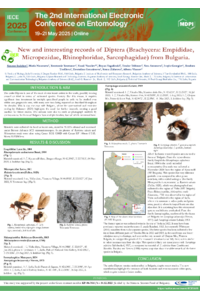
Diptera is one of the most diverse insect orders in the world, possibly ranking second or third in terms of estimated species diversity, and it requires a significant time investment in order to be studied even within one geographic area, with many new taxa being reported or described throughout the decades. This is the case for Bulgaria, where the systematized and extensive Catalog by Hubenov (2021) highlights the need for further research, creating a good baseline for future studies. We have caught or photographed multiple fly species new to the fauna of Bulgaria from multiple families, four of which are discussed here. The hyper-diverse family Empididae is represented by Rhamphomyia anfractuosa, collected from the region of Kyustendil. The family Micropezidae is represented by Rainieria calceata, which was observed and photographed near Vidin. From Rhinophoridae, Melanophora roralis was observed near Vidin and collected in the region of Sofia, where it is common in urban parks and green areas. From the family Sarcophagidae, the species confirmed to be among the fauna of Bulgaria are Sarcophaga belanovskyi and S. schusteri Lehrer, 1959. The former species was collected twice in the city of Sofia in 2022. It may have been previously reported under the name of S. ancilla, but these are currently considered to be separate species. Sarcophaga schusteri has been collected from different parts of Vitosha Mts in 2022 and 2023. Its taxonomic status is not fully clear, as it is similar to other montane taxa from the Alps. This species is likely not synonymous with Sarcophaga subvicina, as it was compared to material of S. subvicina from Czechia and Slovakia and shows differences. Povolny and Verves (1990) expressed suspicion about the older records of Sarcophaga subvicina in Bulgaria. This study is a part of the project under Grant contract number KP-06-N61/6 – 14.12.2022).
Keywords
Balkans
distribution
new country record
Rainieria calceata
Rhamphomyia anfractuosa
Sarcophaga ancilla
Sarcophaga belanovskyi
Sarcophaga schusteri
Sarcophaga subvicina
taxonomy
Poster
Diptera_VVa2.pdf
Genetic Differentiation of Lucilia cuprina and Lucilia sericata Using cox1 and 28S rRNA Genes: Phylogenetic Insights and First Report of L. cuprina in Northwest Africa
Occurrence of Botrytis cinerea across honey bees, hives, and blueberry flowers and fruit on farms in Western Cape, South Africa