Event submissions
Published
This submission belongs to the session S3. Behaviour, Biology, and Physiology of the event The 2nd International Electronic Conference on Entomology
Published date
17 May, 2025
Academic Editor
'%3e%3cpath%20d='M12.6657%2010.9104C12.4185%2010.325%2012.0599%209.79327%2011.6097%209.34482C11.1609%208.89508%2010.6293%208.5365%2010.0442%208.28888C10.0389%208.28626%2010.0337%208.28495%2010.0285%208.28233C10.8446%207.69279%2011.3752%206.73249%2011.3752%205.64904C11.3752%203.8542%209.92103%202.39999%208.1262%202.39999C6.33136%202.39999%204.87715%203.8542%204.87715%205.64904C4.87715%206.73249%205.40774%207.69279%206.22393%208.28364C6.21869%208.28626%206.21345%208.28757%206.20821%208.29019C5.62129%208.5378%205.09463%208.89284%204.64265%209.34613C4.1929%209.79493%203.83432%2010.3266%203.58671%2010.9117C3.34345%2011.4845%203.21226%2012.0987%203.20023%2012.7209C3.19988%2012.7349%203.20233%2012.7488%203.20744%2012.7619C3.21255%2012.7749%203.22022%2012.7867%203.22998%2012.7968C3.23975%2012.8068%203.25142%2012.8147%203.26431%2012.8202C3.2772%2012.8256%203.29105%2012.8284%203.30504%2012.8284H4.09109C4.14874%2012.8284%204.19459%2012.7825%204.1959%2012.7262C4.2221%2011.7148%204.62823%2010.7676%205.34617%2010.0497C6.08899%209.30683%207.0755%208.89808%208.1262%208.89808C9.17689%208.89808%2010.1634%209.30683%2010.9062%2010.0497C11.6242%2010.7676%2012.0303%2011.7148%2012.0565%2012.7262C12.0578%2012.7838%2012.1037%2012.8284%2012.1613%2012.8284H12.9474C12.9613%2012.8284%2012.9752%2012.8256%2012.9881%2012.8202C13.001%2012.8147%2013.0126%2012.8068%2013.0224%2012.7968C13.0322%2012.7867%2013.0398%2012.7749%2013.0449%2012.7619C13.0501%2012.7488%2013.0525%2012.7349%2013.0522%2012.7209C13.0391%2012.0947%2012.9094%2011.4855%2012.6657%2010.9104ZM8.1262%207.9024C7.52486%207.9024%206.9589%207.6679%206.53312%207.24211C6.10733%206.81633%205.87283%206.25037%205.87283%205.64904C5.87283%205.0477%206.10733%204.48174%206.53312%204.05596C6.9589%203.63018%207.52486%203.39567%208.1262%203.39567C8.72753%203.39567%209.29349%203.63018%209.71927%204.05596C10.1451%204.48174%2010.3796%205.0477%2010.3796%205.64904C10.3796%206.25037%2010.1451%206.81633%209.71927%207.24211C9.29349%207.6679%208.72753%207.9024%208.1262%207.9024Z'%20fill='%235D1EE1'/%3e%3c/g%3e%3c/svg%3e) Kristopher Giles
Kristopher GilesCitation
Marchelle Ludick, Christopher W Weldon, Jacquie E van der Waals, Hannelie Human, Occurrence of Botrytis cinerea across honey bees, hives, and blueberry flowers and fruit on farms in Western Cape, South Africa, in Proceedings of The 2nd International Electronic Conference on Entomology, 19 May–21 May 2025, MDPI: Basel, Switzerland
Share
Email
Facebook
Twitter
LinkedIn
Occurrence of Botrytis cinerea across honey bees, hives, and blueberry flowers and fruit on farms in Western Cape, South Africa
'%3e%3cpath%20d='M12.6647%2010.9104C12.4176%2010.325%2012.0589%209.7933%2011.6088%209.34485C11.16%208.89511%2010.6283%208.53653%2010.0432%208.28891C10.038%208.28629%2010.0327%208.28498%2010.0275%208.28236C10.8437%207.69282%2011.3743%206.73252%2011.3743%205.64907C11.3743%203.85423%209.92005%202.40002%208.12522%202.40002C6.33038%202.40002%204.87618%203.85423%204.87618%205.64907C4.87618%206.73252%205.40677%207.69282%206.22296%208.28367C6.21772%208.28629%206.21248%208.2876%206.20724%208.29022C5.62031%208.53783%205.09365%208.89287%204.64167%209.34616C4.19192%209.79496%203.83334%2010.3266%203.58573%2010.9117C3.34247%2011.4846%203.21128%2012.0987%203.19925%2012.721C3.1989%2012.735%203.20135%2012.7489%203.20646%2012.7619C3.21157%2012.7749%203.21924%2012.7868%203.22901%2012.7968C3.23877%2012.8068%203.25045%2012.8148%203.26334%2012.8202C3.27623%2012.8256%203.29007%2012.8284%203.30406%2012.8284H4.09012C4.14776%2012.8284%204.19362%2012.7825%204.19493%2012.7262C4.22113%2011.7148%204.62726%2010.7676%205.34519%2010.0497C6.08802%209.30686%207.07452%208.89811%208.12522%208.89811C9.17592%208.89811%2010.1624%209.30686%2010.9052%2010.0497C11.6232%2010.7676%2012.0293%2011.7148%2012.0555%2012.7262C12.0568%2012.7839%2012.1027%2012.8284%2012.1603%2012.8284H12.9464C12.9604%2012.8284%2012.9742%2012.8256%2012.9871%2012.8202C13%2012.8148%2013.0117%2012.8068%2013.0214%2012.7968C13.0312%2012.7868%2013.0389%2012.7749%2013.044%2012.7619C13.0491%2012.7489%2013.0515%2012.735%2013.0512%2012.721C13.0381%2012.0947%2012.9084%2011.4856%2012.6647%2010.9104ZM8.12522%207.90243C7.52388%207.90243%206.95792%207.66793%206.53214%207.24215C6.10636%206.81636%205.87185%206.2504%205.87185%205.64907C5.87185%205.04773%206.10636%204.48177%206.53214%204.05599C6.95792%203.63021%207.52388%203.3957%208.12522%203.3957C8.72655%203.3957%209.29252%203.63021%209.7183%204.05599C10.1441%204.48177%2010.3786%205.04773%2010.3786%205.64907C10.3786%206.2504%2010.1441%206.81636%209.7183%207.24215C9.29252%207.66793%208.72655%207.90243%208.12522%207.90243Z'%20fill='%235D1EE1'/%3e%3c/g%3e%3c/svg%3e)
Marchelle Ludick 1
Christopher W Weldon 1
Jacquie E van der Waals 2,3
Hannelie Human 1
1. Department of Zoology and Entomology, University of Pretoria, Hatfield 0028, South Africa
2. Department of Plant and Soil Sciences, University of Pretoria, Hatfield 0028, South Africa
3. Citrus Research International, Mbombela, South Africa
Abstract
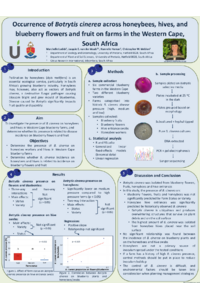
Honey bee (Apis mellifera) pollination is an essential ecological service, particularly in South Africa’s growing blueberry industry. Honey bees may, however, also act as vectors of Botrytis cinerea, a destructive fungal pathogen causing blossom blight and grey mould in blueberries. This study investigated B. cinerea occurrence on blueberry flowers, fruits, honey bees, and hive entrances across six blueberry farms in Western Cape province, South Africa. The blueberry farms were categorized by historical Botrytis pressure (farm status), namely, high, medium, or low. Samples were collected from two farms per status, and two variety blocks per farm. The samples were plated onto Botrytis-selective media, and isolates were identified morphologically and molecularly. The effect of farm status, variety, and tissue type on the presence of B. cinerea was tested using generalized linear fixed effects models, whereas a simple linear regression was used to test the relationship between the presence of the pathogen on blueberry plants and honey bees and hives. The results showed that B. cinerea presence was the highest in the two high-pressure farms and on swabs collected from hives, specifically on the farm where hives were placed near the soil surface. Botrytis cinerea presence on swabs was significantly affected by farm status, while the other variables did not have a significant effect. Additionally, there was no significant relationship between B. cinerea on blueberry plants and honey bees or hive swabs. These findings suggest that honey bees can carry B. cinerea spores to blueberry plants, but the risk of infection depends on multiple factors, particularly environmental ones. The role of honey bees in B. cinerea transmission in blueberries, and biological control agents for the pathogen, warrants further investigation. Cultural control methods such as field sanitation may reduce the build-up of inoculum sources, particularly overwintering structures, while strategic hive placement can further minimise exposure.
Keywords
Plant pathogen
Disease
Vector
Hymenoptera
Vaccinium
Poster
IECE_Poster_M Ludick.pdf
New and interesting records of Diptera (Brachycera: Empididae, Micropezidae, Rhinophoridae, Sarcophagidae) from Bulgaria.
Diapause in mango nut weevil, Sternochaetus mangiferae (Fabricius), a serious pest of mango in India