Event submissions
Published
This submission belongs to the session S5. Pest Management, Pesticide Resistance, and Toxicology of the event The 2nd International Electronic Conference on Entomology
Published date
17 May, 2025
Academic Editor
'%3e%3cpath%20d='M12.6657%2010.9104C12.4185%2010.325%2012.0599%209.79327%2011.6097%209.34482C11.1609%208.89508%2010.6293%208.5365%2010.0442%208.28888C10.0389%208.28626%2010.0337%208.28495%2010.0285%208.28233C10.8446%207.69279%2011.3752%206.73249%2011.3752%205.64904C11.3752%203.8542%209.92103%202.39999%208.1262%202.39999C6.33136%202.39999%204.87715%203.8542%204.87715%205.64904C4.87715%206.73249%205.40774%207.69279%206.22393%208.28364C6.21869%208.28626%206.21345%208.28757%206.20821%208.29019C5.62129%208.5378%205.09463%208.89284%204.64265%209.34613C4.1929%209.79493%203.83432%2010.3266%203.58671%2010.9117C3.34345%2011.4845%203.21226%2012.0987%203.20023%2012.7209C3.19988%2012.7349%203.20233%2012.7488%203.20744%2012.7619C3.21255%2012.7749%203.22022%2012.7867%203.22998%2012.7968C3.23975%2012.8068%203.25142%2012.8147%203.26431%2012.8202C3.2772%2012.8256%203.29105%2012.8284%203.30504%2012.8284H4.09109C4.14874%2012.8284%204.19459%2012.7825%204.1959%2012.7262C4.2221%2011.7148%204.62823%2010.7676%205.34617%2010.0497C6.08899%209.30683%207.0755%208.89808%208.1262%208.89808C9.17689%208.89808%2010.1634%209.30683%2010.9062%2010.0497C11.6242%2010.7676%2012.0303%2011.7148%2012.0565%2012.7262C12.0578%2012.7838%2012.1037%2012.8284%2012.1613%2012.8284H12.9474C12.9613%2012.8284%2012.9752%2012.8256%2012.9881%2012.8202C13.001%2012.8147%2013.0126%2012.8068%2013.0224%2012.7968C13.0322%2012.7867%2013.0398%2012.7749%2013.0449%2012.7619C13.0501%2012.7488%2013.0525%2012.7349%2013.0522%2012.7209C13.0391%2012.0947%2012.9094%2011.4855%2012.6657%2010.9104ZM8.1262%207.9024C7.52486%207.9024%206.9589%207.6679%206.53312%207.24211C6.10733%206.81633%205.87283%206.25037%205.87283%205.64904C5.87283%205.0477%206.10733%204.48174%206.53312%204.05596C6.9589%203.63018%207.52486%203.39567%208.1262%203.39567C8.72753%203.39567%209.29349%203.63018%209.71927%204.05596C10.1451%204.48174%2010.3796%205.0477%2010.3796%205.64904C10.3796%206.25037%2010.1451%206.81633%209.71927%207.24211C9.29349%207.6679%208.72753%207.9024%208.1262%207.9024Z'%20fill='%235D1EE1'/%3e%3c/g%3e%3c/svg%3e) Louis Hesler
Louis HeslerCitation
Dylan Andrew Pullock, Congliang Zhou, Yiannis Ampatzidis, Kerstin Krüger, Aruna Manrakhan, Christopher Weldon, Potential for automation of citrus psyllid pest identification using computer vision-based artificial intelligence recognition, in Proceedings of The 2nd International Electronic Conference on Entomology, 19 May–21 May 2025, MDPI: Basel, Switzerland
Share
Email
Facebook
Twitter
LinkedIn
Potential for automation of citrus psyllid pest identification using computer vision-based artificial intelligence recognition
'%3e%3cpath%20d='M12.6647%2010.9104C12.4176%2010.325%2012.0589%209.7933%2011.6088%209.34485C11.16%208.89511%2010.6283%208.53653%2010.0432%208.28891C10.038%208.28629%2010.0327%208.28498%2010.0275%208.28236C10.8437%207.69282%2011.3743%206.73252%2011.3743%205.64907C11.3743%203.85423%209.92005%202.40002%208.12522%202.40002C6.33038%202.40002%204.87618%203.85423%204.87618%205.64907C4.87618%206.73252%205.40677%207.69282%206.22296%208.28367C6.21772%208.28629%206.21248%208.2876%206.20724%208.29022C5.62031%208.53783%205.09365%208.89287%204.64167%209.34616C4.19192%209.79496%203.83334%2010.3266%203.58573%2010.9117C3.34247%2011.4846%203.21128%2012.0987%203.19925%2012.721C3.1989%2012.735%203.20135%2012.7489%203.20646%2012.7619C3.21157%2012.7749%203.21924%2012.7868%203.22901%2012.7968C3.23877%2012.8068%203.25045%2012.8148%203.26334%2012.8202C3.27623%2012.8256%203.29007%2012.8284%203.30406%2012.8284H4.09012C4.14776%2012.8284%204.19362%2012.7825%204.19493%2012.7262C4.22113%2011.7148%204.62726%2010.7676%205.34519%2010.0497C6.08802%209.30686%207.07452%208.89811%208.12522%208.89811C9.17592%208.89811%2010.1624%209.30686%2010.9052%2010.0497C11.6232%2010.7676%2012.0293%2011.7148%2012.0555%2012.7262C12.0568%2012.7839%2012.1027%2012.8284%2012.1603%2012.8284H12.9464C12.9604%2012.8284%2012.9742%2012.8256%2012.9871%2012.8202C13%2012.8148%2013.0117%2012.8068%2013.0214%2012.7968C13.0312%2012.7868%2013.0389%2012.7749%2013.044%2012.7619C13.0491%2012.7489%2013.0515%2012.735%2013.0512%2012.721C13.0381%2012.0947%2012.9084%2011.4856%2012.6647%2010.9104ZM8.12522%207.90243C7.52388%207.90243%206.95792%207.66793%206.53214%207.24215C6.10636%206.81636%205.87185%206.2504%205.87185%205.64907C5.87185%205.04773%206.10636%204.48177%206.53214%204.05599C6.95792%203.63021%207.52388%203.3957%208.12522%203.3957C8.72655%203.3957%209.29252%203.63021%209.7183%204.05599C10.1441%204.48177%2010.3786%205.04773%2010.3786%205.64907C10.3786%206.2504%2010.1441%206.81636%209.7183%207.24215C9.29252%207.66793%208.72655%207.90243%208.12522%207.90243Z'%20fill='%235D1EE1'/%3e%3c/g%3e%3c/svg%3e)
Dylan Andrew Pullock 1
Congliang Zhou 2

Yiannis Ampatzidis 2
Kerstin Krüger 1,3
Aruna Manrakhan 4,5
Christopher Weldon 1
1. Department of Zoology and Entomology, Forestry and Agricultural Biotechnology Institute, University of Pretoria, Hatfield 0028, South Africa
2. Agricultural and Biological Engineering Department, Southwest Florida Research and Education Center, University of Florida, Immokalee, Florida, USA
3. KWS SAAT SE & Co. KGaA, Grimsehlstraße 31, 37574 Einbeck, Germany
4. Citrus Research International, 2 Baker Street, Mbombela 1201, South Africa
5. Department of Conservation Ecology and Entomology, Stellenbosch University, Matieland, South Africa
Abstract
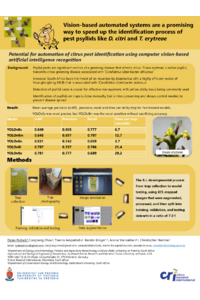
Huanglongbing (HLB), commonly known as Asian citrus greening, is a devastating citrus disease associated with ‘Candidatus Liberibacter asiaticus’ (CLas), a pathogen transmitted by Diaphorina citri. This psyllid species is of Asian origin, and since the mid-2010s has been recorded in Kenya, Ethiopia, Nigeria, Tanzania, Benin, and Ghana, while CLas is present in Ethiopia and Kenya. HLB is also vectored by Trioza erytreae, a psyllid species indigenous to sub-Saharan Africa. Monitoring, early detection, and timely identification are needed to manage the vectors, and consequently HLB. Currently, psyllid identification is expensive due to the use of yellow sticky traps and the need for specialists for time-consuming screening of traps and species identification. Therefore, we aimed to develop a laboratory-based, artificial intelligence (A.I.)-driven diagnostic tool for citrus psyllid pests, while accounting for native non-pest Diaphorina species, on yellow sticky traps. We deployed 544 traps across multiple citrus growing areas within South Africa, Reunion Island, and Mauritius, between December 2021 and September 2023. The traps were collected and inspected for D. citri, native South African Diaphorina species, and T. erytreae. Traps with any of the target psyllid species were photographed using a digital RGB camera, which were annotated highlighting those species. The annotated images were processed and augmented to develop and train five YOLOv8 models using a 7:2:1 training, validation, and testing ratio. Models YOLOv8s and YOLOv8m show promise for rapidly identifying psyllids to permit faster implementation of control methods. Both models achieved a mean average precision of 0.85, taking 6.7 seconds and 12.7 seconds, respectively, to process a two-sided trap. These models showed potential for the initial screening of yellow sticky traps to identify those needing verification of psyllid presence.
Keywords
Diaphorina citri
Trioza erytreae
Integrated pest management
Huanglongbing
YOLOv8
Poster
Dylan Pullock IECE2025 Poster.pdf
Soybean leaf trichomes under drought and herbivory have differential effects on soybean looper (Chrysodeixis includens Walker)
Selective flowers to enhance the performance of the adventive Gryon aetherium parasitoid: a good biocontrol agent in the context of conservation biological control of the painted bug Bagrada hilaris