Event submissions
Published
This submission belongs to the session S4. Biodiversity, Climate Change, Conservation, Ecology, and Evolution of the event The 2nd International Electronic Conference on Entomology
Published date
17 May, 2025
Academic Editor
'%3e%3cpath%20d='M12.6657%2010.9104C12.4185%2010.325%2012.0599%209.79327%2011.6097%209.34482C11.1609%208.89508%2010.6293%208.5365%2010.0442%208.28888C10.0389%208.28626%2010.0337%208.28495%2010.0285%208.28233C10.8446%207.69279%2011.3752%206.73249%2011.3752%205.64904C11.3752%203.8542%209.92103%202.39999%208.1262%202.39999C6.33136%202.39999%204.87715%203.8542%204.87715%205.64904C4.87715%206.73249%205.40774%207.69279%206.22393%208.28364C6.21869%208.28626%206.21345%208.28757%206.20821%208.29019C5.62129%208.5378%205.09463%208.89284%204.64265%209.34613C4.1929%209.79493%203.83432%2010.3266%203.58671%2010.9117C3.34345%2011.4845%203.21226%2012.0987%203.20023%2012.7209C3.19988%2012.7349%203.20233%2012.7488%203.20744%2012.7619C3.21255%2012.7749%203.22022%2012.7867%203.22998%2012.7968C3.23975%2012.8068%203.25142%2012.8147%203.26431%2012.8202C3.2772%2012.8256%203.29105%2012.8284%203.30504%2012.8284H4.09109C4.14874%2012.8284%204.19459%2012.7825%204.1959%2012.7262C4.2221%2011.7148%204.62823%2010.7676%205.34617%2010.0497C6.08899%209.30683%207.0755%208.89808%208.1262%208.89808C9.17689%208.89808%2010.1634%209.30683%2010.9062%2010.0497C11.6242%2010.7676%2012.0303%2011.7148%2012.0565%2012.7262C12.0578%2012.7838%2012.1037%2012.8284%2012.1613%2012.8284H12.9474C12.9613%2012.8284%2012.9752%2012.8256%2012.9881%2012.8202C13.001%2012.8147%2013.0126%2012.8068%2013.0224%2012.7968C13.0322%2012.7867%2013.0398%2012.7749%2013.0449%2012.7619C13.0501%2012.7488%2013.0525%2012.7349%2013.0522%2012.7209C13.0391%2012.0947%2012.9094%2011.4855%2012.6657%2010.9104ZM8.1262%207.9024C7.52486%207.9024%206.9589%207.6679%206.53312%207.24211C6.10733%206.81633%205.87283%206.25037%205.87283%205.64904C5.87283%205.0477%206.10733%204.48174%206.53312%204.05596C6.9589%203.63018%207.52486%203.39567%208.1262%203.39567C8.72753%203.39567%209.29349%203.63018%209.71927%204.05596C10.1451%204.48174%2010.3796%205.0477%2010.3796%205.64904C10.3796%206.25037%2010.1451%206.81633%209.71927%207.24211C9.29349%207.6679%208.72753%207.9024%208.1262%207.9024Z'%20fill='%235D1EE1'/%3e%3c/g%3e%3c/svg%3e) António Soares
António SoaresCitation
Susana Pascual, Dipteran abundance and family richness in different olive landscape contexts, in Proceedings of The 2nd International Electronic Conference on Entomology, 19 May–21 May 2025, MDPI: Basel, Switzerland
Share
Email
Facebook
Twitter
LinkedIn
Dipteran abundance and family richness in different olive landscape contexts

Susana Pascual 1
1. Entomology Group, Plant Protection Department, National Institute of Agricultural and Food Research and Technology (INIA, CSIC), Madrid 28040, Spain
Abstract
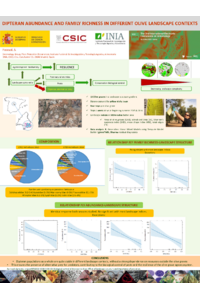
Biodiversity is a key aspect conditioning the resilience of agroecosystems. Landscape complexity favours the abundance and diversity of several groups of beneficial insects in olive groves and disfavours the abundance of the damaging olive fly, Bactrocera oleae, and the olive moth, Prays oleae. In addition to beneficial and harmful Dipterans, canopy-dwelling flies in olive groves have a role in the sustainability of the agroecosystem by providing alternative prey to important predators. The abundance and family richness of Dipterans was studied in the olive-growing area of southeastern Madrid, Spain, in 15 olive groves representing a landscape complexity gradient. Flies were sampled in the spring of two growing seasons by means of yellow sticky traps, and the landscape structure was characterised using composition and configuration indices calculated using Fragstats in ArcGIS.
Dipterans belonging to 32 families were recorded, with Chloropidae and Sciaridae being the most abundant. Some families with predatory or parasitoid behaviour were observed, such as Syrphidae, Dolichopodidae, and Tachinidae. No strong landscape effects were detected. The area of the olive groves (CAO) around the groves sampled had a slight negative effect on both the abundance and family richness of Diptera, a pattern that followed the effect of landscape structure on beneficial insects. However, a negative effect of the Shannon's evenness index (SHEI) was detected, which more closely followed the pattern described for harmful insect pests. Thus, Dipteran populations in olive canopies appear to be quite stable in different landscape contexts, without strong dependence on resources outside the olive groves, although different families are likely to have different behaviours. This ensures the presence of alternative prey for predators, contributing to biological control of pests and therefore to the resilience of the olive grove agroecosystem.
Keywords
alternative prey
biodiversity
biological control
Diptera
landscape
olive
Poster
PascualDipteraMDPI2025.pdf
Selective flowers to enhance the performance of the adventive Gryon aetherium parasitoid: a good biocontrol agent in the context of conservation biological control of the painted bug Bagrada hilaris
Laboratory Evaluation of a Novel Insecticide, Isocycloseram, against the Common Bed Bug (Cimex lectularius L.)