Event submissions
Published
This submission belongs to the session S2. Biochemistry, Biotechnology, Genetics, and Genomics of the event The 2nd International Electronic Conference on Entomology
Published date
17 May, 2025
Academic Editor
'%3e%3cpath%20d='M12.6657%2010.9104C12.4185%2010.325%2012.0599%209.79327%2011.6097%209.34482C11.1609%208.89508%2010.6293%208.5365%2010.0442%208.28888C10.0389%208.28626%2010.0337%208.28495%2010.0285%208.28233C10.8446%207.69279%2011.3752%206.73249%2011.3752%205.64904C11.3752%203.8542%209.92103%202.39999%208.1262%202.39999C6.33136%202.39999%204.87715%203.8542%204.87715%205.64904C4.87715%206.73249%205.40774%207.69279%206.22393%208.28364C6.21869%208.28626%206.21345%208.28757%206.20821%208.29019C5.62129%208.5378%205.09463%208.89284%204.64265%209.34613C4.1929%209.79493%203.83432%2010.3266%203.58671%2010.9117C3.34345%2011.4845%203.21226%2012.0987%203.20023%2012.7209C3.19988%2012.7349%203.20233%2012.7488%203.20744%2012.7619C3.21255%2012.7749%203.22022%2012.7867%203.22998%2012.7968C3.23975%2012.8068%203.25142%2012.8147%203.26431%2012.8202C3.2772%2012.8256%203.29105%2012.8284%203.30504%2012.8284H4.09109C4.14874%2012.8284%204.19459%2012.7825%204.1959%2012.7262C4.2221%2011.7148%204.62823%2010.7676%205.34617%2010.0497C6.08899%209.30683%207.0755%208.89808%208.1262%208.89808C9.17689%208.89808%2010.1634%209.30683%2010.9062%2010.0497C11.6242%2010.7676%2012.0303%2011.7148%2012.0565%2012.7262C12.0578%2012.7838%2012.1037%2012.8284%2012.1613%2012.8284H12.9474C12.9613%2012.8284%2012.9752%2012.8256%2012.9881%2012.8202C13.001%2012.8147%2013.0126%2012.8068%2013.0224%2012.7968C13.0322%2012.7867%2013.0398%2012.7749%2013.0449%2012.7619C13.0501%2012.7488%2013.0525%2012.7349%2013.0522%2012.7209C13.0391%2012.0947%2012.9094%2011.4855%2012.6657%2010.9104ZM8.1262%207.9024C7.52486%207.9024%206.9589%207.6679%206.53312%207.24211C6.10733%206.81633%205.87283%206.25037%205.87283%205.64904C5.87283%205.0477%206.10733%204.48174%206.53312%204.05596C6.9589%203.63018%207.52486%203.39567%208.1262%203.39567C8.72753%203.39567%209.29349%203.63018%209.71927%204.05596C10.1451%204.48174%2010.3796%205.0477%2010.3796%205.64904C10.3796%206.25037%2010.1451%206.81633%209.71927%207.24211C9.29349%207.6679%208.72753%207.9024%208.1262%207.9024Z'%20fill='%235D1EE1'/%3e%3c/g%3e%3c/svg%3e) David Haymer
David HaymerCitation
Aleksandra Trajković, Marijana Ilić Milošević, Saša Stanković, Danka Dragojlović, Helena Stojanović, Aleksa Stojčić, Vladimir Žikić, Repurposing Spodoptera littoralis: from pest to sustainable resource cycling model, in Proceedings of The 2nd International Electronic Conference on Entomology, 19 May–21 May 2025, MDPI: Basel, Switzerland
Share
Email
Facebook
Twitter
LinkedIn
Repurposing Spodoptera littoralis: from pest to sustainable resource cycling model
'%3e%3cpath%20d='M12.6647%2010.9104C12.4176%2010.325%2012.0589%209.7933%2011.6088%209.34485C11.16%208.89511%2010.6283%208.53653%2010.0432%208.28891C10.038%208.28629%2010.0327%208.28498%2010.0275%208.28236C10.8437%207.69282%2011.3743%206.73252%2011.3743%205.64907C11.3743%203.85423%209.92005%202.40002%208.12522%202.40002C6.33038%202.40002%204.87618%203.85423%204.87618%205.64907C4.87618%206.73252%205.40677%207.69282%206.22296%208.28367C6.21772%208.28629%206.21248%208.2876%206.20724%208.29022C5.62031%208.53783%205.09365%208.89287%204.64167%209.34616C4.19192%209.79496%203.83334%2010.3266%203.58573%2010.9117C3.34247%2011.4846%203.21128%2012.0987%203.19925%2012.721C3.1989%2012.735%203.20135%2012.7489%203.20646%2012.7619C3.21157%2012.7749%203.21924%2012.7868%203.22901%2012.7968C3.23877%2012.8068%203.25045%2012.8148%203.26334%2012.8202C3.27623%2012.8256%203.29007%2012.8284%203.30406%2012.8284H4.09012C4.14776%2012.8284%204.19362%2012.7825%204.19493%2012.7262C4.22113%2011.7148%204.62726%2010.7676%205.34519%2010.0497C6.08802%209.30686%207.07452%208.89811%208.12522%208.89811C9.17592%208.89811%2010.1624%209.30686%2010.9052%2010.0497C11.6232%2010.7676%2012.0293%2011.7148%2012.0555%2012.7262C12.0568%2012.7839%2012.1027%2012.8284%2012.1603%2012.8284H12.9464C12.9604%2012.8284%2012.9742%2012.8256%2012.9871%2012.8202C13%2012.8148%2013.0117%2012.8068%2013.0214%2012.7968C13.0312%2012.7868%2013.0389%2012.7749%2013.044%2012.7619C13.0491%2012.7489%2013.0515%2012.735%2013.0512%2012.721C13.0381%2012.0947%2012.9084%2011.4856%2012.6647%2010.9104ZM8.12522%207.90243C7.52388%207.90243%206.95792%207.66793%206.53214%207.24215C6.10636%206.81636%205.87185%206.2504%205.87185%205.64907C5.87185%205.04773%206.10636%204.48177%206.53214%204.05599C6.95792%203.63021%207.52388%203.3957%208.12522%203.3957C8.72655%203.3957%209.29252%203.63021%209.7183%204.05599C10.1441%204.48177%2010.3786%205.04773%2010.3786%205.64907C10.3786%206.2504%2010.1441%206.81636%209.7183%207.24215C9.29252%207.66793%208.72655%207.90243%208.12522%207.90243Z'%20fill='%235D1EE1'/%3e%3c/g%3e%3c/svg%3e)
Aleksandra Trajković 1
Marijana Ilić Milošević 2
Saša Stanković 2
Danka Dragojlović 3
Helena Stojanović 2
Aleksa Stojčić 2
Vladimir Žikić 2
1. Faculty of Sciences and Mathematics, University of Nis
2. Department of Biology and Ecology, Faculty of Sciences and Mathematics, University of Niš, Serbia
3. Institute of Food Technology, University of Novi Sad, Serbia
Abstract
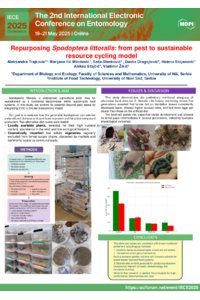
Insect farming offers a promising avenue for sustainable food systems, especially when integrated with waste management strategies. Spodoptera littoralis, a destructive agricultural pest known for its generalist nature, holds potential beyond its pest status. This study investigates its role within a circular bioeconomy model that utilizes underused local resources as substrates to transform agricultural waste into valuable nutritional outputs. Colonies of S. littoralis were maintained under laboratory conditions on two alternative diets, dandelion leaves and a beetroot–potato mix, alongside a standard artificial diet as a benchmark. Dandelion leaves were selected for their abundance, high nutritional value, and minimal environmental footprint. The beetroot–potato mix consisted of cosmetically imperfect, unspoiled vegetables discarded by local markets. This approach aimed to identify a waste stream that does not qualify as true waste but remains outside larger supply chains, ensuring minimal competition with other bioeconomies. While prior work has established the feasibility of these diets in supporting key life history traits, this study shows their preliminary nutritional adequacy through proximate analysis. Caterpillars fed with dandelion contained 46.69 g protein and 14.83 g fat per 100 g, while the beetroot–potato mix offered 31.87 g protein and 15.61 g fat per 100 g, which aligns with nutritional profiles typical for noctuid polyphagous species. Beyond protein production, the go-to focus in the edible insect sector, lepidopteran insects are valued for their bioactive compounds with potential applications in health and industry. Future research into the chemical composition of larvae reared on such substrates could reposition S. littoralis as a versatile bioconverter within circular bioeconomy frameworks.
Keywords
bioconversion
edible insects
Lepidoptera
Poster
sciforum-113514-Aleksandra.pdf
Expert systems in interactive species identification: a case of 2,000 caterpillars
Evaluation of insects' attraction to garden plants in a semi-arid region of Spain