Event submissions
Published
This submission belongs to the session S3. Behaviour, Biology, and Physiology of the event The 2nd International Electronic Conference on Entomology
Published date
17 May, 2025
Academic Editor
'%3e%3cpath%20d='M12.6657%2010.9104C12.4185%2010.325%2012.0599%209.79327%2011.6097%209.34482C11.1609%208.89508%2010.6293%208.5365%2010.0442%208.28888C10.0389%208.28626%2010.0337%208.28495%2010.0285%208.28233C10.8446%207.69279%2011.3752%206.73249%2011.3752%205.64904C11.3752%203.8542%209.92103%202.39999%208.1262%202.39999C6.33136%202.39999%204.87715%203.8542%204.87715%205.64904C4.87715%206.73249%205.40774%207.69279%206.22393%208.28364C6.21869%208.28626%206.21345%208.28757%206.20821%208.29019C5.62129%208.5378%205.09463%208.89284%204.64265%209.34613C4.1929%209.79493%203.83432%2010.3266%203.58671%2010.9117C3.34345%2011.4845%203.21226%2012.0987%203.20023%2012.7209C3.19988%2012.7349%203.20233%2012.7488%203.20744%2012.7619C3.21255%2012.7749%203.22022%2012.7867%203.22998%2012.7968C3.23975%2012.8068%203.25142%2012.8147%203.26431%2012.8202C3.2772%2012.8256%203.29105%2012.8284%203.30504%2012.8284H4.09109C4.14874%2012.8284%204.19459%2012.7825%204.1959%2012.7262C4.2221%2011.7148%204.62823%2010.7676%205.34617%2010.0497C6.08899%209.30683%207.0755%208.89808%208.1262%208.89808C9.17689%208.89808%2010.1634%209.30683%2010.9062%2010.0497C11.6242%2010.7676%2012.0303%2011.7148%2012.0565%2012.7262C12.0578%2012.7838%2012.1037%2012.8284%2012.1613%2012.8284H12.9474C12.9613%2012.8284%2012.9752%2012.8256%2012.9881%2012.8202C13.001%2012.8147%2013.0126%2012.8068%2013.0224%2012.7968C13.0322%2012.7867%2013.0398%2012.7749%2013.0449%2012.7619C13.0501%2012.7488%2013.0525%2012.7349%2013.0522%2012.7209C13.0391%2012.0947%2012.9094%2011.4855%2012.6657%2010.9104ZM8.1262%207.9024C7.52486%207.9024%206.9589%207.6679%206.53312%207.24211C6.10733%206.81633%205.87283%206.25037%205.87283%205.64904C5.87283%205.0477%206.10733%204.48174%206.53312%204.05596C6.9589%203.63018%207.52486%203.39567%208.1262%203.39567C8.72753%203.39567%209.29349%203.63018%209.71927%204.05596C10.1451%204.48174%2010.3796%205.0477%2010.3796%205.64904C10.3796%206.25037%2010.1451%206.81633%209.71927%207.24211C9.29349%207.6679%208.72753%207.9024%208.1262%207.9024Z'%20fill='%235D1EE1'/%3e%3c/g%3e%3c/svg%3e) Kristopher Giles
Kristopher GilesCitation
Purnima Singh, Swati Diwakar, Gyan Prakash Sharma, Understanding the ecological consequences of invasive species on host plant selection by native insect herbivores, in Proceedings of The 2nd International Electronic Conference on Entomology, 19 May–21 May 2025, MDPI: Basel, Switzerland
Share
Email
Facebook
Twitter
LinkedIn
Understanding the ecological consequences of invasive species on host plant selection by native insect herbivores
'%3e%3cpath%20d='M12.6647%2010.9104C12.4176%2010.325%2012.0589%209.7933%2011.6088%209.34485C11.16%208.89511%2010.6283%208.53653%2010.0432%208.28891C10.038%208.28629%2010.0327%208.28498%2010.0275%208.28236C10.8437%207.69282%2011.3743%206.73252%2011.3743%205.64907C11.3743%203.85423%209.92005%202.40002%208.12522%202.40002C6.33038%202.40002%204.87618%203.85423%204.87618%205.64907C4.87618%206.73252%205.40677%207.69282%206.22296%208.28367C6.21772%208.28629%206.21248%208.2876%206.20724%208.29022C5.62031%208.53783%205.09365%208.89287%204.64167%209.34616C4.19192%209.79496%203.83334%2010.3266%203.58573%2010.9117C3.34247%2011.4846%203.21128%2012.0987%203.19925%2012.721C3.1989%2012.735%203.20135%2012.7489%203.20646%2012.7619C3.21157%2012.7749%203.21924%2012.7868%203.22901%2012.7968C3.23877%2012.8068%203.25045%2012.8148%203.26334%2012.8202C3.27623%2012.8256%203.29007%2012.8284%203.30406%2012.8284H4.09012C4.14776%2012.8284%204.19362%2012.7825%204.19493%2012.7262C4.22113%2011.7148%204.62726%2010.7676%205.34519%2010.0497C6.08802%209.30686%207.07452%208.89811%208.12522%208.89811C9.17592%208.89811%2010.1624%209.30686%2010.9052%2010.0497C11.6232%2010.7676%2012.0293%2011.7148%2012.0555%2012.7262C12.0568%2012.7839%2012.1027%2012.8284%2012.1603%2012.8284H12.9464C12.9604%2012.8284%2012.9742%2012.8256%2012.9871%2012.8202C13%2012.8148%2013.0117%2012.8068%2013.0214%2012.7968C13.0312%2012.7868%2013.0389%2012.7749%2013.044%2012.7619C13.0491%2012.7489%2013.0515%2012.735%2013.0512%2012.721C13.0381%2012.0947%2012.9084%2011.4856%2012.6647%2010.9104ZM8.12522%207.90243C7.52388%207.90243%206.95792%207.66793%206.53214%207.24215C6.10636%206.81636%205.87185%206.2504%205.87185%205.64907C5.87185%205.04773%206.10636%204.48177%206.53214%204.05599C6.95792%203.63021%207.52388%203.3957%208.12522%203.3957C8.72655%203.3957%209.29252%203.63021%209.7183%204.05599C10.1441%204.48177%2010.3786%205.04773%2010.3786%205.64907C10.3786%206.2504%2010.1441%206.81636%209.7183%207.24215C9.29252%207.66793%208.72655%207.90243%208.12522%207.90243Z'%20fill='%235D1EE1'/%3e%3c/g%3e%3c/svg%3e)
Purnima Singh 1
Swati Diwakar 1
Gyan Prakash Sharma 1
1. Department of Environmental Studies, University of Delhi, Delhi, 110007, India
Abstract
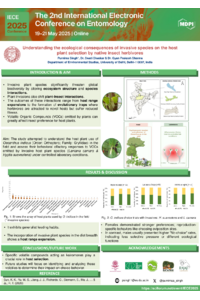
The ecological consequences of invasive plant species extend beyond the displacement of native flora, influencing interspecies interactions and reshaping community dynamics. Among these interactions, the associations between herbivorous insects and their host plants are understudied. This study focuses on Oecanthus indicus, a native tree cricket species, to examine how host plant associations are affected by the introduction of invasive plants. Using a combination of olfactory tube assays and performance trials, we investigated the behavioral preferences and physiological outcomes of Oecanthus when exposed to native and invasive plant species. Olfactory assays revealed a notable preference for the volatile emissions of invasive plants, suggesting that these plants may emit stronger or chemically distinct cues that attract the crickets. However, performance trials, which evaluated fitness outcomes such as survival, growth rates, and reproductive success, showed that this attraction does not consistently translate into enhanced fitness. This disconnect suggests that invasive plants could function as ecological traps, luring native herbivores without supporting their long-term viability. Our findings emphasize the complex interplay between behavioral attraction and physiological adaptation, highlighting how generalist herbivores like Oecanthus indicus navigate the altered host plant landscape introduced by biological invasions. While generalists are often presumed to have greater adaptive flexibility, our results reveal significant ecological trade-offs, underscoring the challenges these species face in balancing immediate preferences with long-term fitness. By exploring the mechanisms underpinning host plant shifts, this study contributes to a broader understanding of how invasive plants reshape insect–plant interactions. These insights are crucial for biodiversity conservation and ecosystem management, as they underscore the potential for invasive species to disrupt ecological networks and drive unintended consequences for native insect populations. Our work highlights integrative approaches that incorporate chemical ecology, behavioral biology, and conservation strategies to mitigate the cascading impacts of plant invasions on native insect herbivores.
Keywords
Insect behaviour
invasive species
host preference
evolution traps
Poster
IECE2025_PurnimaSingh.pdf
Toxic Effects of Diatomaceous Earth Treated with Citrus Peels on the Granary Weevil (Sitophilus granarius L.) [Coleoptera: Curculionidae]
BLASTOBASIS GLANDULELLA: A POORLY STUDIED ALIEN PEST OF QUERCUS, JUGLANS AND AESCULUS FRUITS