Event submissions
Published
This submission belongs to the session S4. Novel Antimicrobial Agents: Discovery, Design, Synthesis and Action of the event The 4th International Electronic Conference on Antibiotics
Published date
19 May, 2025
Academic Editor
'%3e%3cpath%20d='M12.6657%2010.9104C12.4185%2010.325%2012.0599%209.79327%2011.6097%209.34482C11.1609%208.89508%2010.6293%208.5365%2010.0442%208.28888C10.0389%208.28626%2010.0337%208.28495%2010.0285%208.28233C10.8446%207.69279%2011.3752%206.73249%2011.3752%205.64904C11.3752%203.8542%209.92103%202.39999%208.1262%202.39999C6.33136%202.39999%204.87715%203.8542%204.87715%205.64904C4.87715%206.73249%205.40774%207.69279%206.22393%208.28364C6.21869%208.28626%206.21345%208.28757%206.20821%208.29019C5.62129%208.5378%205.09463%208.89284%204.64265%209.34613C4.1929%209.79493%203.83432%2010.3266%203.58671%2010.9117C3.34345%2011.4845%203.21226%2012.0987%203.20023%2012.7209C3.19988%2012.7349%203.20233%2012.7488%203.20744%2012.7619C3.21255%2012.7749%203.22022%2012.7867%203.22998%2012.7968C3.23975%2012.8068%203.25142%2012.8147%203.26431%2012.8202C3.2772%2012.8256%203.29105%2012.8284%203.30504%2012.8284H4.09109C4.14874%2012.8284%204.19459%2012.7825%204.1959%2012.7262C4.2221%2011.7148%204.62823%2010.7676%205.34617%2010.0497C6.08899%209.30683%207.0755%208.89808%208.1262%208.89808C9.17689%208.89808%2010.1634%209.30683%2010.9062%2010.0497C11.6242%2010.7676%2012.0303%2011.7148%2012.0565%2012.7262C12.0578%2012.7838%2012.1037%2012.8284%2012.1613%2012.8284H12.9474C12.9613%2012.8284%2012.9752%2012.8256%2012.9881%2012.8202C13.001%2012.8147%2013.0126%2012.8068%2013.0224%2012.7968C13.0322%2012.7867%2013.0398%2012.7749%2013.0449%2012.7619C13.0501%2012.7488%2013.0525%2012.7349%2013.0522%2012.7209C13.0391%2012.0947%2012.9094%2011.4855%2012.6657%2010.9104ZM8.1262%207.9024C7.52486%207.9024%206.9589%207.6679%206.53312%207.24211C6.10733%206.81633%205.87283%206.25037%205.87283%205.64904C5.87283%205.0477%206.10733%204.48174%206.53312%204.05596C6.9589%203.63018%207.52486%203.39567%208.1262%203.39567C8.72753%203.39567%209.29349%203.63018%209.71927%204.05596C10.1451%204.48174%2010.3796%205.0477%2010.3796%205.64904C10.3796%206.25037%2010.1451%206.81633%209.71927%207.24211C9.29349%207.6679%208.72753%207.9024%208.1262%207.9024Z'%20fill='%235D1EE1'/%3e%3c/g%3e%3c/svg%3e) Marc Maresca
Marc MarescaCitation
Luísa Rafaela Baptista, Susana Alarico, Igor Tiago, Nuno Empadinhas, Ana Maranha, Exploring Skin Microbiome Interactions for Antimicrobial Discovery in Diabetic Foot Ulcers, in Proceedings of The 4th International Electronic Conference on Antibiotics, 21 May–23 May 2025, MDPI: Basel, Switzerland
Share
Email
Facebook
Twitter
LinkedIn
Exploring Skin Microbiome Interactions for Antimicrobial Discovery in Diabetic Foot Ulcers
'%3e%3cpath%20d='M12.6647%2010.9104C12.4176%2010.325%2012.0589%209.7933%2011.6088%209.34485C11.16%208.89511%2010.6283%208.53653%2010.0432%208.28891C10.038%208.28629%2010.0327%208.28498%2010.0275%208.28236C10.8437%207.69282%2011.3743%206.73252%2011.3743%205.64907C11.3743%203.85423%209.92005%202.40002%208.12522%202.40002C6.33038%202.40002%204.87618%203.85423%204.87618%205.64907C4.87618%206.73252%205.40677%207.69282%206.22296%208.28367C6.21772%208.28629%206.21248%208.2876%206.20724%208.29022C5.62031%208.53783%205.09365%208.89287%204.64167%209.34616C4.19192%209.79496%203.83334%2010.3266%203.58573%2010.9117C3.34247%2011.4846%203.21128%2012.0987%203.19925%2012.721C3.1989%2012.735%203.20135%2012.7489%203.20646%2012.7619C3.21157%2012.7749%203.21924%2012.7868%203.22901%2012.7968C3.23877%2012.8068%203.25045%2012.8148%203.26334%2012.8202C3.27623%2012.8256%203.29007%2012.8284%203.30406%2012.8284H4.09012C4.14776%2012.8284%204.19362%2012.7825%204.19493%2012.7262C4.22113%2011.7148%204.62726%2010.7676%205.34519%2010.0497C6.08802%209.30686%207.07452%208.89811%208.12522%208.89811C9.17592%208.89811%2010.1624%209.30686%2010.9052%2010.0497C11.6232%2010.7676%2012.0293%2011.7148%2012.0555%2012.7262C12.0568%2012.7839%2012.1027%2012.8284%2012.1603%2012.8284H12.9464C12.9604%2012.8284%2012.9742%2012.8256%2012.9871%2012.8202C13%2012.8148%2013.0117%2012.8068%2013.0214%2012.7968C13.0312%2012.7868%2013.0389%2012.7749%2013.044%2012.7619C13.0491%2012.7489%2013.0515%2012.735%2013.0512%2012.721C13.0381%2012.0947%2012.9084%2011.4856%2012.6647%2010.9104ZM8.12522%207.90243C7.52388%207.90243%206.95792%207.66793%206.53214%207.24215C6.10636%206.81636%205.87185%206.2504%205.87185%205.64907C5.87185%205.04773%206.10636%204.48177%206.53214%204.05599C6.95792%203.63021%207.52388%203.3957%208.12522%203.3957C8.72655%203.3957%209.29252%203.63021%209.7183%204.05599C10.1441%204.48177%2010.3786%205.04773%2010.3786%205.64907C10.3786%206.2504%2010.1441%206.81636%209.7183%207.24215C9.29252%207.66793%208.72655%207.90243%208.12522%207.90243Z'%20fill='%235D1EE1'/%3e%3c/g%3e%3c/svg%3e)
Luísa Rafaela Baptista 1,2

Susana Alarico 1,2
Igor Tiago 3,4

Nuno Empadinhas 1,2
Ana Maranha 1,2
1. Centre for Neuroscience and Cell Biology, University of Coimbra, Coimbra, 3004-504 Coimbra, Portugal
2. Centre for Innovative Biomedicine and Biotechnology, University of Coimbra, Coimbra, 3004-504 Coimbra, Portugal
3. Department of Life Sciences, University of Coimbra, Coimbra, 3000-456 Coimbra, Portugal
4. TimeUp Lda, IPN incubator, Coimbra, 3030-199 Coimbra, Portugal
Abstract
Diabetes and diabetic foot ulcers (DFUs) pose a significant clinical burden. Antibiotic treatments are often ineffective, contributing to the growing antimicrobial resistance crisis.
We investigated interactions between bacterial isolates from diabetic and non-diabetic patients to detect the production of antimicrobial compounds with potential therapeutic applications.
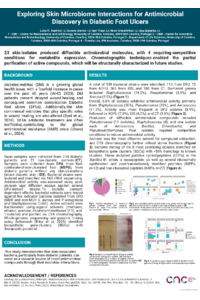
A total of 539 bacterial strains were identified by 16S rRNA gene sequencing. In total, 79 isolates were from DFUs and 55 were from a contralateral non-ulcerated foot (NDFU), while 254 isolates were from diabetic patients without any skin ulcerations (intact diabetic skin - IDS), and 151 were from non-diabetic individuals (CT). The predominant genera identified were Staphylococcus (74.2%), Pseudomonas (5%), and Kocuria (3.3%).
Screening for antimicrobial activity was performed using spot-on-lawn agar diffusion assays against five indicator bacteria isolated from DFU (MDR and non-MDR S. aureus and P. aeruginosa and Staphylococcus CoNS). Overall, 6.7% of isolates exhibited antimicrobial activity against at least one indicator strain. The most active isolates belonged to the genera Staphylococcus (44.4%), Pseudomonas (30.6%), and Aerococcus (13.9%), with single active isolates from Acinetobacter, Bacillus, Enterobacter, and Pseudoxanthomonas.
Antimicrobial activity was mainly detected on isolates from DFU (10.1%), followed by IDS (7.9%), NDFU (7.3%), and, rarely, from CT (2.6%). Contact-dependent killing was ruled out by testing bacterial extracts. Isolates capable of producing diffusible antimicrobial molecules included Pseudomonas (10 isolates), Staphylococcus (5), Aerococcus (1), Bacillus (1), and Enterobacter (1). Additionally, Staphylococcus (2), Aerococcus (1), and Enterobacter (1) required competitive conditions to induce antimicrobial production.
Antimicrobial extracts were fractionated using organic solvents (Methanol, Ethanol, Acetone, Chloroform methanol (2:1), 1-Butanol) and chromatography (C18 cartridge) to isolate bioactive compounds. Whole-genome sequencing and genome-wide mining analysis uncovered promising biosynthetic gene clusters (BGCs), including one predicted to encode a rhizomide-like molecule.
This study highlights the potential of skin bacteria and their interactions as a source of novel antimicrobial compounds.
Funding: 2022.06809.PTDC_AMRFight
Keywords
Keywords: DFU
bacterial competition
skin microbiome
antimicrobial discovery
Poster
ECA_2025_poster.pdf
Assessing The Antimicrobial Activity Of Gemmotherapy Extracts
Isolation, Purification and Antifungal Activity of Daidzeins Produced by Halotolerant Streptomyces sampsonii INA01478